


What Happens After an AI Engine Cites You?

An AI citation puts a page in front of a buyer who already has a specific question. The click that follows is deliberate, the buyer checking the claim before acting anywhere else. TrustRadius found in 2025 that about 72% of B2B buyers meet a Google AI Overview during research, and about 90% of those click through to verify the cited source. That click is the real path from AI citation to pipeline, and most GEO strategies do not measure it.
The team tracks citation rate and mention share and calls that a result. The buyer came to verify a claim, and if nothing on the other end recognises that visit as a signal, the moment closes and the buyer moves to the next source on their list.
Each engine sends a different kind of visit:
- ChatGPT tends to arrive with a narrow question already answered in the buyer's head, so the click is closer to due diligence than discovery.
- Google AI Overview sends a buyer comparing several sources in one session, giving the page one shot to look more credible than what sits beside it.
- Perplexity sends a buyer already deep into a comparison, having read several sources before clicking any one of them.
- Gemini grounds its answers widely but names the underlying brand far less often, so the visit can arrive with almost no warning a citation happened at all.
None of this shows up in a standard analytics report, where every visit looks identical: one more line in a session count, with no record of which engine sent it or what question triggered the click. Intelligent Resourcing's Generative Engine Optimisation approach treats each engine's citation behaviour as a distinct signal type, because flattening that input before it reaches a rep breaks the funnel downstream.
Market Blindness Costs You Booked Meetings
A team can rank first in every AI answer for its category and still miss every buyer that click-through sends. Ranking and detection are two different systems, and this is Market Blindness, demand moving through the team's own pages while nobody sees it happen.
A citation-verifying visit carries more intent than most inbound traffic a team already tracks. The buyer read a specific answer, decided the source was worth checking and landed on a page built to answer their exact question at their exact stage. That sits closer to a Verified Buying Window™ than a cold visit ever gets, but only if something is watching for it.
Most teams never built their GTM stack to catch this. Analytics tools count the session and move on. They do not flag it, score it or hand it to a rep with context attached. Signal-Led Growth depends on catching exactly this kind of visit, not on producing more of the content that earns it. The team keeps producing more citation-worthy content on the assumption that visibility compounds into revenue on its own. It does not. Visibility without a signal layer produces more unseen visits, not more meetings.
How Does the Signal-Led GEO Funnel Work?
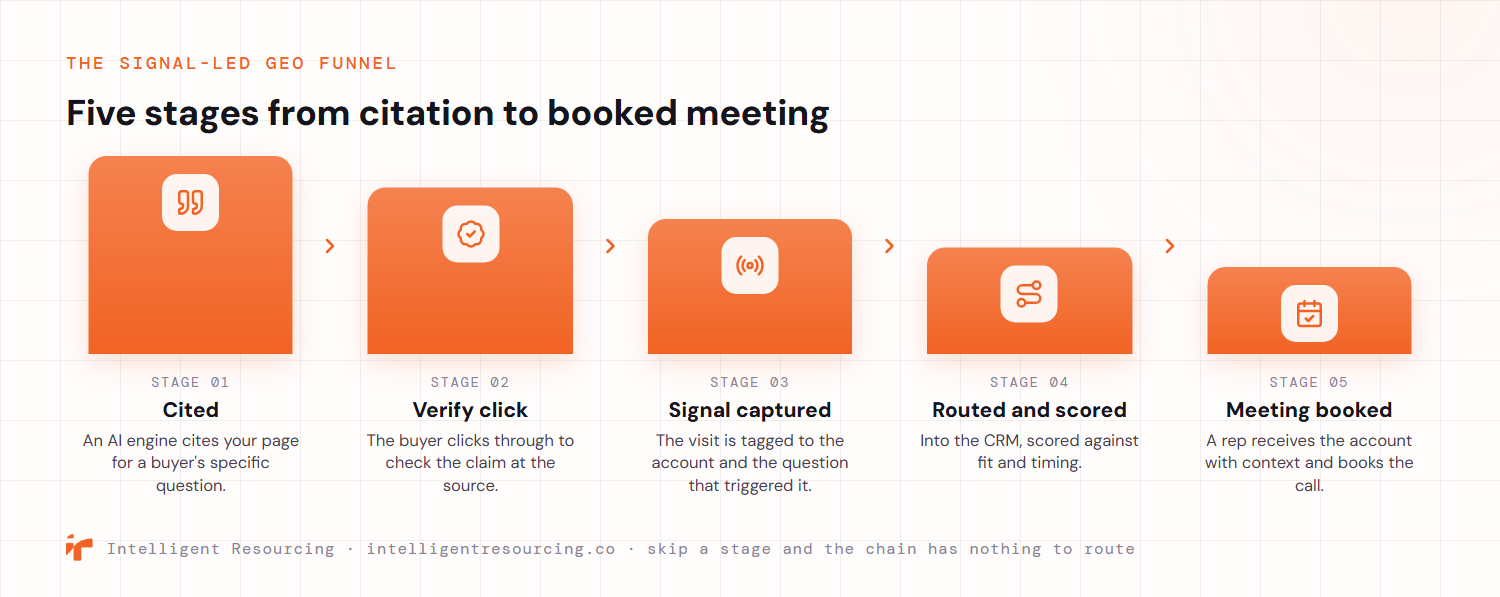
Turning a citation into a meeting takes a chain that runs from the answer engine to the sales calendar, not just to the page. A signal-led AEO funnel runs in this order:
- An AI engine cites the page for a buyer's specific question.
- The buyer clicks through to verify the claim on the source itself.
- The system captures the visit as a signal, tagged against the account and the question that triggered it.
- The signal routes into the CRM, scored against fit and timing.
- A rep receives the account with context: which question, which page, how recently.
Intelligent Resourcing's lead generation system runs on exactly this kind of infrastructure, built to turn AI citations into leads instead of just collecting them. Skip signal capture and the chain has nothing to route. Skip routing and the signal sits in a dashboard nobody checks before the window closes. The routing itself typically runs through a Clay workflow, the layer built to enrich an account the moment it shows activity and push it into the CRM with context already attached.
GTM Engineering is the methodology that connects citation-earning content to the CRM that catches what it generates. According to Demand Gen Report's 2026 database strategies survey, only half of organisations keep sales and marketing data in one connected system. The rest run exactly the disconnected setup this bridge is built to close.
Speed matters once the bridge is in place. Firms that contact a lead within an hour are nearly seven times more likely to qualify it than firms that wait an hour longer, and more than 60 times more likely than firms that wait a day, according to a 2011 audit of 2,241 US companies. One well-structured, answer-first page went from published to a booked demo in three days. That is one example, not a guarantee, but it shows how fast a signal-led system can move once the detection layer exists.
AEO Alone Rarely Turns Into Booked Meetings
Winning the citation is the easy part. Building what happens after it is hard, and most teams still measure only the easy half.
The path from AEO to booked meetings is longer than most GEO vendors want to sell. Citation rate is one number that goes up or down, easy to report monthly. The detection and routing layer requires connecting content work to CRM work, a different skill set and a different conversation than a standard content retainer covers.
Agencies typically stop at the content because that is the part they know how to price, leaving the signal layer as somebody else's problem, usually nobody's, until a client asks why citation rate keeps climbing while pipeline stays flat.
How Did the Signal-Led GEO Funnel Perform for One Client?
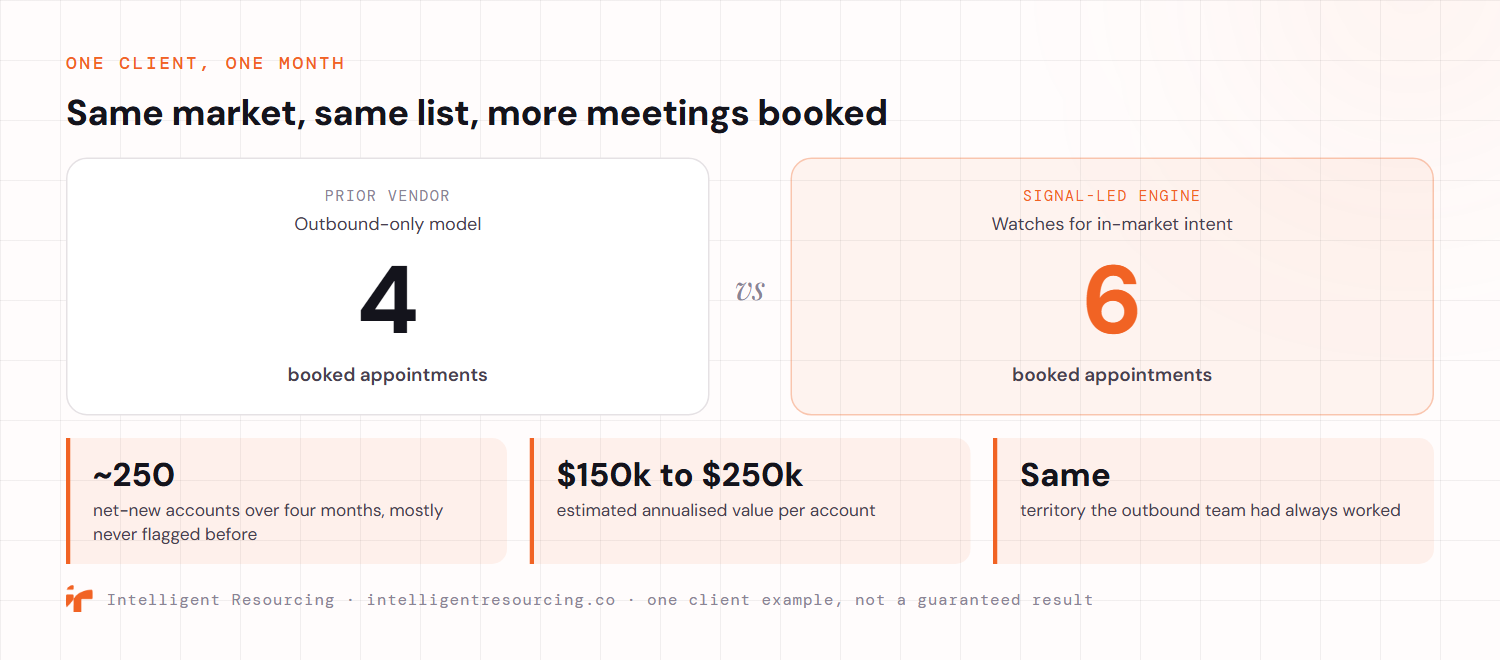
A national waste-management company replaced an outbound-only lead generation model with a signal-led system built to watch for this exact buyer behaviour. The old model treated every account the same way, whether it arrived cold from a purchased list or already showing intent through search and citation activity.
The engine delivered around 150 net-new accounts in the first phase and roughly 250 over four months, sourced largely from accounts the previous model had never even identified as in-market. Those accounts existed in the same territory the outbound team had always worked. The difference was that the old model had no way to tell which of them were actively researching a solution, so every account got the same generic sequence regardless of timing.
The comparison that mattered most was not volume. In a single month, the engine produced 6 booked appointments against the prior vendor's 4, across the same industry and target list. Each account carried an estimated $150,000 to $250,000 in annualised value, so the gap between 4 and 6 meetings was close to an extra half account's worth of pipeline, produced in the same market, in the same window.
How to Tell If the Funnel Is Converting?

Citation rate and mention share are the wrong scoreboard. Both can rise while pipeline stays flat. The number that matters is the signal-to-meeting rate: of the citation-verifying visits captured each month, how many became a routed signal, and how many of those became a booked conversation.
Few teams can answer that today, not because the number is bad but because nobody tracks it as its own metric. Closing that gap is a data architecture problem before it is a content problem. Tag the visit at the moment it happens, and carry that tag through to the rep. Once that tag exists, the signal-to-meeting rate becomes a number a team can manage week to week, instead of a blind spot that only surfaces once pipeline has already stalled.
Is the Signal-Led Funnel Right for Your Team?
Not every team needs the full funnel immediately. If deal size and follow-up capacity are not both there yet, build the content first and add detection once they are.
Best for:
- Teams whose average deal size makes a missed signal genuinely expensive.
- B2B companies already earning AI citations with no visibility into what happens after the click.
- Sales teams ready to act on a routed signal inside the same week it arrives.
Not for:
- Teams with short cycles where citation tracking alone already covers the need.
- Businesses with no follow-up motion in place yet to receive a routed signal.
- Teams still building their first GEO content, before there is citation volume worth capturing.
The trade-off: a signal layer costs more to build than a citation dashboard. It is what turns visibility into a specific number of meetings instead of an abstract mention count. If the trade-off holds for the deal sizes in play, the next step is mapping the signal layer against whatever CRM is already running, not adding another content sprint on top of citations that are already landing.
GTM Engineering
Intelligent Resourcing maps your signal layer against the CRM you already run, so citation-verifying clicks get captured, scored and routed to a rep before the buying window closes. Book a call to get your funnel reviewed.
FAQs
Does an AI citation guarantee a booked meeting?
No. A citation only puts the page in front of a buyer. Whether that turns into a meeting depends on whether the visit that follows gets captured, scored and routed to a rep.
What is a signal-led GEO funnel?
It is the chain of infrastructure that carries a citation-verifying visit from the moment an AI engine cites a page through to a booked meeting, rather than letting the visit end at an analytics dashboard.
How is this different from just tracking citations?
Citation tracking measures whether the content gets cited. A signal-led funnel measures and acts on what happens after the click, which is the part citation tracking alone never touches.
Do I need Clay or a CRM already in place to run this?
Some form of CRM is required, since the funnel routes signals into it. Clay is the layer most commonly used to enrich and route the account once a signal fires, but the concept works with any tool that can tag a visit and hand it to a rep with context.
How fast can a citation turn into a meeting?
It varies by category and buyer readiness. One well-structured, answer-first page went from published to a booked demo in three days.