

Signal-led ABM is an account-based marketing framework that uses live buying signals to decide which accounts receive attention and when. Intelligent Resourcing applies this model by combining account fit, signal strength, recency and sales routing, so teams focus effort on accounts that are both commercially relevant and actively moving towards a buying decision.
Most B2B teams still build their target-account list once a quarter, then work that same list for three months. The problem is timing: the list may contain accounts that fit the ideal customer profile but are not ready to buy, while the smaller number showing real intent receives the same treatment as everyone else.
A signal-led ABM framework fixes that by letting first-party, third-party and relationship signals determine which accounts move into active plays. The Ehrenberg-Bass Institute estimates that around 95% of B2B buyers are out of market at any given time, so the advantage comes from identifying the small share that is active now and concentrating effort there.
What is signal-led ABM?
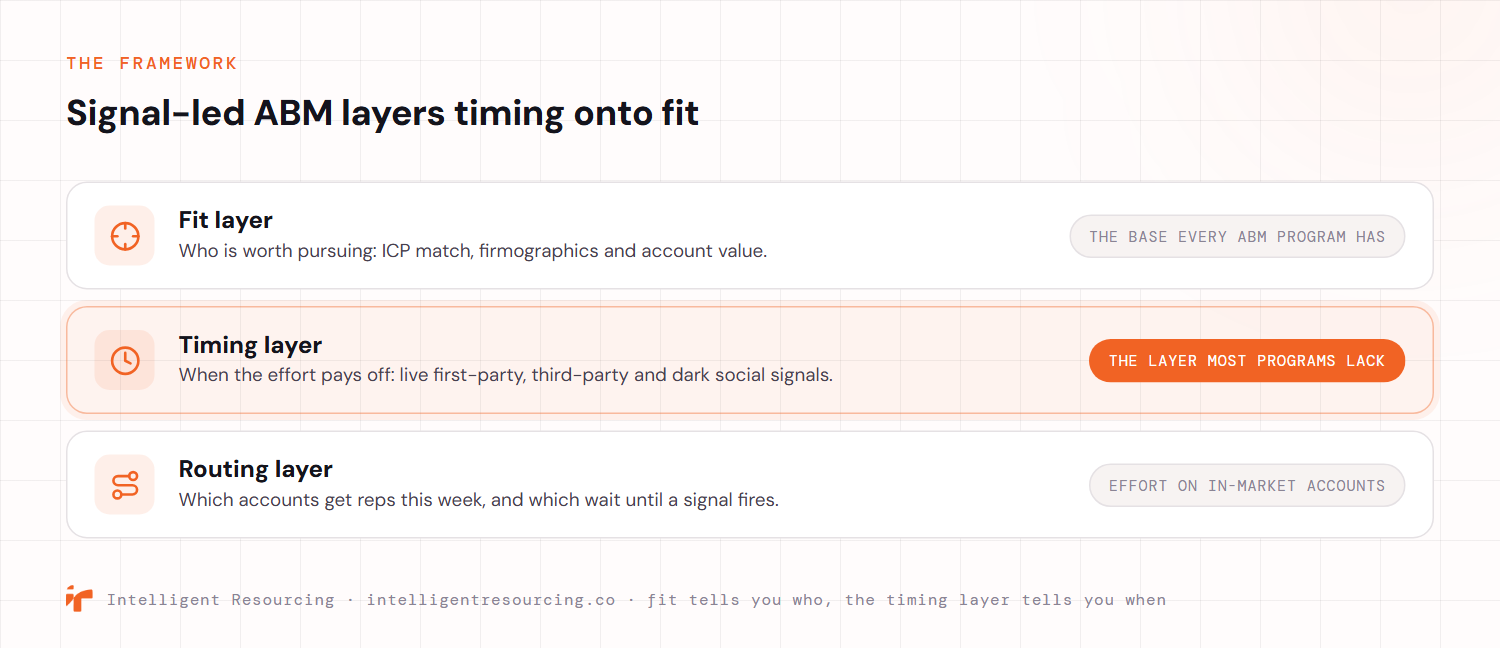
Signal-led ABM is an account-based marketing approach that prioritises and times engagement using real buying signals rather than a fixed target-account list. It is an operating discipline, not a product you buy.
Traditional programs qualify accounts on fit, meaning how closely an account matches your ideal customer profile. Signal-led ABM keeps fit but adds a second layer most programs lack: timing, meaning whether the account is showing in-market behaviour right now.
An account can be a perfect fit and completely cold. Fit tells you who is worth pursuing; signals tell you when pursuing them is worth the effort. Without the timing layer, budget flows evenly across a list where most accounts are not buying, which is the single largest source of wasted ABM spend.
The practical difference is where your reps spend Monday morning: on the next name in a list, or on the account that just triggered a signal.
How ABM signals evolved: first-party, third-party and dark social
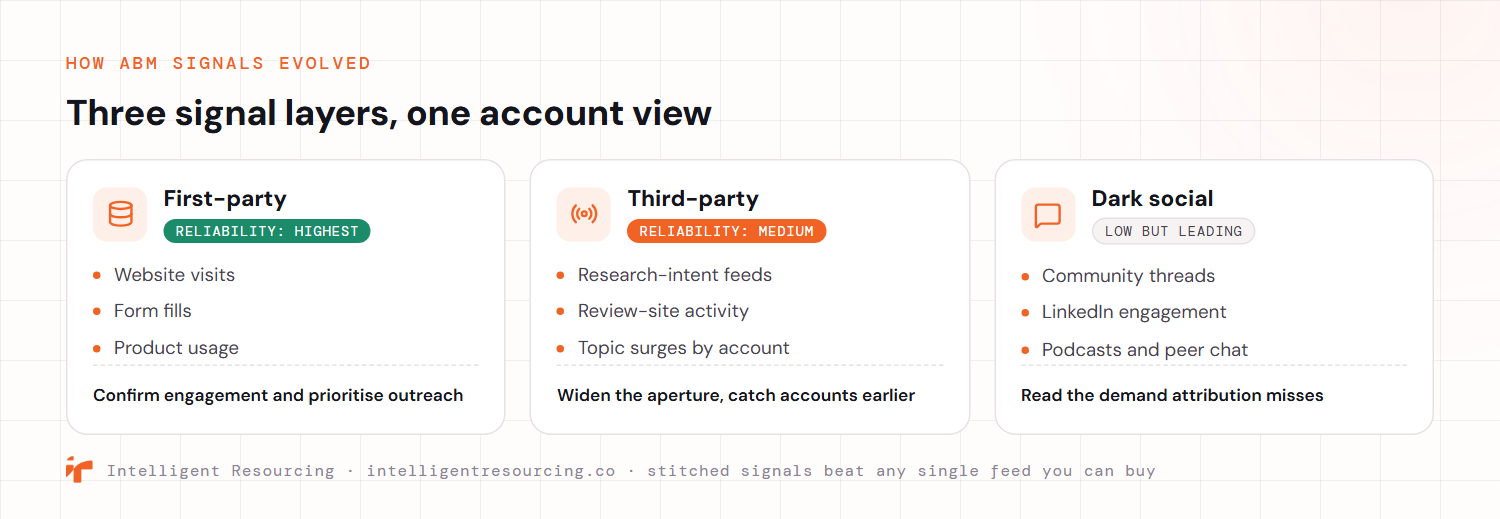
ABM signals now come from three layers, and no single layer tells the whole story. First-party signals are the interactions you own: website visits, form fills and product usage. Third-party signals sit outside your properties, where research-intent providers such as Bombora, G2 and TechTarget report on the topics an account is researching. The third layer is dark social, the dark funnel of peer conversations, community threads, podcasts and LinkedIn engagement that attribution never captures. Early ABM programs bought one intent feed and called it a strategy.
The shift now is toward stitching first-party and third-party intent data together with dark social into a single account-level view. DevCommX puts it plainly: first-party intent confirms documented interest while third-party intent widens the aperture to catch prospects earlier. Stitched signals beat any single feed because one source confirms what another only suggests.
| Signal layer | Example sources | Reliability | Best use |
|---|---|---|---|
| First-party | Website visits, form fills, product usage | Highest | Confirm engagement, prioritise outreach |
| Third-party | Bombora, G2, TechTarget | Medium | Widen aperture, catch accounts earlier |
| Dark social / dark funnel | Communities, LinkedIn, podcasts, peer chat | Low but leading | Read demand that attribution misses |
Which means the goal is not to pick the most reliable layer but to combine them, using low-reliability leading signals to look early and high-reliability first-party signals to confirm before you commit reps.
The six-stage signal-led ABM framework
The signal-led ABM framework runs as a repeatable loop, not a linear funnel. Six stages carry you from raw signals to revenue and back, and the framework is deliberately tool-agnostic: platforms plug into the stages, they do not replace the strategy. The loop compounds, because the final stage feeds outcomes back into scoring so the system sharpens with every cycle. The signal-led ABM playbook walks through each stage with the plays attached.
Detect: stitch signals across sources
Detection means capturing first, third and dark social signals into one place, mapped against a single account. A lone signal is noise; clustered signals are conviction, because several independent sources pointing at the same account rarely coincide by accident.
Score: weight signals by strength and recency
Scoring combines signal strength with ICP fit, so the queue reflects both who the account is and what it is doing. Build in signal decay so stale triggers lose weight, because a research spike from ninety days ago is not the same buying intent as one from yesterday.
Target: tier accounts and refresh dynamically
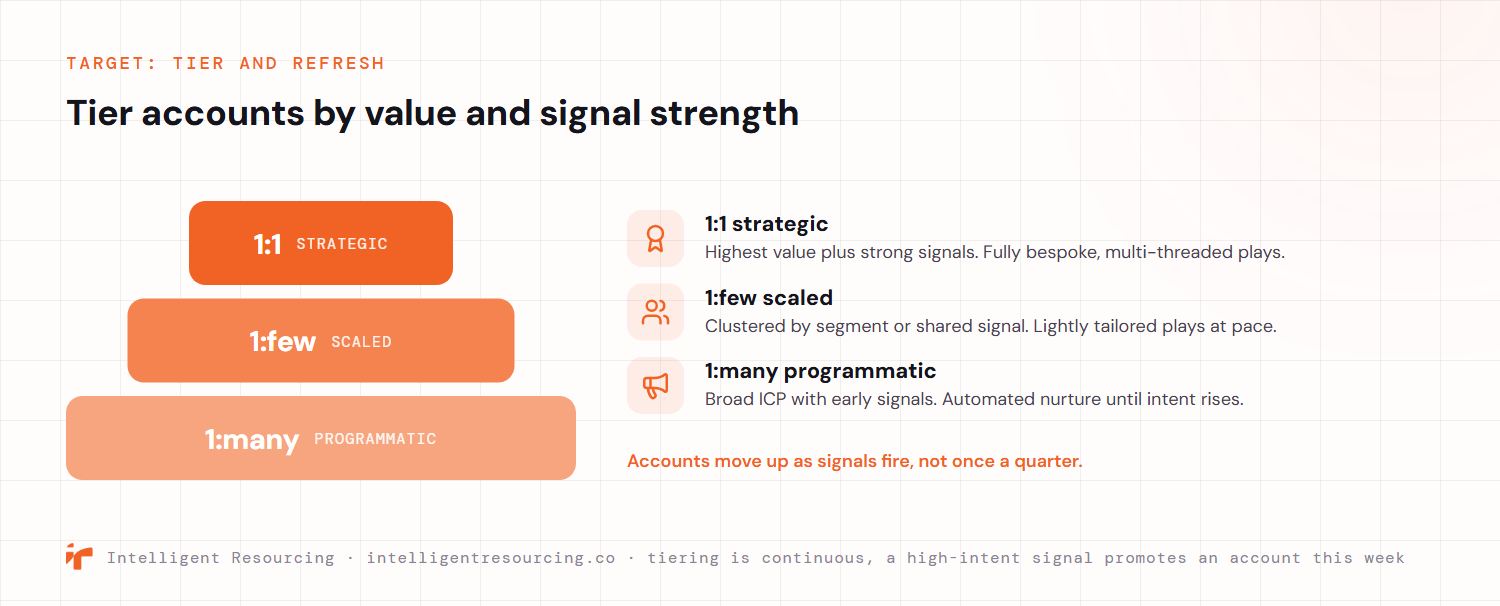
Tier accounts into 1:1, 1:few and 1:many by value and signal strength, then move them between tiers as signals fire. Tiering is continuous, not a quarterly exercise: an account that triggers a high-intent signal should be promoted this week, not at the next planning cycle.
Engage: coordinate the buying committee across channels
Engagement is multi-threaded and multi-channel, a discipline closer to signal-led sales than campaign blasting, and every touch references the specific signal that prompted it. Map messages to buying committee roles rather than a single contact, because enterprise buying decisions routinely involve a whole committee, which makes single-threaded outreach too narrow to move a deal.
Measure: track account progression, not lead volume
Measurement tracks account-level progression rather than raw lead volume, because a rising lead count can hide the fact that no target accounts are moving. Watch pipeline created and stage velocity per account. The measurement section below covers the metrics that matter.
Learn: feed outcomes back into scoring
Feed closed-won and closed-lost patterns back into your scoring model so the signals that preceded revenue gain weight and the ones that lead nowhere lose it. This is what makes the framework compound: each cycle re-weights which signals matter for your market. Owning that loop is GTM engineering work, not campaign management.
Which buying signals actually matter (and how to weight them)
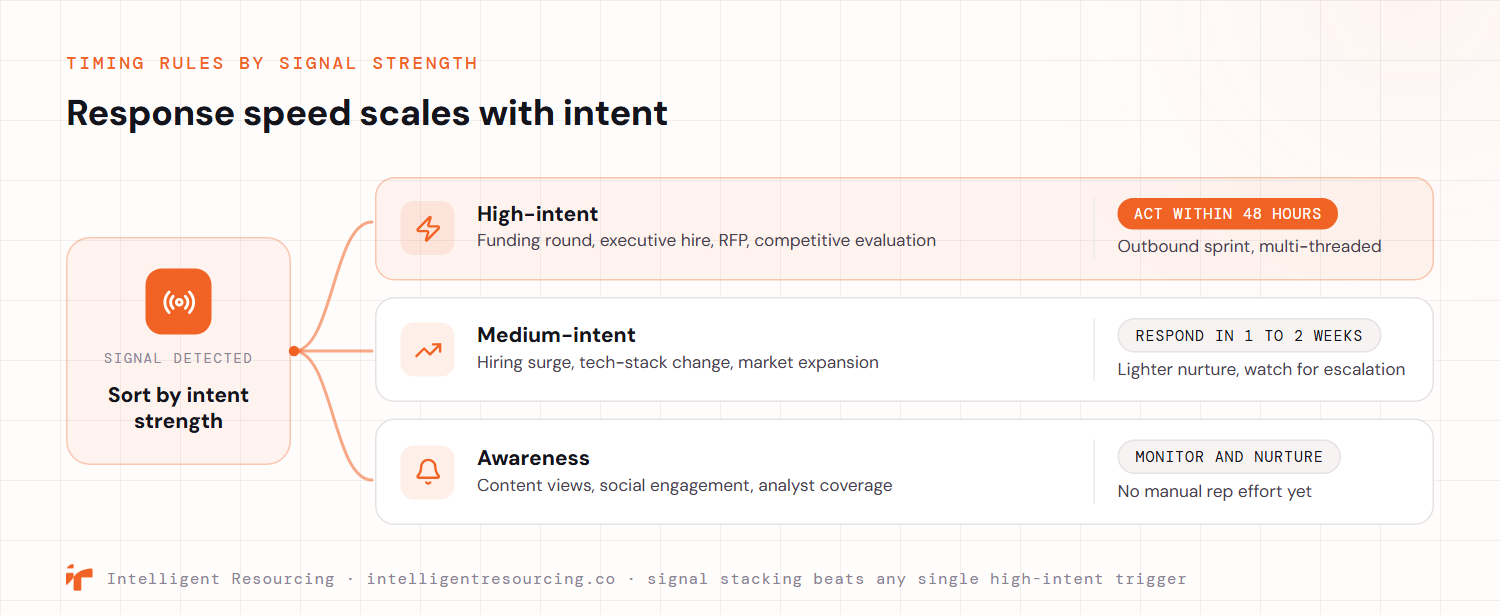
Not all buying signals carry equal weight, so prioritise by intent strength and respond fastest to the strongest. A funding round or a public RFP is a different order of intent from a single blog visit, and treating them the same wastes the scarcest resource you have, which is rep time.
Signal stacking beats any single trigger: three medium signals clustered on one account often outrank one isolated high-intent event. Speed should scale with strength, because the value of a high-intent signal decays in days. This matters more when you remember the committee behind the signal. A typical B2B buying group involves six to ten decision makers, so the account that looks ready is rarely one person.
| Signal tier | Examples | Response window |
|---|---|---|
| High-intent | Funding event, executive hire, RFP, competitive evaluation | Within 48 hours |
| Medium-intent | Hiring surge, tech-stack change, market expansion | 1-2 weeks |
| Awareness | Content consumption, social engagement, analyst coverage | Monitor and nurture |
Which means your response playbook should be tiered too: a 48-hour outbound sprint for high-intent triggers, a lighter nurture for awareness signals, and no manual effort at all on accounts showing nothing.
Building your signal layer and stack
A signal-led ABM stack has four layers, and you should buy for the layer you are weakest in, not for the logo on the box. The data and identity layer, built from enrichment and visitor-identification tools, tells you who the account and its contacts are. Some teams close the weakest layer with people rather than software. The comparison between an account-based marketing agency and a signal-led build sets out both routes.
Outcomes Rocket's 2025 State of ABM Report, a survey of 771 marketers, found that 78.7% of companies now use AI in their ABM programs, so the real differentiator is data quality, not tool count; poor data breaks every layer above it. The right tools are the ones that fill your specific gap, which is easier to see once you compare signal-based marketing tools against your own account-based GTM plan.
| Stack layer | Job to be done | Example categories |
|---|---|---|
| Data / identity | Know who the account and contacts are | Enrichment, visitor identification |
| Intent | Detect first and third-party research intent | 6sense, Demandbase, Bombora, G2 |
| Orchestration | Trigger and coordinate plays on signals | Workflow and orchestration tools |
| System of record | Hold account, pipeline and activity data | CRM (HubSpot, Salesforce) |
Which means the smart first move is not a platform purchase but picking two or three signals you can act on today, proving they produce pipeline, then scaling the stack around what works. A leaner version of the same motion runs without a platform at all. The account-based GTM approach covers what to keep and what to drop.
Signal-led ABM vs traditional ABM and demand gen
Signal-led ABM is not a replacement for traditional ABM or demand generation; it is the timing layer that makes both work harder. Traditional ABM targets a static named list. Demand generation chases volume across a broad audience. Signal-led ABM sits between them, running a focused, signal-driven motion alongside an always-on awareness program aimed at your total addressable market.
| Dimension | Traditional ABM | Demand gen | Signal-led ABM |
|---|---|---|---|
| Targeting | Static named list | Broad ICP audience | Signal-qualified accounts |
| List cadence | Quarterly | Always-on | Continuous, signal-driven |
| Primary metric | Account engagement | MQL volume | Pipeline from in-market accounts |
| Timing trigger | Planning cycle | Campaign calendar | Live buying signals |
Which means you do not choose between the three: you run demand gen to create awareness, then let signals route the highest-intent accounts into a focused ABM motion.
Measuring signal-led ABM: pipeline over MQLs
Measure signal-led ABM at the account level, because MQL reporting hides whether the accounts you actually want are progressing. A healthy program tracks engagement score across channels, stakeholder coverage within the committee, signal-to-meeting conversion, pipeline created per target account, and the win-rate gap between signalled and non-signalled accounts.
That last metric is the one that proves timing adds lift. Account-level measurement also protects your budget, because few marketing leaders are highly confident attributing revenue to intent signals in the first place. Keeping a full activity ledger, with every signal, touch and stage change logged against the account, is what lets you show finance the line from signal to revenue when the next budget review lands.
| Metric | What it measures | Why it beats an MQL |
|---|---|---|
| Engagement score | Account activity across channels | Reflects account, not a single lead |
| Signal-to-meeting rate | Signals that convert to meetings | Tests signal quality, not volume |
| Pipeline per account | Value created per target account | Ties effort to revenue |
| Win rate (signalled vs not) | Close rate difference | Proves timing adds lift |
Which means when marketing is asked what ABM returned, the answer is a pipeline figure tied to named accounts, not a lead count no one downstream trusts.
Build your signal-led ABM engine with Intelligent Resourcing
The core principle is simple: fit tells you which accounts are worth pursuing, but signals tell you when the effort will pay off, and a signal-led framework builds the entire motion around that timing. If your ABM list is built once a quarter and your reps are working accounts that are not in-market, a signal-led framework fixes the timing problem first.
Book a call with Intelligent Resourcing to map your signal layer and account tiers. The cost of waiting is real: every quarter you run a static list, competitors acting on live signals reach the same in-market accounts first, and you are left chasing the deals they passed on.
GTM Engineering
Intelligent Resourcing builds and runs a signal-led ABM motion on your own stack, mapping your signal layer, scoring model and account tiers. Book a call to find the in-market accounts you are missing.
FAQs
What is signal-led ABM in simple terms?
Signal-led ABM is account-based marketing that uses real buying signals to decide which accounts to engage and when, instead of working a target list built once a quarter. It keeps the fit criteria of traditional ABM but adds a timing layer, so effort concentrates on accounts showing live in-market behaviour rather than spreading evenly across names that may not be buying for months.
How is signal-led ABM different from intent-based marketing?
Intent data is one input; signal-led ABM is the wider discipline. Intent-based marketing usually means acting on third-party research intent alone. Signal-led ABM stitches that third-party intent together with first-party signals you own and dark social signals from communities and social platforms, then reads them across the whole buying committee rather than a single contact. Intent tells you a topic is hot; the full signal picture tells you which account and who.
What tools do you need to start with signal-led ABM?
You can start without an enterprise platform. A minimum viable stack is one first-party capture method or visitor-identification tool, one third-party intent source, a CRM as your system of record, and a simple orchestration path to trigger outreach when a signal fires. Add deeper intent platforms once your first signals are producing pipeline, not before. Buy for the gap you have, not the logo.
Which buying signals should you track first?
Start with the two or three signals most correlated with your won deals. For many teams that means a funding event, an executive hire in a relevant function, or a competitive evaluation, but check your own closed-won history rather than copying a generic list. Prove those signals produce pipeline, then expand. Tracking every possible signal from day one creates noise you do not have the rep time to action.
How long before signal-led ABM shows pipeline?
Engagement signals appear within weeks, because you are acting on accounts that are already active. Pipeline typically shows in 60 to 90 days as those engaged accounts book meetings and enter opportunities. Full attribution takes longer, usually one complete sales cycle, before you can compare win rates on signalled versus non-signalled accounts with confidence. Expect leading indicators fast and revenue proof after a quarter.