


Microsoft Copilot Decides Citations Through Retrieval, Not Ranking

This is about getting your own content cited as a source inside Copilot's answers, not about how to reference Copilot in APA or MLA. The distinction matters more since Microsoft's November 2025 AI Search shipped visible citations: Copilot now curates an answer and lists the web sources behind it, and your job is to be one of those sources. This is the same discipline behind our generative engine optimisation work, applied specifically to Bing's retrieval chain.
Microsoft Copilot decides through retrieval, not ranking. Consumer and web Copilot ground answers using Grounding with Bing Search, so Bing's index is the citation surface. Microsoft 365 Copilot grounds work answers on the Microsoft Graph. Copilot Studio agents ground on the knowledge sources a builder connects. Match your strategy to the surface your buyer uses.
Three Copilot surfaces draw on three different sources. Copilot's web grounding returns information from public sites that Bing has indexed. That makes Bing, not Google, your entry point for public-web citation.
Work answers behave differently. Microsoft 365 Copilot reads the Microsoft Graph, including emails, SharePoint files, and Teams messages. You cannot earn those citations from outside the tenant. Copilot Studio agents are narrower again. They ground on configured knowledge, such as a website, a SharePoint library, or an Azure AI Search index.
Citations are now visible to the user. Microsoft's November 2025 AI Search curates a response and lists its web sources in a references pane, expandable with "Show all". That pane is where your link appears or does not. The flow is retrieval then extraction. Bing retrieves candidate pages, then Copilot lifts the passage that answers the prompt. Ranking alone does not guarantee a quote. The page must also be structured so a clean passage can be pulled. Build for that, and you build for AI search visibility across engines.
What Are Microsoft Copilot's Source Citation Criteria?

Microsoft Copilot's citation criteria form a chain, not a wish-list. Bing indexability gates everything. After that, organic authority and position, query-to-heading relevance, freshness, passage-level extractability, and entity verification each raise or lower your odds. Break the first link and the rest cannot fire. Work the chain in order.
- Bing indexability comes first. Web citations are drawn through Grounding with Bing Search. If Bing cannot crawl the page, Copilot cannot cite it.
- Organic authority and position decide retrieval. Organic position one carries a 58% citation rate, falling to about 14% at position ten, a roughly fourfold gap that puts the top of page one ahead of the rest.
- Query-to-heading relevance lifts selection. Headings that match the prompt's meaning are retrieved more often than generic ones.
- Freshness matters for time-sensitive queries. Add an explicit "as of" date, such as "as of June 2026", on volatile claims.
- Extractability decides the quote. Copilot pulls passage-level chunks, so a self-contained answer beats a long preamble.
- Entity verification closes the chain. Use consistent Organization data and sameAs references to LinkedIn, Crunchbase, and Wikipedia.
The pattern holds across engines. Originality.AI found 52% of Google AI Overview citations come from top-ten organic results, which confirms organic authority remains a strong AI-citation signal. Copilot is no exception. Earn the ranking first, then make the ranked page extractable.
Structure Content Answer-First to Get Cited in Copilot
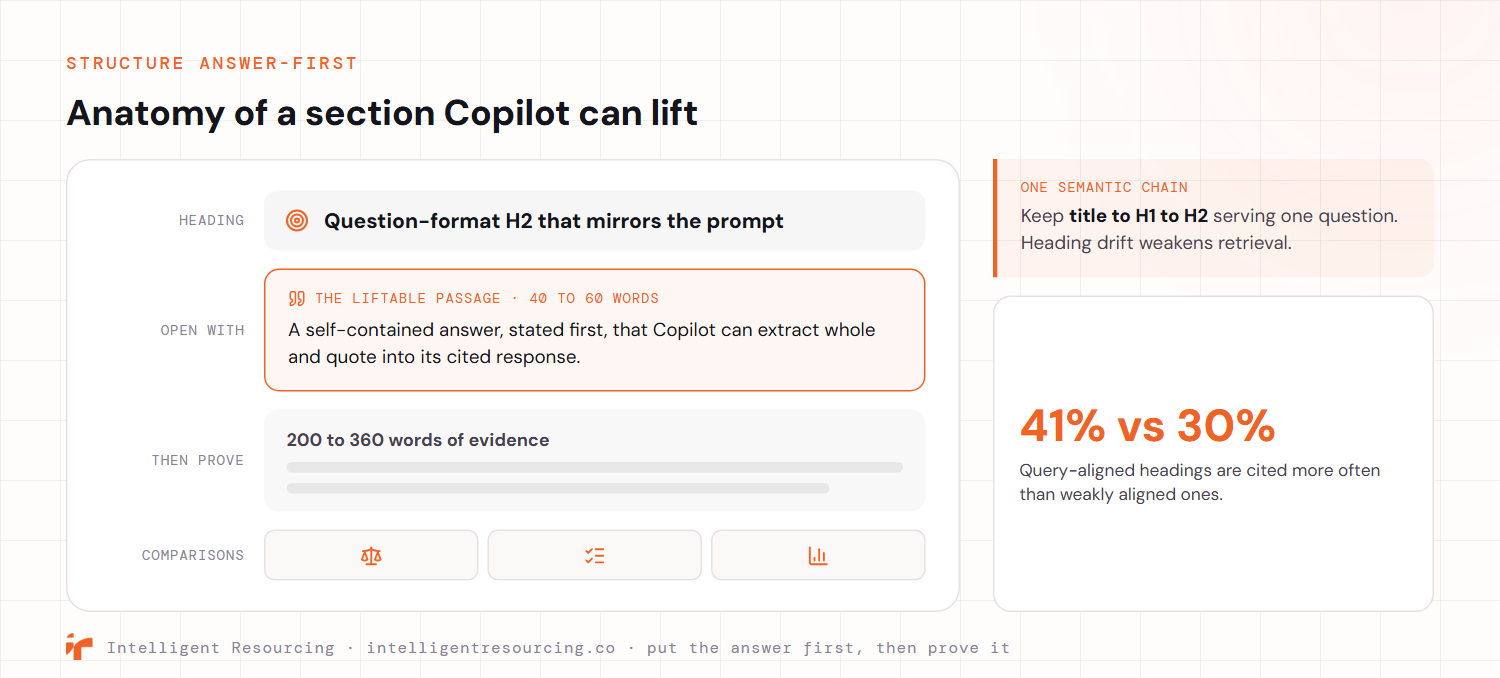
Structure content answer-first. Open each section with a question-format H2, then a 40 to 60 word standalone answer Copilot can lift. Follow with 200 to 360 words of evidence. Keep one semantic chain from title to H1 to H2s. Render comparisons as tables, because tables extract more cleanly than prose.
Semantic chain integrity is the foundation. Your title, H1, and every H2 should serve one question. A heading that belongs to a different article is topic drift, and drift weakens retrieval.
Heading alignment is measurable. Headings closely aligned to the query are cited 41% of the time, versus roughly 30% for weak alignment. Question-format H2s are the most reliable way to hit that alignment. This is a subset of the wider discipline covered in our guide on how to get cited by AI search engines, and the same pattern applies to how to structure content for AI citation.
Front-loading matters too. Grounding-snippet selection favours self-contained content placed early, so put the answer first, then prove it. Lists and tables beat prose for extraction. A comparison table gives Copilot a clean, liftable unit; three paragraphs of prose do not.
When we rebuilt a B2B SaaS client's integration guide around answer-first blocks, their share of target Copilot prompts moved from zero citations to four of twelve within 60 days. The only change was structure: question H2s, 50-word openers, and a comparison table replacing three paragraphs.
Use this checklist:
- Write question-format H2s that mirror the prompt's meaning.
- Open every section with a 40 to 60 word answer.
- Name one entity per paragraph.
- Render comparisons as tables, not prose.
- Use the primary keyword naturally; never stuff it.
Three Technical and Schema Signals Make Your Content Citable
Three technical signals make content citable. FAQPage and Article schema should mirror your on-page answer text exactly, the parity rule. The grounding chunk should be server-side rendered, with lazy-loading disabled for AI and Bing crawlers. Organization schema with sameAs links verifies your entity. These are engineering tasks, distinct from the writing.
| Signal | What to implement | Why it matters for Copilot |
|---|---|---|
| FAQPage / Article schema | Mirror the direct answer text verbatim | Documented citation amplifier; feeds extractable Q&A |
| SSR grounding chunk | No JS toggles or lazy-load in the top 500 words | Bing and AI crawlers often skip JavaScript-rendered content |
| sameAs entity links | LinkedIn, Crunchbase, Wikipedia | Reinforces entity verification for retrieval |
These signals sit with your technical team, not your writers. Flag them in the brief so they ship alongside the content.
Schema earns its place through evidence. Adding external source citations ranks among the highest-impact optimisation methods, with lower-ranked top-five pages gaining the most visibility. Structured markup and cited claims work together: schema exposes the answer, citations make it trustworthy.
Two practical reads for the build: our guide to schema markup for AI, and how to get AI to crawl your content. Server-side rendering is the common thread. If Bing's crawler has to execute JavaScript to see your answer, it often will not.
Where Do Most Teams Fail to Get Cited in Copilot?

Most teams fail at the index gate. Content blocked from Bing cannot be retrieved, so Copilot never sees it. Others hide the grounding chunk behind JavaScript, optimise for the wrong meaning of "cite", or chase citation on a zero-authority domain. Each failure breaks the retrieval chain at a different point. Intelligent Resourcing sees the index gate fail most often on client sites that migrated platforms without checking Bing's crawl status.
- Deindexed or Bing-blocked pages are the most common failure. Because Grounding with Bing Search is the source, a blocked page leads to zero retrieval and zero citation.
- A JavaScript-only grounding chunk fails next. AI and Bing crawlers often skip client-side JavaScript, so the answer renders for humans but not for the crawler.
- Thin or hedged answers cannot be lifted. Vague openers give Copilot nothing to quote, so it moves to a competitor's page.
- Missing author and entity signals weaken trust. Without a named author or consistent Organization data, entity verification stays incomplete.
- Treating Copilot Studio configuration as a substitute is a strategic error. Configuring an internal agent does not earn public-web citations, because the two ground on different sources.
Fix the index gate first. Everything downstream depends on it.
Track and Improve Your Copilot Citation Share With Share of Model
Track citation share with Share of Model. Pick 20 to 50 high-intent prompts. Run them across Copilot, and add Perplexity and ChatGPT for context. Record each result as cited, recommended, or absent. Divide citations by total prompts for your baseline. Re-test the same set every 30 to 90 days. This is the same measurement gap covered in our guide on AI visibility versus rankings.
Improvement comes from substantive refreshes, not timestamps. Update the evidence, statistics, or examples every 60 to 90 days; a date change alone does nothing. AirOps found that pages published 30 to 89 days before a query earned the highest citation rates, so cadence is a real lever.
Set realistic windows. Tactical fixes, such as schema and stronger direct answers, typically move within one to three months. Structural work, such as topical clusters and entity building, takes three to six months.
Separate timeless principles from time-sensitive data. Keep your evergreen analysis in one place and your dated statistics in another, so a price change updates one section, not the whole page. Attribute Share of Model movements to specific actions where you can, so you learn which change earned the citation.
Make Your Content Citable in Microsoft Copilot
Copilot citation is earned at the implementation layer, not bought. The work is concrete: get indexed in Bing, restructure into answer-first chunks, mirror your schema, and verify your entity. Most teams already rank somewhere; they just are not built to be extracted.
That gap is what our answer engine optimisation work closes. We audit your Copilot citation readiness against the criteria above, then prioritise the fixes that move your Share of Model first.
If you want a read on where your content stands, book a call. We will run a GEO and AEO audit of your top prompts and show you which pages Copilot can already cite, and which need structural work.
Content Creation
Intelligent Resourcing's Content Strategy team audits your Copilot citation readiness against these criteria, then prioritises the fixes that move your Share of Model first. Book a call for a GEO and AEO audit of your top prompts.
FAQs
Does Microsoft Copilot cite sources?
Yes. Copilot's web answers show numbered references you expand with "Show all", grounded through Bing. Microsoft's November 2025 AI Search made this references pane standard. Microsoft 365 Copilot cites work documents the user can already access, drawn from the Microsoft Graph rather than the public web.
Is getting cited in Copilot the same as ranking in Bing?
No. Strong Bing indexation and ranking are necessary but not sufficient. A page can rank well and still go unquoted. Extractable structure, FAQPage schema, and entity signals decide whether Copilot actually lifts a passage from your ranked page into its answer.
How is Copilot citation different from ChatGPT or Perplexity?
Copilot leans on Bing grounding and brand-owned structured content. Perplexity weights freshness and earned media, with an aggressive 30-day recency bias. ChatGPT weights organic position and web consensus. Optimise the same answer-first foundation, then adjust freshness and authority signals for each engine.
Does schema markup help you get cited in Microsoft Copilot?
Yes. FAQPage and Article schema are documented citation amplifiers when they mirror your on-page text exactly, following the parity rule. They pair best with server-side rendering, so Bing's crawler reads the markup without executing JavaScript. Schema alone will not rescue a thin answer.
How long does it take to get cited in Microsoft Copilot?
It depends on existing Bing visibility. Tactical fixes, such as schema and stronger direct answers, typically show in one to three months. Structural authority and content-cluster work take three to six months. A deindexed or zero-authority domain may see no movement until that foundation is fixed.