


What Is Answer Engine Optimisation (AEO) in B2B?

Answer Engine Optimisation (AEO) is the practice of structuring content so answer engines extract and surface a direct answer, often without a click. It is the oldest of the three disciplines, born in the featured-snippet and voice-assistant era before AI chat existed. In B2B, it earns visibility on the questions buyers ask while researching a category.
AEO targets concrete surfaces: Google featured snippets, People Also Ask boxes, AI Overviews and voice assistants. These are the places a buyer gets an answer without visiting a page, so it matters most higher up the funnel, where buyers are still defining a category rather than comparing vendors. Google now advises owners to optimise for AI-powered search experiences rather than only classic blue links. Getting answer engine optimisation right means writing crisp, self-contained answers a machine can lift cleanly: Q&A formatting, concise definitions and schema that labels the answer.
What Is Generative Engine Optimisation (GEO) in B2B?
Generative Engine Optimisation (GEO) is the practice of optimising content so it is referenced and cited inside AI-generated answers from tools like ChatGPT, Perplexity, Gemini and Claude. Rather than winning a single ranking, GEO aims to make your content a credible source the model quotes when it composes a response.
The term comes from a 2023 Princeton and Georgia Tech paper that coined GEO and tested nine content optimisation methods. The B2B stake is different from classic SEO. Citation is not winner-take-all; an AI answer typically pulls from several sources at once. So the goal is not the single top rank; it is to be one of the credible corroborating sources across many related queries. That is why LLM SEO leans on quotable statistics, clear structure and sources the model can verify.
What Is Large Language Model Optimisation (LLMO) in B2B?
Large Language Model Optimisation (LLMO) is the broadest of the three: optimising brand, content and entity signals so large language models surface, recommend and cite you. It works both in live AI search and from the model's own trained knowledge, which means it reaches beyond any single answer surface.
LLMO adds an off-site load traditional SEO never fully prioritised: consistent brand mentions, a Wikipedia and Wikidata presence, Crunchbase and G2 coverage, and a coherent knowledge-graph footprint. In practice, many practitioners use LLMO and GEO interchangeably. The useful distinction is scope: practitioners map these acronyms as a hierarchy, with LLMO the broadest umbrella and AEO the narrowest, surface-specific practice. For B2B, this is the AI visibility layer that governs how a model represents your brand when no live search is running.
AEO vs GEO vs LLMO: What Are the Key Differences?
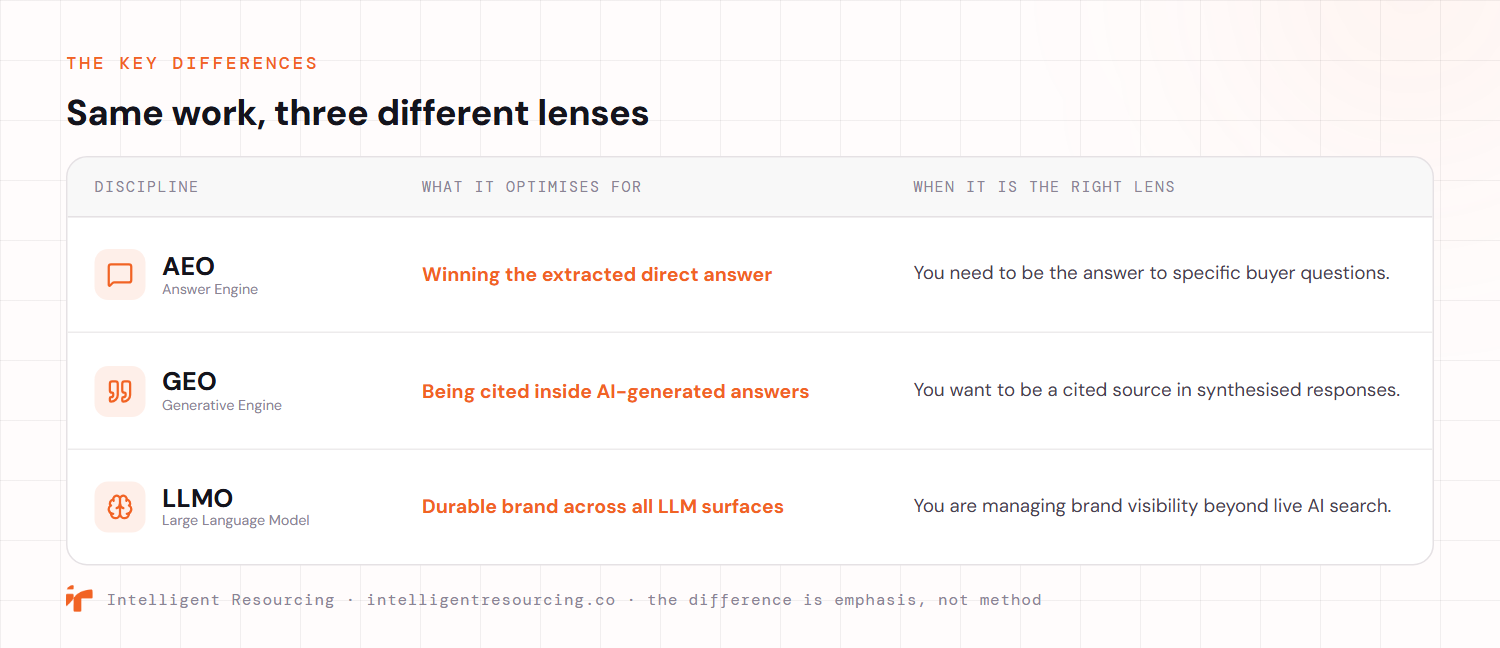
The short version: AEO wins the extracted answer, GEO wins the citation inside a generated response, and LLMO wins durable representation across every model surface. The differences are mostly emphasis, not method. The same clean structure, quotable claims and entity signals feed all three at once.
In practice the toolkits are close. DevCommX reports that the AEO, GEO and LLMO toolkits overlap by roughly 80 percent, and that AI answers usually cite three to five sources rather than crowning a single winner. That overlap is why a single well-built asset can serve all three at once.
| Dimension | AEO | GEO | LLMO |
|---|---|---|---|
| Definition | Winning the extracted direct answer | Getting cited inside generative AI answers | Being surfaced and recommended across all LLM surfaces |
| Primary surface | Featured snippets, PAA, voice, AI Overviews | ChatGPT, Perplexity, Gemini, Claude | All AI assistants plus the underlying model |
| Signature tactic | Q&A formatting, concise answers, schema | Quotable stats, cited sources, clear structure | Entity signals, schema, authority across the web |
| Success metric | Answer-box win rate | Citation share in AI answers | AI mention and recommendation frequency |
Where AEO, GEO and LLMO Overlap
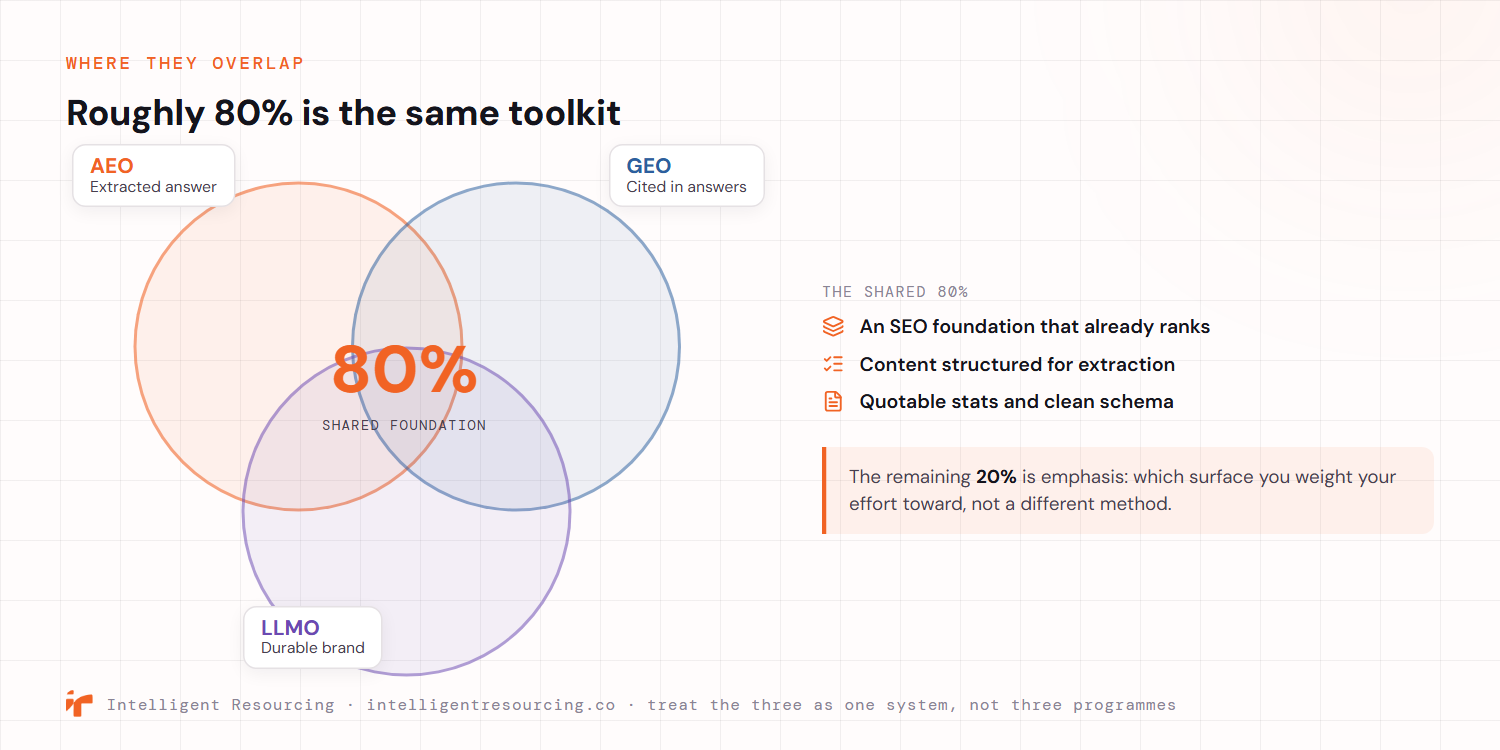
Roughly 80 percent of the checklist is shared: clean structure, quotable claims, schema and strong entity signals. That is why one well-built asset can win a snippet, appear in an AI Overview and get cited by Perplexity at the same time.
Where They Genuinely Diverge
AEO emphasises the answer format, GEO emphasises the live generative surface, and LLMO emphasises the model's durable representation of your brand plus off-site entity corroboration. Same direction of travel; different point of focus.
Why Do B2B Buyers Keep Mixing Up AEO, GEO and LLMO?
Buyers mix them up because the underlying work overlaps heavily, the vocabulary is unsettled with no industry consensus, and vendors coin fresh terms to differentiate their offer. When three acronyms describe nearly the same practice, they blur together in everyday conversation. The cost is measurement; if you cannot name the surface you optimise for, you cannot track success on it.
That naming problem is the practical trap. The buying context makes it worse: much B2B research now happens in a dark funnel, inside AI chats and vendor shortlists you never see in analytics. The Starr Conspiracy has compiled 18 sourced B2B benchmarks tracking AI Overview click-through and answer-engine citation rates, which shows how fast the measurement surface is shifting under teams that still count blue-link clicks.
The Work Overlaps More Than the Words Suggest
The three terms describe the same direction of travel: machine-extractable, citation-ready content. That shared goal is why they feel interchangeable in day-to-day practice.
Vendors Have an Incentive to Coin New Terms
Each new acronym lets a vendor claim a new discipline to sell against. The failure mode is predictable: teams run three separate programmes, or buy the wrong scope, when one integrated initiative would do the job.
Which Should Your B2B Team Focus On First?

Build the SEO foundation first, then treat AEO, GEO and LLMO as one initiative weighted by where your buyers actually search. There is no need to run three programmes. A single, well-structured, well-sourced asset can compete on every surface once your domain has baseline authority.
Match the emphasis to your situation. Starting from zero: do the SEO work first, because AI engines disproportionately cite pages that already rank. Already ranking but losing clicks: restructure your top pages for extractability so the answer engines quote you instead of replacing you. Selling to a research-heavy buyer: lean into GEO and LLMO, because those buyers build a shortlist inside AI tools before they reach your site. GrowthSpree estimates that roughly 32 percent of B2B vendor discovery now runs through AI-search citations in 2026; treat that as a vendor estimate rather than an independent figure, but the direction is clear. Either way, disciplined AI search optimisation is the foundation the other two build on.
Getting AEO, GEO and LLMO Right for Your B2B Content
The teams that win at AI search are the ones with vocabulary precise enough to build a system, not chase acronyms. AEO, GEO and LLMO are three lenses on one job: making your content the source a machine trusts and quotes. Intelligent Resourcing is an Australian B2B content agency that builds answer-first, citation-ready content designed to be extracted, cited and recommended across AI search. If you want one system rather than three disconnected programmes, get in touch to see how disciplined answer engine optimisation fits your pipeline.
Content Creation
Intelligent Resourcing builds answer-first, citation-ready content on your own stack, designed to be extracted, cited and recommended across AEO, GEO and LLMO surfaces. Book a call to map the surfaces your buyers use and the content that earns the cite.
FAQs
Is LLMO the same as GEO?
Effectively yes in practice. Both describe getting cited and recommended by AI systems; LLMO is the broader umbrella, and GEO is the live generative-search emphasis.
What is the difference between AEO and GEO?
AEO optimises for the extracted direct answer on answer surfaces like snippets and AI Overviews. GEO optimises for citation inside AI-generated responses on chat platforms such as ChatGPT and Perplexity.
Do AEO, GEO and LLMO replace SEO?
No. SEO remains the technical and authority foundation, and AI engines disproportionately cite pages that already rank well.
Which matters most for B2B in 2026?
A blend weighted toward AI visibility. Buyers increasingly research vendors in ChatGPT, Perplexity and Gemini before they visit a website.
Can one page be optimised for AEO, GEO and LLMO at once?
Yes. A single asset with a crisp definition, clear headings, a comparison table, quotable data and clean schema can serve all three at the same time.