
What Is Content Distribution Automation?
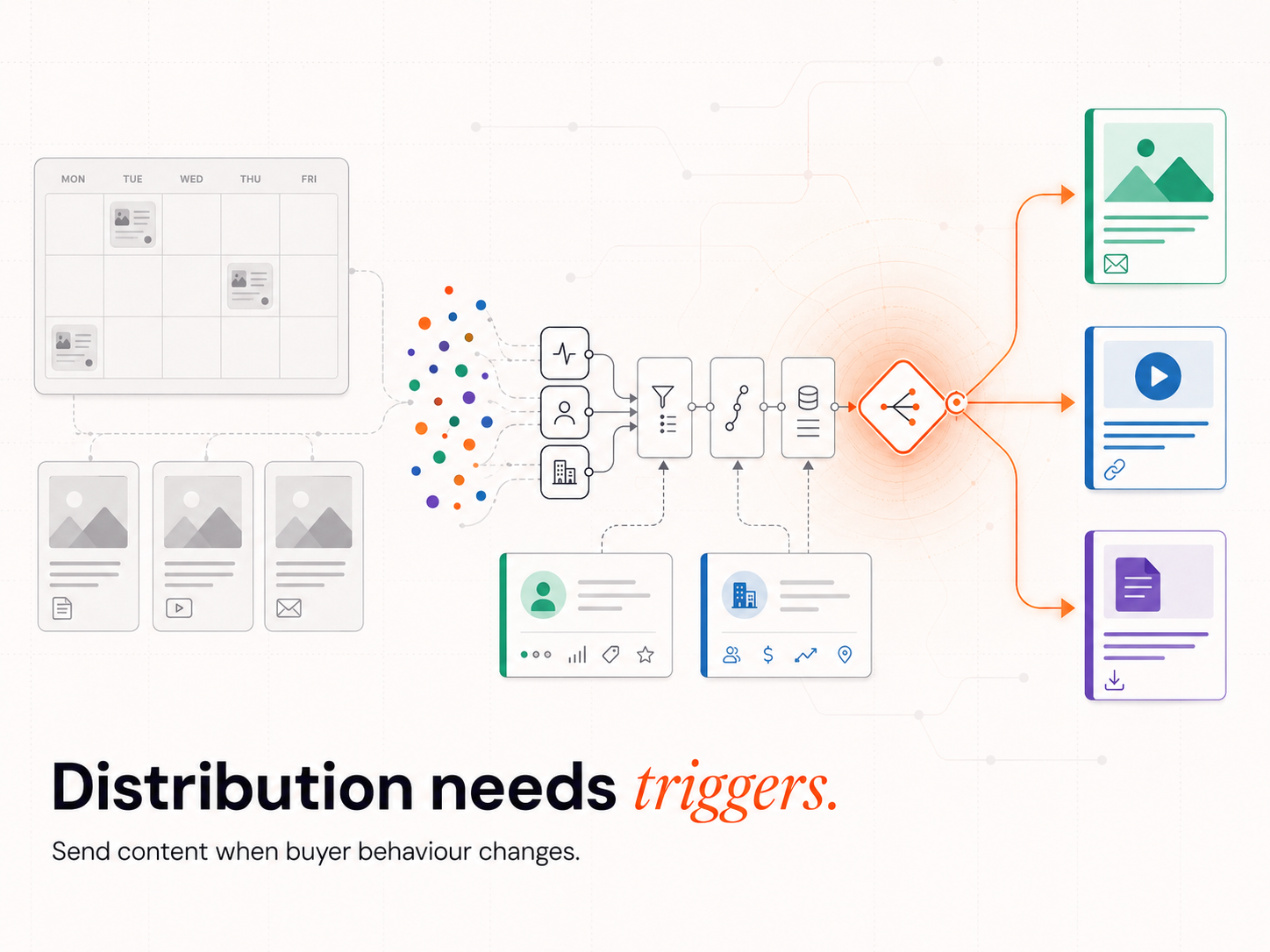
Content distribution automation is the process of delivering blog posts, emails, social media updates and other marketing assets across multiple platforms without manual intervention. Automation publishes content based on triggers and audience signals, ensuring each contact receives relevant content at the right stage, not on a fixed schedule.
CMI's 2025 B2B research found that 55% of B2B marketers still cite creating content that drives action as their top challenge. Signal-triggered distribution directly addresses this by ensuring content fires when buyer readiness is confirmed, not when the publishing calendar says so.
Why automate content distribution now?
Most teams over-invest in creating content and under-invest in distributing it, which is where the pipeline actually comes from. Orbit Media's blogger survey found bloggers spend 47% less time promoting an article than writing it, and only 20% promote a piece before it goes live. The asset is finished; the distribution barely starts.
Buyers, meanwhile, expect to be reached across channels. A 2025 study reported by Digital Commerce 360 found 84% of B2B buyers say it is important for sellers to operate across multiple online and offline channels. Manual posting cannot keep that many channels consistent and timely at once.
Automation closes both gaps, and the payback shows up most clearly in email. Omnisend found automated emails drove 37% of all email sales in 2024 despite being just 2% of email volume. Trigger-based delivery, not more sending, is what moves revenue.
Key Benefits of Content Distribution Automation
Some of the main advantages of automating content distribution include:
Increased efficiency: Content is distributed across platforms without manual scheduling.
Consistency: Ensures messaging remains aligned and consistent across channels.
Scalability: Automates workflows to handle high volumes of content at scale.
Real-time performance tracking: Monitor the effectiveness of content distribution and optimise in real time.
How Clay + n8n Automate Content Distribution
Clay handles the data layer: pulling CRM signals, enriching contact records and determining which contacts receive which content based on real behaviour. n8n handles the execution layer: triggering workflows when signals fire and routing content to the right channel. Together they remove the manual steps between a published piece and the audience it should reach.
How Clay Helps
Clay's enrichment platform connects CRM and marketing tools, bringing customer data, behaviours and signals into one platform to power personalised automation workflows. This signal-based marketing approach allows teams to act on buyer intent in real time.
Clay integrates customer relationship data with your marketing tools, ensuring content delivery is personalised based on real-time user actions such as website visits, email clicks or social media interactions. This allows marketers to automatically tailor content to match user behaviour, improving engagement and conversion rates.
GTM engineers use Clay to build sophisticated data enrichment pipelines that power personalised outreach at scale. By connecting customer signals with your content distribution workflows, you ensure the right message reaches the right person at precisely the right moment.
How n8n Helps
n8n's workflow automation serves as an automation hub that connects various applications, enabling teams to automate tasks like content syndication, social media posting and email distribution.
n8n acts as the central automation engine that connects your CMS with email platforms like Mailchimp or HubSpot, or social media networks such as Facebook, X and LinkedIn. With n8n, content is automatically posted to social media platforms or delivered to email subscribers based on triggers like new blog posts or product updates. For a practical look at how HubSpot and n8n automation connects these systems, that guide covers the full integration architecture.
Together, Clay and n8n connect content distribution by syncing data between your CMS, email tools and social media platforms.
How to Build Multi-Channel Content Workflows
A governed multi-channel content workflow requires 4 steps: channel mapping, CMS integration, social automation and email sequence configuration. Each step builds on the previous one. Skipping the CMS integration step and connecting social or email directly is the most common configuration error, the data layer is absent and personalisation logic has nothing to run on.
The core idea is to map each trigger to a single automated action, so one event reaches every active channel at once:
| Trigger event | What the system detects | Automated distribution action |
|---|---|---|
| New blog post published | CMS publish event fires in n8n | Auto-post to LinkedIn, X and the newsletter queue; create social variants |
| High-intent account visits pricing | Clay flags the account and enriches the record | Route a tailored email sequence and alert the owner in Slack |
| Webinar or product update | Calendar or product trigger | Syndicate to email segments and retarget engaged contacts |
| Content engagement crosses a score | Clay score threshold in HubSpot | Move the contact from nurture to a sales-ready sequence |
Step 1: Define Your Distribution Channels
To build an effective automated content distribution system, understand where your target audience consumes content. Are they reading blog posts on your website? Engaging with your brand on social media? Receiving email campaigns? Identifying the best channels for your content creates an efficient distribution strategy.
Step 2: Integrate Your CMS with Clay and n8n
Integrating your CMS with Clay is the first step in building an efficient content workflow. Once connected, Clay pulls content data and integrates it with your CRM, enabling the automation of personalised content delivery.
n8n then connects your CMS with email platforms (like Mailchimp or HubSpot) and social media platforms (like X, Facebook and LinkedIn). With n8n's drag-and-drop interface, set up workflows that trigger automatic content delivery whenever new content is published or user behaviours are detected.
Teams running multiple CMS, email and social platforms without an integration layer face data inconsistency and delayed publishing. Clay + n8n solves this at the connection point: Clay maintains data accuracy across the stack while n8n routes content from a single trigger to every active channel.
Step 3: Automate Social Media Posting
One of the most significant advantages of content distribution automation is social media posting. With n8n, you automate posts to social platforms, ensuring your content reaches the right audience at the optimal time. Trigger-based social media posting means that your posts are automatically published when certain actions occur, such as a new blog post being published or a product update being announced. Unlike scheduled posts, which may not always match the moment or user behaviour, trigger-based posting ensures that content is timely, relevant and aligned with user intent.
Step 4: Automate Email Campaigns
Clay and n8n also automate email campaigns by syncing content from your CMS with email distribution platforms. Using data from your CRM, Clay enables you to create personalised email sequences that are triggered by buyer signals, like a new lead, a product visit or an abandoned cart.
By segmenting audiences based on where they are in their journey (new subscribers, leads or customers), you automate targeted email campaigns that nurture and engage each group with relevant content, driving better results and improving conversion rates.
How do you overcome common content distribution automation bottlenecks?
3 bottlenecks derail content distribution automation before it reaches scale: tool sprawl, data synchronisation failures and inadequate governance. Each is a configuration problem, not a tool limitation. Identifying which bottleneck is active in a given stack determines which fix to apply first.
Dealing with Tool Sprawl
Tool sprawl leads to inefficiencies when multiple tools are not well-integrated. With Clay and n8n, you centralise data and workflows, reducing the need for multiple disconnected systems. This centralises data management for marketing teams from a single point, improving efficiency and reducing errors.
When data is inconsistent before automation starts, automation spreads that inconsistency faster. This is the core governance problem: automation does not fix bad data, it amplifies it. The fix is Clay's enrichment and deduplication layer, which validates records before any content trigger fires.
Data Synchronisation Issues
Ensuring that data flows smoothly between CMS, email and social media tools is crucial. When working with multiple platforms, maintaining data consistency is essential. Clay ensures that your CRM data is synchronised, while n8n connects the various tools, ensuring that content is delivered based on the most up-to-date customer information.
Quality Assurance and Governance
GTM engineers set up approval workflows within n8n, ensuring that content meets quality and brand standards before being distributed automatically. These workflows include checks for compliance, tone and relevance, ensuring that the content being delivered aligns with the company's goals and messaging.
Building signal-based marketing systems requires careful governance to ensure that automated content maintains brand consistency whilst responding to real-time buyer signals.
What are the best practices for content distribution automation?
Effective content distribution automation requires 3 ongoing practices: personalisation at the data layer, real-time performance tracking and continuous workflow refinement. Most teams configure automation once and consider it done. The teams that achieve consistent results treat each of these as a weekly operational discipline, not a setup task.
Personalisation at Scale
Automation does not mean sacrificing personalisation. By using behavioural data to drive content creation, marketers deliver tailored content across email and social media platforms. Automated workflows use data from Clay to personalise content for different buyer personas or customer segments, ensuring the right content reaches the right people.
Tracking and Analytics
With n8n, you integrate with Google Analytics, HubSpot or Clay's CRM tools to track the performance of content across multiple channels. Real-time data allows you to optimise campaigns, monitor engagement and tweak workflows for better performance.
Continuous Optimisation
Content distribution workflows should not be static. Testing and refining automation workflows, including experimenting with different posting times, content formats and messaging strategies, helps optimise engagement and conversions over time.
How do you scale content distribution without adding headcount?
A governed content distribution system replaces manual steps between publishing and delivery. The efficiency comes from trigger architecture: content moves when a signal, CMS publish event or approval rule fires, not when a team member manually schedules the next post or email.
Act-On and Ascend2's State of B2B Marketing Automation 2025 reports that 75% of B2B marketers plan to increase their marketing automation budgets in 2025, and 96% find their automation efforts at least somewhat successful. The direction is clear: teams are investing in automation, but the advantage comes from governing the data, triggers and workflow logic behind it.
For content distribution, Clay and n8n should not be positioned as shortcuts for posting more often. They should be positioned as a governed operating system for sending the right content to the right audience when the data says the timing is right.
For businesses looking to build content distribution systems at scale, Intelligent Resourcing's GTM engineering service designs, implements and optimises automation workflows. Teams starting with automation or scaling existing processes can accelerate results by working with specialists who design the data governance and trigger architecture from the start. For a view of the full signal-led stack, see B2B lead generation services.
Content Creation
Connecting tools without a governance layer just spreads inconsistency faster. The Revenue Operations Studio at Intelligent Resourcing makes n8n the governed execution layer and Clay the data layer, so content fires on a Verified Buying Window, not a calendar.
FAQs
What are the benefits of automating content distribution?
Automating content distribution saves time, ensures consistent messaging across channels and allows marketers to target the right audience with relevant, timely content.
How do Clay and n8n work together to automate content distribution?
Clay connects CRM and marketing tools to provide data-driven insights, while n8n automates workflows by syncing your CMS, email platforms and social media tools to deliver content automatically based on triggers and customer behaviour.
Can I automate content distribution for multiple social media platforms at once?
Yes, n8n allows you to automate content distribution across multiple social media platforms, ensuring timely and consistent posting based on triggers like new blog posts or product updates.
How can I ensure my automated content is personalised?
By integrating your CMS with Clay and n8n, you automate content distribution based on customer data, enabling personalised emails and social media posts based on behaviour, preferences and user segments.
What are the common pitfalls in content distribution automation?
Common challenges include tool sprawl, data synchronisation issues and maintaining content quality and consistency. These are addressed by using integrated systems like Clay and n8n, which centralise data and automate workflows across channels.