
Why Is Your Competitor Cited in ChatGPT and You Are Not?
Your competitor is cited because they built more off-site signals AI systems trust. This is a citation gap, not an SEO gap: ChatGPT weighs reviews, listicles, community threads, and comparison content. It reads corroborated entities, not your product roadmap, which means rank alone will not get you cited.
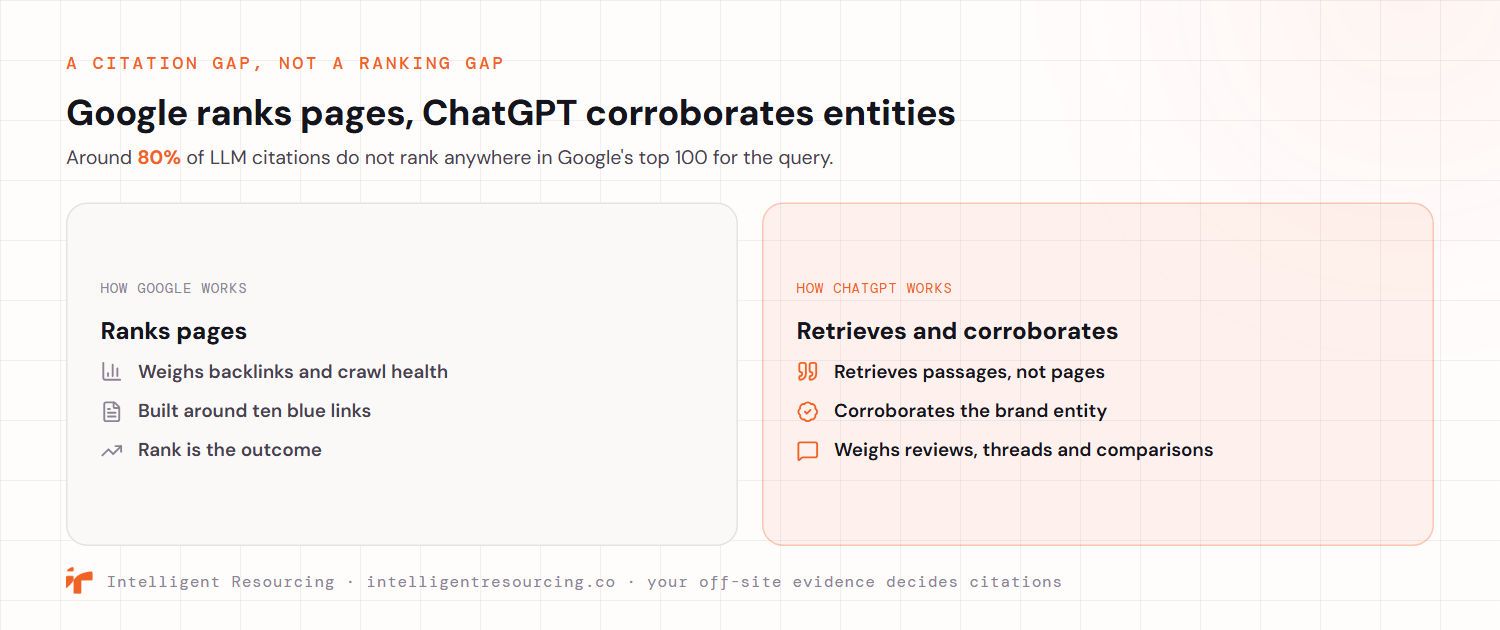
Google ranks pages; ChatGPT retrieves passages and corroborates entities. Your off-site evidence decides citations, not just your product quality. Answer engine optimisation treats citations as the goal and builds the exact signals AI systems read.
Is this a Google ranking problem or a citation gap?
It is a citation gap, because AI systems recognise entities, then corroborate them. ChatGPT looks for a consistent brand entity and cross-references reviews, mentions and listings.
Ahrefs found that around 80% of LLM citations do not rank anywhere in Google's top 100 for the original query, which supports the conclusion that rankings alone do not guarantee inclusion in a ChatGPT answer. Brands seeing organic clicks decline should also review how to recover traffic lost to Google AI Overviews while building the citation signals answer engines rely on.
4 signals that decide who ChatGPT cites
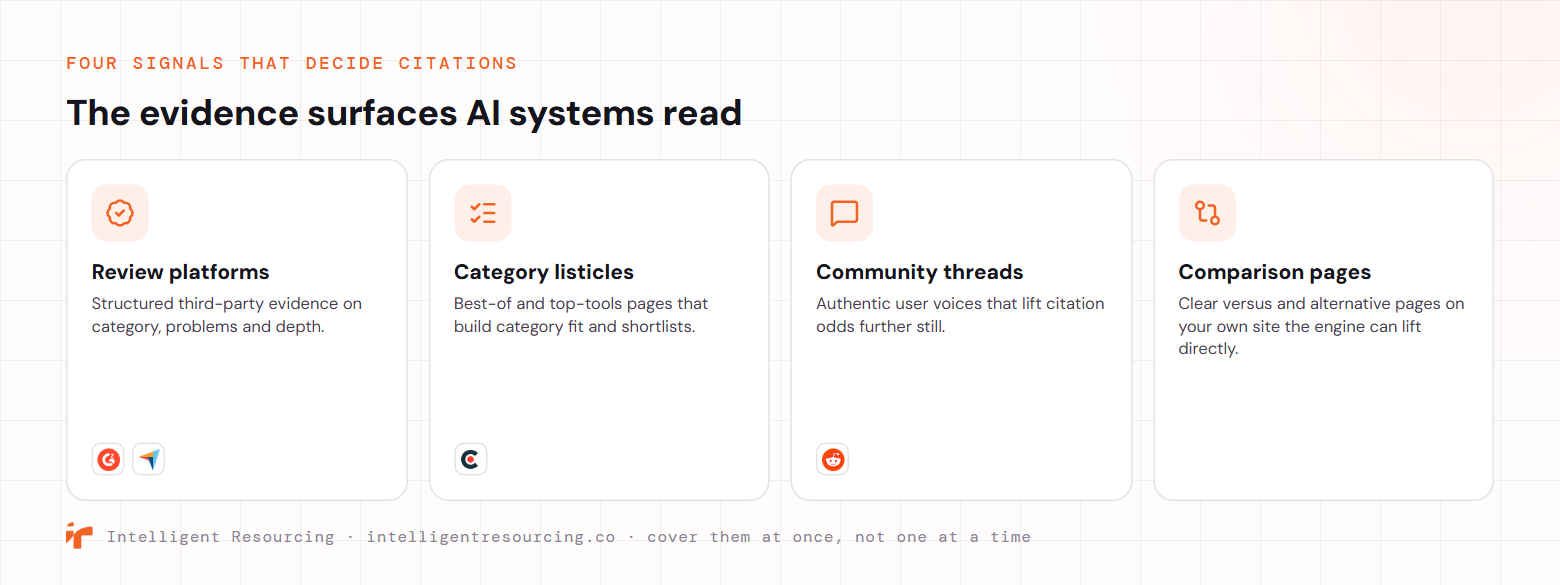
ChatGPT citations are shaped by the external signals that make an entity easier to verify, compare and trust.
A competitor that covers review platforms, category listicles, community discussion and comparison content at the same time gives ChatGPT more evidence to verify and cite.
How Does ChatGPT Actually Choose Which Brands to Cite?
ChatGPT citations come from two paths: what it can retrieve live, and what it has learned from repeated patterns over time.
SparkToro found that across repeated brand-recommendation prompts in ChatGPT, Claude and Google AI Overviews, the same brand list in the same order appeared less than 0.1% of the time. The goal is consistent presence across many buyer prompts, not one perfect position.
Build consistent category association across your owned and third-party sources so AI systems can understand, retrieve and cite your brand more reliably.
How does live retrieval differ from training memory?
Live retrieval and training memory work on different clocks. OAI-SearchBot fetches current pages during a query; GPTBot ingests content into model training. Live retrieval reacts within weeks, while training memory compounds across months.
Make your pages easy to crawl and easy to quote, then make your brand show up consistently across the sources AI systems learn from. Fast visibility and long-term recognition need to work together.
What Are Competitors Doing to Get Cited That You Are Not?
Competitors are building a broader off-site presence across the sources AI systems treat as evidence:
- Completing and strengthening their G2 and Capterra profiles
- Getting included in relevant 'best of' listicles
- Earning authentic mentions in Reddit and Quora threads
- Publishing clear comparison pages
- Covering multiple evidence surfaces at once, instead of relying only on their own website
Your competitor treats AI as a channel, and AI search marketing sits beside their classic SEO. They fill every evidence surface on purpose: SE Ranking found that domains with complete profiles on G2, Trustpilot, and Capterra roughly triple their chances of appearing in ChatGPT answers, and community mentions lift those odds further still.
How do review platforms and listicles drive citations?
Review platforms such as G2, Capterra and Trustpilot give AI systems structured third-party evidence about a brand. They show the category a company belongs to, the problems customers mention, the competitors it is compared with, and whether there is enough review depth to support a recommendation.
Listicles add another layer of evidence: when a brand appears in relevant 'best of', 'top tools' or 'best providers for X' pages, AI systems can use those pages to understand category fit and build shortlists. A single mention is useful, but repeated inclusion across trusted category pages is stronger.
A complete profile with detailed reviews, current product information and consistent category language is easier to cite than a thin listing. The same applies to listicles: being included on pages that match your target category reinforces what the brand should be known for.
Why do Reddit and community mentions matter so much?
Community threads read as authentic third-party signals. Reddit and Quora discussions carry real user voices, and that authenticity correlates with higher citation odds, lifting citation probability meaningfully further than review profiles alone. OpenAI also holds a Reddit content partnership, so Reddit text feeds ChatGPT answers directly.
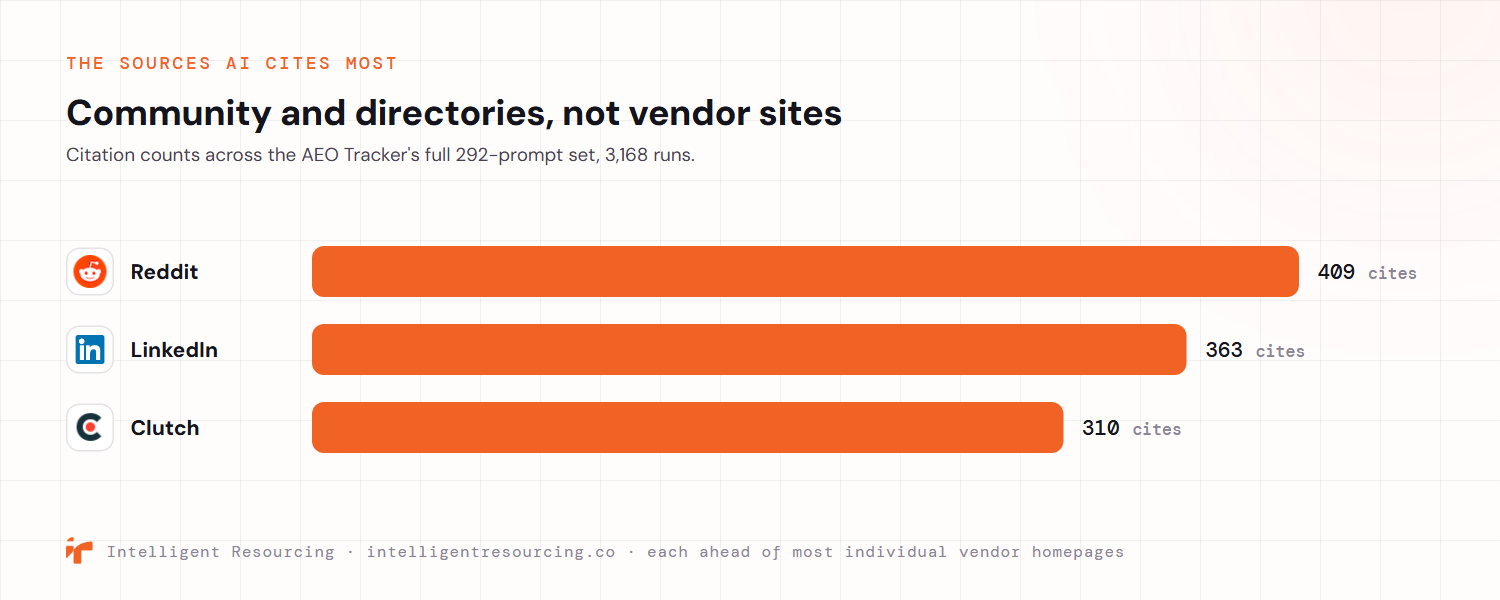
Across the Intelligent Resourcing AEO Tracker's full 292-prompt set (3,168 runs), the sources AI cites most are community and directory pages, not vendor sites: Reddit is cited 409 times, LinkedIn 363, and Clutch 310, each ahead of most individual agency homepages. When our own domain is cited, it is the answer-first blog pages that get pulled.

How Do You Get Cited in ChatGPT? The AEO Fix Playbook
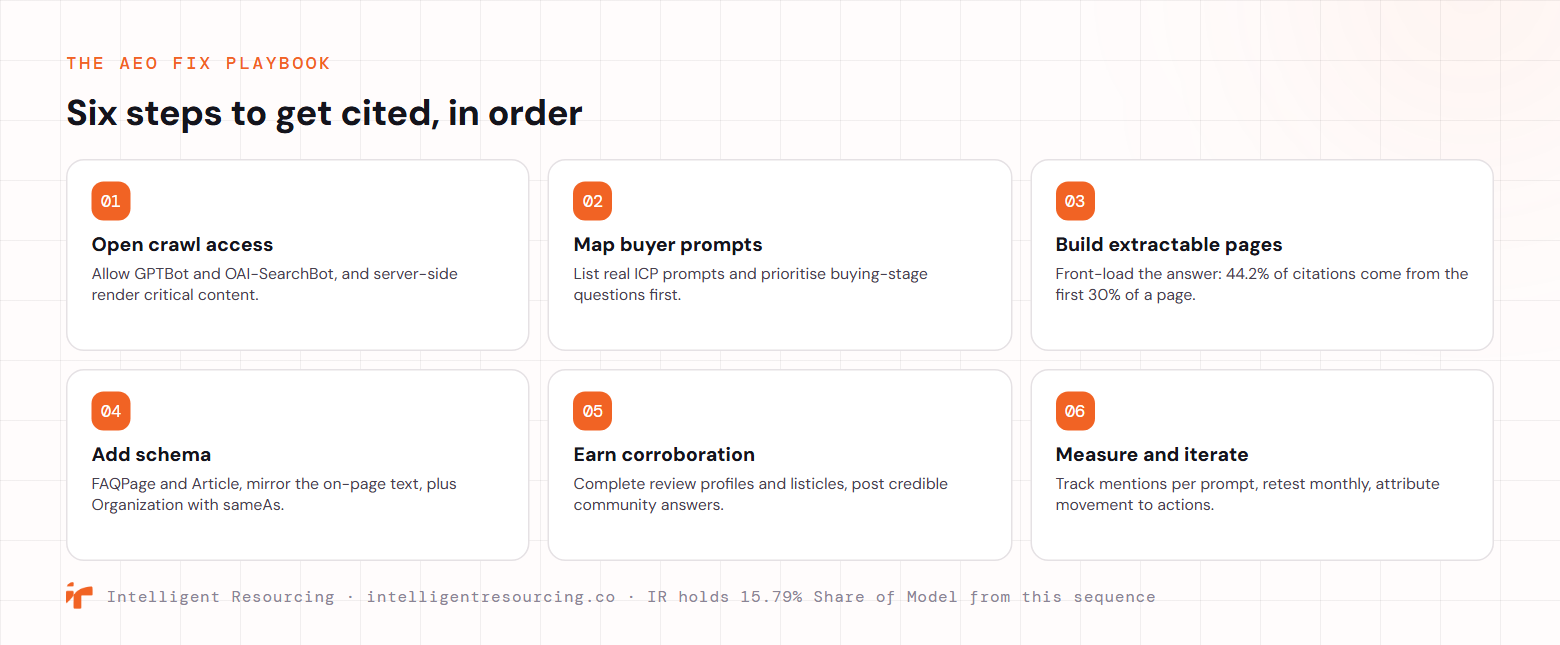
- Open crawl access. Allow GPTBot and OAI-SearchBot in robots.txt and server-side render critical content, because AI crawlers skip JavaScript-only pages.
- Map buyer prompts. List the real prompts for your ICP types and prioritise buying-stage questions first; question mining for AI search surfaces the exact phrasing.
- Build extractable answer pages. Front-load the direct answer early: Position Digital found that 44.2% of citations come from a page's first 30%.
- Add schema. Implement FAQPage and Article schema, mirror the on-page text exactly, and add Organization schema with sameAs links.
- Earn third-party corroboration. Complete review profiles and listicle entries, post credible community answers, and keep entity details consistent across LinkedIn and Crunchbase.
- Measure and iterate. Track brand mentions per prompt, retest across engines monthly, and attribute movement to specific actions.
How Do You Measure Citation Gains and Sustain Them?
What closing the gap looks like in numbers
As of 9 July 2026, our AEO Tracker holds 253 buyer prompts and runs across five engines. Across that set, Intelligent Resourcing holds a 15.79% Share of Model, the highest in its tracked category. The underlying rates read the same way: a 30.7% citation rate, a 19.9% mention rate, and an average mention position of 1.9, meaning when we are named we are usually named first. None of that came from a homepage rewrite; it came from the ordered sequence above, run on a schedule and measured against a fixed prompt set. That is the difference between a number you can defend and a screenshot you cannot.

Content Creation
Closing the gap is a system, not a one-off. We tighten your entity signals, ship extractable pages AI crawlers retrieve, and baseline your Share of Model, then track it forward the same way we track our own.
FAQs
Why is my competitor cited in ChatGPT and I am not?
They built stronger off-site citation signals. Reviews, listicles, community threads, and comparison content all feed ChatGPT, and their entity is more consistent across the web. This is a citation gap, not a product gap. Close it by matching their evidence footprint on G2, Reddit, and Capterra.
How long does it take to get cited in ChatGPT?
Live-retrieval citations can appear within weeks, once pages are crawlable and extractable for OAI-SearchBot. Full category presence takes 3 to 6 months, compounding through GPTBot training and entity consistency. Tactical wins come fast; structural authority takes patience.
Does ranking on Google help with ChatGPT citations?
Not directly. Ahrefs found around 80% of LLM citations do not rank in Google's top 100. The two systems weight different signals: Google reads backlinks and on-page factors, while ChatGPT reads corroborated entities. Build for both, but do not assume rankings carry over.
Can you pay to get cited in ChatGPT?
No. There is no paid placement for organic citations. ChatGPT earns them through corroboration and entity consistency, so you cannot buy a spot on its shortlist. Never manipulate Reddit or Wikipedia to fake signals; earned mentions are the only durable route.
What is AEO and how does it differ from SEO?
AEO stands for answer engine optimisation. It targets citation inside AI answers, while SEO targets ranking for blue links. AEO weighs entity consistency and third-party corroboration; SEO weighs backlinks and on-page factors. You need both working together now.