
Why Does Data Accuracy Matter More in AU/APAC Than in North America?
ZoomInfo's global database is optimised for North American density. In AU/APAC markets, where total addressable accounts number in the thousands rather than millions, one invalid send is not equivalent to one invalid send in a list of 50,000. A single bad campaign damages sender reputation in an environment where recovery contacts are limited, ESP warnings arrive sooner and the total pool of valid addresses is smaller to begin with.
Why global databases underserve AU/NZ
ZoomInfo's coverage model maximises total records across a global database. North American markets generate more frequent data signals: role changes, funding announcements, technology installs. These signals keep database accuracy higher in those regions. AU/NZ records receive less frequent enrichment because the signal volume is lower. The result: contacts in AU/NZ reflect outdated roles, departed decision-makers and companies that changed structure since the last refresh.
MarketingSherpa research, cited by DemandScience, found that B2B data decays at 2.1% per month, which annualises to 22.5% per year. For a database of 10,000 APAC contacts, over 2,000 records are inaccurate within 12 months. When those records are batch-refreshed quarterly, errors compound across 3 months of outreach before the next refresh cycle catches them.
How smaller TAM amplifies bounce rate damage
In North American outbound, a 5% bounce rate on a sequence of 10,000 sends produces 500 bounced contacts. The sender can rotate domains, suppress bounced contacts and continue at scale. In a SaaS company targeting 500 AU/NZ accounts, a 5% bounce rate produces 25 bounced records from a pool where every account has material pipeline value. Each bounce carries greater weight, and ESP warnings arrive before the team can course-correct.
Apollo's email benchmark research identifies below 2% as the healthy threshold for bounce rates across B2B outbound, with sub-1% hard bounces as the modern standard for well-maintained lists. APAC teams operating above that threshold are not facing a volume problem. They are facing a data quality problem that compounds each quarter the batch update cycle runs unchecked.
How Do Clay and ZoomInfo Handle Email Validation Differently?
ZoomInfo validates email addresses at the time of database enrichment, then marks them as "likely deliverable" until the next update cycle. Clay validates each email address in real time at the point of use, before the record enters HubSpot or triggers any SmartLead sequence. The distinction is when validation happens: before the outreach fires, or after it fails.
ZoomInfo's confidence scoring model
ZoomInfo assigns a confidence score to each contact record based on how recently the data was confirmed, which sources contributed to it and whether the email pattern matches known delivery history. A high confidence score means the email was verified at enrichment time, not that it is valid now.
For fast-moving sectors in AU/APAC, role changes happen frequently. A 3-to-6-month confidence window carries meaningful inaccuracy risk for SaaS, fintech and professional services teams targeting executives who move between companies faster than North American equivalents. The sequence fires against stale addresses. Bounces accumulate. The sending domain takes the reputation hit.
Clay's verification-first enrichment model
Intelligent Resourcing builds Clay workflows that validate each APAC contact record in real time before it reaches HubSpot or SmartLead. Clay's Enrichment Waterfall checks Apollo, LinkedIn and Clearbit in sequence, returning the most accurate available record from the first provider that confirms the contact as valid. If no provider confirms the email address as deliverable, the record does not enter the sequence.
Conditional blocking logic sits inside the workflow. Records that fail the validation threshold are suppressed before CRM entry. The SDR receives only contacts that passed real-time validation, not contacts that passed validation 3 months ago when the last database refresh ran.
Where Does ZoomInfo Data Fall Short for AU/APAC Outbound Teams?
ZoomInfo's AU/APAC coverage gaps appear in 3 specific ways: lower verified contact density per company in AU/NZ compared to North American equivalents, slower detection of role changes in high-turnover sectors and technology stack intelligence that reflects quarterly refresh cycles rather than real-time installs.
Coverage density in AU/NZ
ZoomInfo indexes fewer verified contacts per company in AU/NZ than in comparable North American companies. For a team targeting 50-to-300-person SaaS companies in Sydney or Melbourne, the database returns 2 to 3 verified contacts per account where a comparable North American account returns 8 to 10. That density gap pushes SDR teams into manual research to fill contact records before sequencing. This consumes the time the data subscription was supposed to save.
Role change latency
In fintech, SaaS and professional services sectors across AU/APAC, where executive movement is frequent, ZoomInfo's batch update cycle produces a specific failure mode: the role change is detected after the outreach fires. A contact who was VP of Sales 3 months ago and has since moved to a different company receives an outreach sequence that references their old role and old account. The send bounces, or it reaches their replacement who has no context for the outreach.
Technology stack intelligence gaps
ZoomInfo's Scoops and technology stack data for APAC companies update on a similar batch schedule. For teams using technology installs as a buying signal (a company adding Salesforce or HubSpot often signals a revenue operations build-out), the signal arrives weeks or months after the actual install. Intelligent Resourcing's Agentic Signal Listening layer monitors these events in real time through signal-based automation workflows: when a target account installs Salesforce, Clay detects it within 24 to 48 hours, not at next quarter's refresh.
How Does Clay's Refresh Cadence Compare to ZoomInfo's Batch Update Cycle?
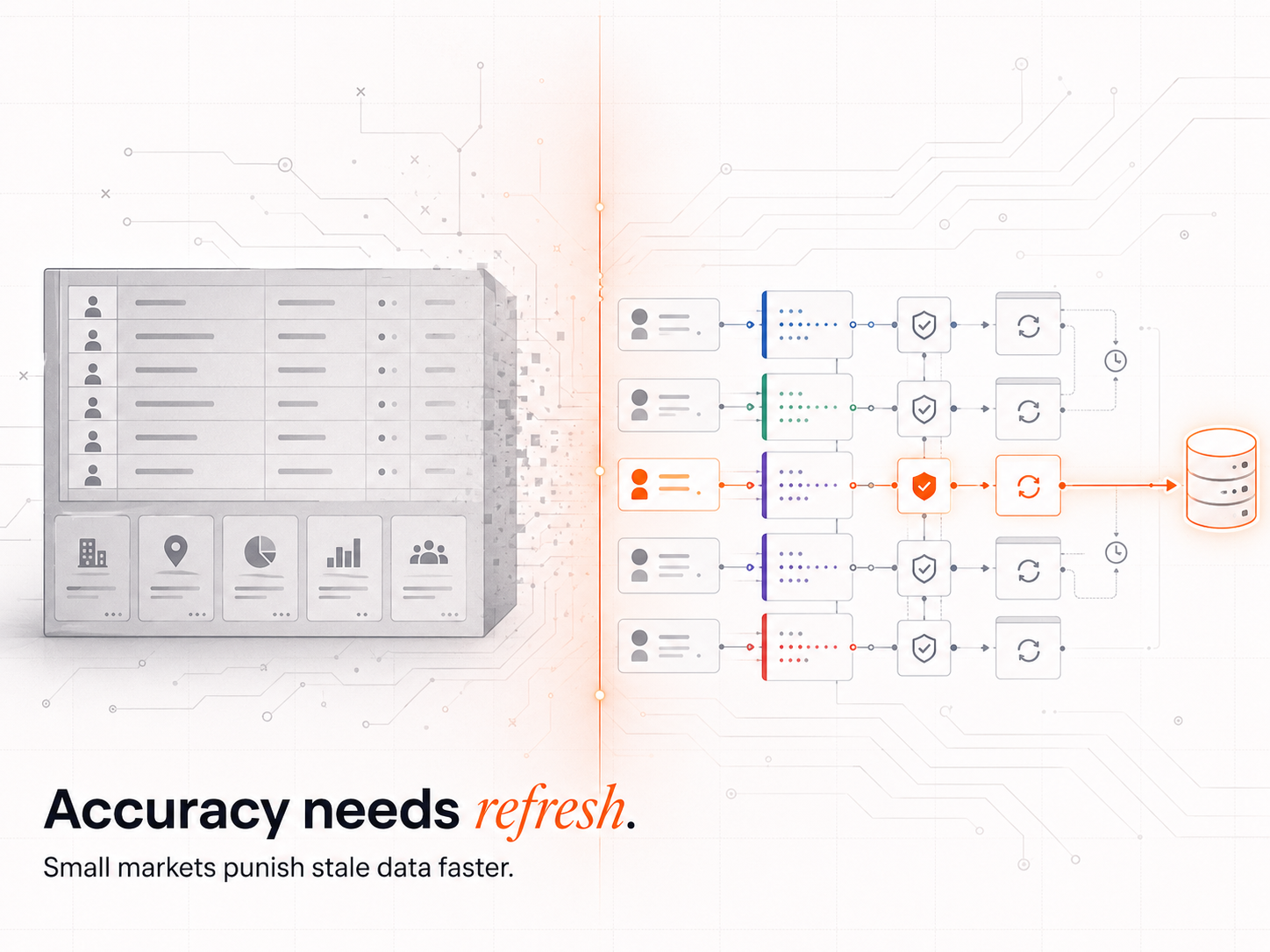
ZoomInfo updates its database on a scheduled batch cycle: quarterly for most records, with faster refreshes for high-activity accounts. Clay does not run a scheduled refresh cycle. Enrichment fires when a signal fires: a job change, a funding announcement, a technology install. The record is updated when the event happens, not when the calendar dictates.
Triggered enrichment vs scheduled refresh
Clay's enrichment architecture runs on events, not schedules. When Intelligent Resourcing's GTM engineering team configures a Clay workflow for an APAC client, the trigger logic determines what events cause a re-enrichment: a monitored contact changes LinkedIn role, a target account posts a new VP-level job listing, a company closes a funding round. Each event fires an enrichment run against that specific account record, checking Apollo, LinkedIn and Clearbit in sequence to return the most current data available.
For a SaaS company targeting 200 accounts in AU/NZ financial services, this means the CRM reflects where contacts actually are today. An SDR opening HubSpot each morning looks at records enriched the last time a relevant signal fired for that account, not records from 3 months ago waiting for a batch cycle to catch up.
Confidence thresholds that protect outbound quality
Clay workflows allow teams to set confidence thresholds per data field. If an email address does not pass the validation threshold, the field stays blank rather than being populated with an unverified address. If a phone number cannot be confirmed as mobile-direct, it is not written to the CRM. Records that fail threshold checks are logged for review. They do not enter sequences and do not generate bounces.
This is the structural difference between a database that marks records as likely accurate and a workflow that refuses to write inaccurate data in the first place.
What Is the Difference Between Database Accuracy and Workflow Accuracy?
Database accuracy measures whether records in a provider's database are correct at the time of enrichment. Workflow accuracy measures whether records that enter your CRM and outreach sequences are valid at the point of use. ZoomInfo optimises for database accuracy at enrichment time. Clay-based workflows optimise for execution accuracy: each record is validated when the workflow fires, not when the database last ran a refresh cycle.
Why the distinction matters in APAC outbound
A team using ZoomInfo can have a database with 85% accuracy, meaning 85% of records were valid at the time of last enrichment. If the average APAC record is 4 months old at send time and B2B data decays at 22.5% per year (1.9% per month), those records have decayed by 7.5% since enrichment. In a 500-account APAC campaign, that produces 37 contacts sending to wrong addresses or wrong roles before the sequence completes.
Validity's 2025 State of CRM Data Management report found that 37% of CRM users reported losing revenue as a direct consequence of poor data quality, and 76% said less than half of their organisation's CRM data is accurate and complete. Those figures reflect the outcome of database-first architecture: data enters the CRM at enrichment time and is not re-validated until the next batch refresh runs.
Clay's point-of-use validation
Intelligent Resourcing's Clay-based enrichment model validates at the point of use rather than at the point of database entry. When a HubSpot workflow triggers a SmartLead sequence, the Clay enrichment check runs first. If the contact's email fails validation, the sequence does not fire for that record. If it passes, the sequence fires with a record validated within the previous 24 to 48 hours, not the previous quarter.
For AU/APAC teams where every contact in a 200-account TAM has material pipeline value, this execution accuracy model produces measurably lower bounce rates and better deliverability than a confidence-scored database model.
Where Does Intelligent Resourcing's Approach Fall Short?
Clay-based Enrichment Waterfall logic requires a defined ideal customer profile before the system produces clean results. If the ICP is still being validated across sectors, company size, technology footprint and growth signals, the Clay waterfall surfaces noise at scale rather than verified, signal-confirmed leads. Verification quality is only as good as the targeting criteria fed into it.
Intelligent Resourcing's model is not suited to teams running static list campaigns where a one-time pull of contact data is sufficient. If the outreach motion is "build a list, run a sequence, repeat," the Clay Enrichment Waterfall architecture adds complexity without proportionate return. ZoomInfo's database model is simpler and more cost-effective for that use case.
The system requires internal sales capacity to act on signal-routed leads. Clay detects the signal, validates the record and routes it to HubSpot. A qualified account executive needs to be available to act on that notification. Without internal AEs to close the opportunities the system surfaces, the investment does not pay back.
How Do You Build a Clay-Based Enrichment System for AU/APAC Outbound?
A Clay-based enrichment system for AU/APAC outbound requires 4 components: the ICP definition, the signal detection layer in Clay, the CRM routing logic in HubSpot and the outreach execution layer in SmartLead. The critical factor is sequence: ICP and signal rules must be defined before the Clay enrichment layer runs, not after it has already populated the CRM with noise.
ICP definition first, enrichment second
Intelligent Resourcing's engagements with AU/APAC B2B clients show the same failure mode when the order is reversed: the enrichment waterfall starts before the ICP criteria are locked. Clay pulls records, validates emails and routes contacts into HubSpot. Without tight targeting criteria (company size, technology footprint, growth signals and decision-maker seniority), the contacts that pass Clay's validation threshold are not the accounts the sales team would actually call.
During an engagement with a SaaS company targeting 200 accounts in ANZ financial services, Intelligent Resourcing ran a 30-day signal validation period before activating any outreach. Clay monitored the 200 target accounts, enriched records when signals fired and surfaced which buying events correlated with genuine pipeline interest. The outreach layer activated in week 5. Bounce rate on the first sequence was 0.8%, below the 2% threshold that Apollo's benchmark research identifies as the healthy standard for well-maintained outbound lists.
The 4-layer stack
Clay is the enrichment and signal detection layer. It monitors each target account across LinkedIn, Apollo and Crunchbase. When a monitored account crosses a defined signal threshold (new executive hire, funding announcement or technology install), Clay enriches the record, checks it through the validation waterfall and routes it to HubSpot.
HubSpot receives validated, signal-confirmed records and assigns them to the correct rep or sequence. SmartLead executes the outreach, manages deliverability settings and returns replies to HubSpot for rep visibility. n8n connects all 3 platforms through custom conditional logic: if Clay flags a funding event, the account matches the ICP and the contact passes email validation, n8n triggers the relevant sequence in SmartLead.
For the full implementation architecture, see automated B2B lead generation with Clay and n8n.
Intelligent Resourcing's Revenue Operations Studio delivers this Clay-to-HubSpot Enrichment Waterfall on the client's own stack within 4 to 6 weeks from ICP finalisation. See the full lead generation service for scope and engagement details.
Comparisons
Single-source data leaves AU/APAC lists stale and bouncing. The Revenue Operations Studio at Intelligent Resourcing installs a Clay Enrichment Waterfall on your HubSpot stack, validating each record in real time before it triggers outreach.
FAQs
Is ZoomInfo accurate in Australia and New Zealand?
ZoomInfo has lower coverage density in AU/NZ compared to North American markets, with slower detection of role changes in high-turnover sectors. Quarterly batch updates mean APAC records often reflect contacts who have moved roles or left companies since the last refresh cycle. B2B data decays at 22.5% per year, making a 3-to-6-month update window a significant accuracy gap for AU/APAC outbound teams.
How does Clay improve email deliverability for AU/APAC teams?
Clay validates each email address in real time before the record enters HubSpot or triggers any outreach sequence. If an email fails the validation check, the record is suppressed: it does not enter the sequence and does not generate a bounce. This point-of-use validation model keeps bounce rates below the 2% threshold that Apollo's benchmark research identifies as the healthy standard for well-maintained outbound lists.
Why does bounce rate matter more in smaller markets?
In AU/APAC, total addressable accounts number in the thousands for most B2B companies, not the millions available in North American markets. Each bounce carries greater weight when the sender's reputation is judged against a smaller pool of sending history. Email service providers issue warnings faster, and the account pool available to rebuild sending reputation is more limited. One bad campaign in AU/NZ causes more lasting damage than an equivalent campaign in a North American market.
What is an Enrichment Waterfall and why does it improve APAC data quality?
An Enrichment Waterfall checks each contact record against multiple data providers in sequence (Apollo, LinkedIn and Clearbit), returning the most accurate available record from the first provider that confirms it. Rather than relying on a single provider's database, the waterfall fills APAC coverage gaps from alternate sources. If no provider confirms the record as valid, it does not enter the CRM.
Can teams use ZoomInfo and Clay together?
Yes. Some teams use ZoomInfo for initial list building in North American markets and Clay for dynamic, real-time enrichment and validation where APAC accuracy matters. In this hybrid model, records from ZoomInfo are run through a Clay validation waterfall before entering any outreach sequence. The list build and the validation are handled by different tools, with Clay acting as the quality gate before the sequence fires.
What is the difference between database accuracy and workflow accuracy?
Database accuracy measures whether records are correct at the time they enter a provider's database. Workflow accuracy measures whether records that enter your CRM and outreach sequences are valid at the moment of use. ZoomInfo optimises for database accuracy at enrichment time. Clay-based workflows optimise for execution accuracy: each record is validated when the workflow fires, not when the database last ran a refresh cycle.