
One path builds visibility and waits for inbound demand. The other captures existing demand by spotting buying signals, routing them into the CRM, and turning them into pipeline. Homer Digital Marketing sits closer to the first path, which suits founder-led service businesses. This guide profiles five alternatives for teams that need something different, with capability, pricing, who each suits, and where each falls short.
The shift matters in 2026 because buyers do most of their own research first. G2's 2024 buyer research found that 34% of buyers say research is the longest stage of their buying process, and review sites are now the single most-consulted source, ahead of vendor sales reps. For Australian teams selling into B2B categories with multiple stakeholders, waiting for visibility alone to do the work can feel too slow.
The shift in Australian B2B growth
Australian B2B firms are moving from broad awareness activity toward models that connect demand creation, data, CRM logic, and sales follow-up more tightly. Visibility still matters; it is just no longer enough on its own. If most buyer research happens before direct contact, the winning move is not only to be seen, but to know when interest appears and act on it fast. Part of the shift is commercial: service firms, consultants, and founder-led businesses often benefit from visibility-led authority because the founder is a big part of what the buyer is buying, and Homer's content aligns closely with that. Part is operational: product-led B2B companies, SaaS teams, and scale-ups need signal capture, enrichment, routing, and a system that does not rely on the founder posting every week.
Why businesses look beyond Homer Digital Marketing
Authority can be too slow for some sales motions
Homer's model is built around visibility, authority, and automation. That works for founder-led service businesses, but it is a slower fit for teams that need pipeline from buyers who are in-market now. If your category depends on timing, account signals, and faster routing to sales, a visibility-first model can feel indirect.
Founder-led growth does not always scale cleanly
For consultants, coaches, recruiters, and reputation-led firms, founder visibility is a strong lever. The trade-off is that some B2B teams do not want growth tied so tightly to one person's face, voice, and content cadence; they want a system that keeps running even when the founder is not posting.
Content does not fix workflow gaps
More visibility does not solve CRM mess, weak routing, delayed follow-up, or poor handoffs between marketing and sales. Many firms start looking for alternatives when they realise the real bottleneck is inside the system behind demand, not the amount of content posted.
Some teams need a different growth lever altogether
Not every business wants to bet on founder authority. Some want paid search at scale, some want outsourced outbound, some want a self-serve prospecting platform they run in-house. A Homer Digital Marketing shortlist should compare different growth models, not just similar agencies.
How to compare Homer Digital Marketing alternatives
The providers below solve different problems, so the right comparison is not "who is best" but "which model fits the bottleneck you actually have". Run each option through these six criteria before you shortlist; the questions matter more than the logos.
| Criterion | Question to ask | What a strong answer looks like |
|---|---|---|
| Growth model | Is the provider built around visibility, system design, paid acquisition, or outbound? | One clear model matched to your bottleneck, not a little of everything |
| Create vs capture demand | Do they build new attention, or capture buyers already in-market? | The ability to act on live buying intent, not only generate awareness |
| Automation and data depth | Simple nurture and content, or enrichment, scoring, routing, and decision logic? | Workflows that qualify and route accounts, not just publish more content |
| CRM and handoff | Does the work connect to the CRM and sales follow-up? | Clean routing and handoffs, not leads dropped into an inbox |
| What keeps running | Do you keep a capability, or does it reset each month? | A system that compounds, or at least a process your team can repeat |
| Business fit | Founder-led service business, or product-led B2B with multiple stakeholders? | A model matched to how you actually sell and who signs off |
Quick comparison of the alternatives
| Option | Capability | Main strength | Pricing | What it lacks |
|---|---|---|---|---|
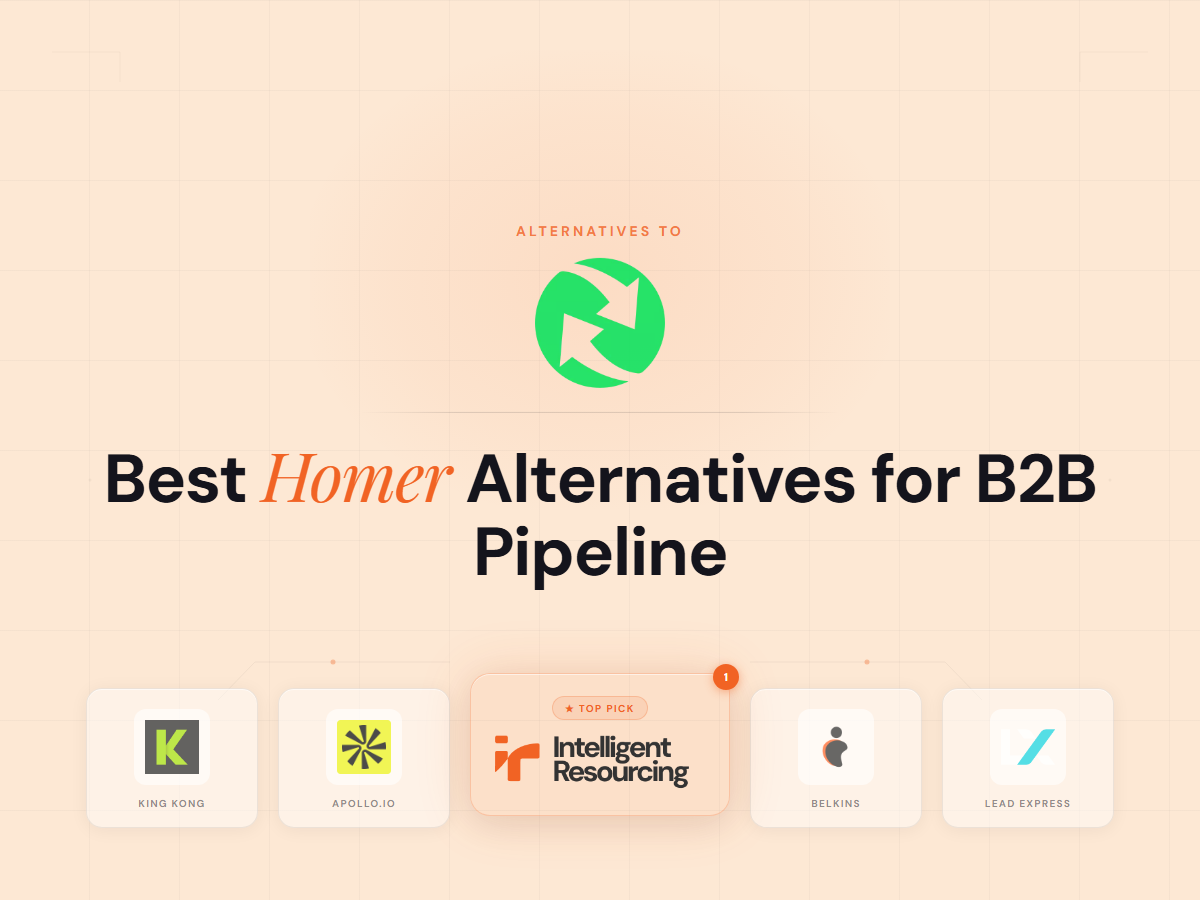
| Intelligent Resourcing | Signal-led system: Clay workflows, n8n automation, GTM engineering, CRM sync | Signal-led targeting, stronger workflow control, runs as an ongoing capability | Bespoke, scoped per build | Collaborative and bespoke; not a founder-visibility or content shop |
| Cleverly | Managed LinkedIn outreach, cold email, cold calling, appointment setting | Managed LinkedIn lead flow, the closest analogue to Homer's authority model | LinkedIn from US$397/mo; cold email from US$1,995/mo | Volume and automation-led, not deep personal brand; needs your own Sales Navigator |
| WebFX | Managed paid search and paid social with revenue reporting | Hands-off, accountable paid media with published entry pricing | PPC from US$650/mo plus ad spend; ~6-month minimum | US-based, no AU presence; true cost is fee plus media spend |
| Apollo.io | Self-serve prospecting database, sequences, dialer, CRM enrichment | Broad do-it-yourself functionality at a low per-seat entry | Free; paid from ~US$49/user/mo (annual) to ~US$119 a user (top tier) | You run it yourself; credits expire monthly and overages add up |
| CIENCE | Done-for-you outbound SDRs, multi-channel, proprietary data | High-volume managed outbound without hiring SDRs | No public price; indicative ~US$4,200-9,000/mo plus setup and per-appointment fees | Templated playbook delivery; setup and commissions inflate cost |
Our top 3 picks for 2026
These three lead the list because each is the clearest answer to a specific bottleneck: a signal-led system, a managed authority motion, or accountable paid acquisition.
1. Intelligent Resourcing
Best for a signal-led system that ties demand to CRM-routed pipeline.
Intelligent Resourcing is not another content-led authority agency. Its model is built around GTM engineering, Clay workflows, n8n automation, and CRM-connected lead generation: an always-on layer watches target accounts for buying signals such as a funding round, a leadership change, or a new tool in the stack, then Clay enriches and scores the account, and n8n routes it into your CRM with the next action attached. The point is not more content; it is acting on the right account at the right moment and making sure sales never loses it in a handoff. The full build is set out in automated B2B lead generation with Clay and n8n.
Pricing. Bespoke, scoped per build rather than sold per seat or per lead. There is no public rate card; pricing follows a scoping conversation about ICP, signals, and stack.
Best for. Australian B2B firms with a defined ICP whose problem is not "we need more visibility" but "our pipeline process is manual, noisy, and hard to scale," and who already have demand signals but lack the workflow discipline to act on them. What it lacks: it is collaborative and bespoke, so it needs internal sales capacity to act on routed accounts and a ramp before the system is fully live, and it is not a founder-visibility, content, or personal-brand shop.
2. Cleverly
Best for managed LinkedIn authority and outreach, the closest match to Homer's own lane.
Cleverly is a managed LinkedIn and outbound demand-gen agency: done-for-you LinkedIn outreach, cold email, and cold calling, with managed targeting, copy, and appointment setting. If you like Homer's authority-led, relationship-first approach but want the outreach run for you at higher volume, Cleverly is the nearest alternative. It leans on proven outbound playbooks and a large delivery team rather than building a single founder's personal brand, which makes it faster to switch on but less distinctive in voice.
Pricing. LinkedIn outreach from about US$397 a month, with higher tiers around US$697 to US$997, and cold email from about US$1,995 a month. You also need your own LinkedIn Sales Navigator on top, which is easy to miss when comparing entry prices.
Best for. Founders and service firms that want managed LinkedIn lead flow without doing the outreach themselves. What it lacks: it is volume and automation-led rather than deep personal-brand building, results depend heavily on your offer and list quality, and the Sales Navigator cost sits outside the headline fee.
3. WebFX
Best for hands-off paid acquisition with accountable, transparent pricing.
WebFX is a managed paid-acquisition agency running paid search and paid social, with revenue-first reporting through its RevenueCloudFX platform and unusually transparent productised pricing for an agency. Where Homer builds organic authority over time, WebFX buys attention now and optimises it against revenue, which suits firms that want faster, measurable traffic and are comfortable funding media spend to get it.
Pricing. PPC management starts at US$650 a month plus ad spend, typically on a six-month minimum, with enterprise tiers priced as a percentage of spend. The true monthly cost is the management fee plus the media budget, not the entry fee alone.
Best for. Service businesses that want a hands-off, accountable paid-media program with published entry pricing. What it lacks: a six-month commitment, no Australian local presence, and a model that is paid-demand rather than a built signal-led system that keeps working when you pause spend.
Other alternatives worth a look
Apollo.io
Best for self-serve outbound run in-house.
Apollo.io is a self-serve sales platform: a 210M-plus contact prospecting database with email sequencing, a dialer, and CRM enrichment. It is do-it-yourself software rather than a managed service, so it suits lean teams that already have someone to run the motion and just need data and tooling cheaply. The free tier and low per-seat entry make it easy to start, but the platform rewards process discipline; if your outreach is weak, Apollo simply makes bad outreach easier to send at scale.
Pricing. A free tier, then paid plans from roughly US$49 per user a month (Basic, billed annually) up to about US$119 a user for the top tier (three-seat minimum). Credits reset monthly, so heavy enrichment and phone-number reveals push the real cost higher than the sticker price.
Best for. Lean in-house teams that want data and outbound tooling at a low entry cost and are happy to run the motion themselves. What it lacks: it is a tool, not a partner, so strategy, list quality, and follow-through are entirely on you.
CIENCE
Best for high-volume managed outbound without hiring SDRs.
CIENCE is a done-for-you outbound agency: managed SDRs across phone, email, and social, backed by its own 300M-plus contact data and appointment setting. It is built for throughput, standing up a multi-channel outbound motion quickly without you recruiting and training reps. The trade-off is standardisation; reviewers note delivery can feel templated and needs pushing to tailor messaging to a nuanced ICP.
Pricing. No public rate card; indicative third-party figures put managed SDR programs around US$4,200 to US$9,000 a month, plus a one-time setup and per-held-appointment commissions from about US$250. Setup fees and commissions push the true cost well above the headline retainer.
Best for. Companies that want high-volume outbound throughput without building an in-house SDR team. What it lacks: it is managed execution, not a system you keep, so the capability leaves when the contract ends.
Verdict
The right Homer Digital Marketing alternative depends entirely on the bottleneck you are solving, so match the model rather than chasing the biggest name.
Choose Intelligent Resourcing if your problem is not visibility but what happens after interest appears: messy CRM data, weak routing, slow follow-up, or signals nobody acts on. It is the strongest fit for Australian B2B firms with a defined ICP that want a signal-led system run as an ongoing capability.
Choose Cleverly if you like Homer's authority-led, LinkedIn-first approach but want the outreach managed for you at higher volume, and you are comfortable supplying your own Sales Navigator and offer.
Choose WebFX if you want hands-off, accountable paid acquisition with transparent entry pricing and are ready to fund the media spend that makes it work.
Choose Apollo.io if you have an in-house team and want cheap, capable self-serve tooling rather than a partner.
Choose CIENCE if your immediate need is high-volume managed outbound and you would rather outsource the SDR function than build it.
And if you mainly need founder-led visibility for a service business where the founder is the product, Homer Digital Marketing may still be the right call. For everyone else moving from awareness to a signal-led pipeline, Intelligent Resourcing is the strongest alternative on this list, because it builds and runs the operating layer the others sit on top of.
Want a closer comparison?
This guide is the overview. For the direct head-to-head, read Intelligent Resourcing vs Homer Digital Marketing next, and the wider signal-based lead generation guide explains the operating model behind it.
Comparisons
If your real bottleneck is routing, enrichment, and CRM hygiene, not content output, talk to the GTM engineering team about a signal-led system run as an ongoing capability.