
Live buying signals expose account intent before a form fill. Covert Digital's model focuses on managed digital marketing across SEO, paid media, AEO, and HubSpot. When that model does not produce a qualified B2B pipeline, the gap is signal detection, and more campaign activity will not close it.
When Campaign Metrics Look Good and Pipeline Does Not Move
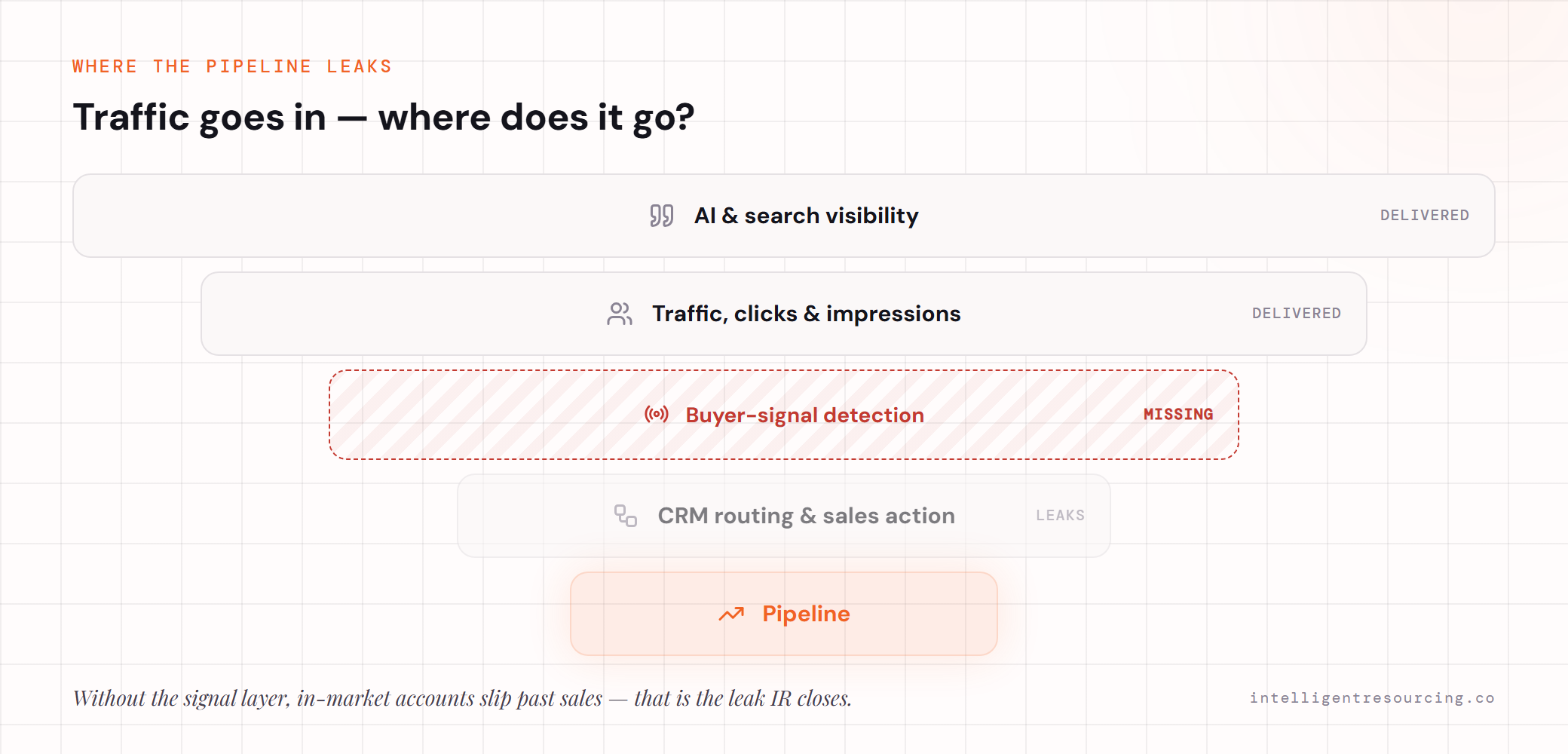
For most teams, the trigger is usually a lead quality complaint: campaigns run, rankings improve, paid activity continues, yet sales cannot see which accounts are actively evaluating. Public Covert Digital review data is limited. Clutch lists 1 review, a 4.5 rating, and positive feedback around adaptability, project management, qualified leads, and brand authority.
Because the public complaint pattern is thin, the fair comparison is a fit issue rather than a product failure. The gap appears when a B2B team needs account-level signal intelligence, not only campaign reporting. Covert Digital publicly positions itself as an end-to-end digital marketing agency across SEO, paid media, strategy, content, development, AEO, and HubSpot CRM.
This results in a clear switching moment: a business receives activity reports but still cannot tell which accounts visited pricing pages, compared vendors, or re-entered the buying journey. Every month outreach runs on a fixed cadence while buyers move through an undetected window is a month where sales effort is spent on timing the system chose, not timing the buyer signalled.
Covert Digital still suits businesses that need managed digital execution. The alternatives below are each evaluated against these limitations.
What To Look For In A Covert Digital Alternative
Live buying signal detection
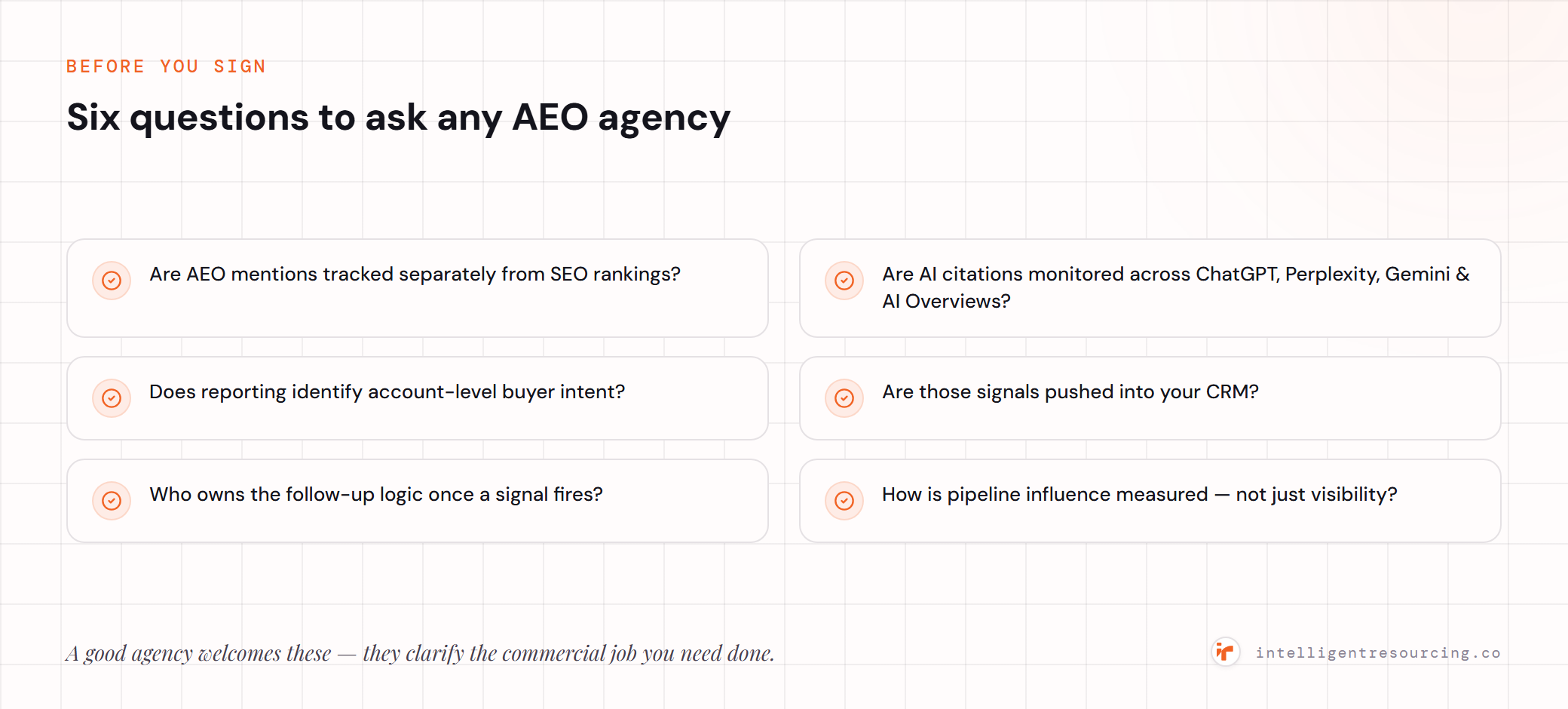
Weight this criterion most heavily when your primary frustration is lead quality. Ask whether the agency tracks buying signals: pricing page visits, demo requests, repeat company visits, funding events, hiring signals, and job change triggers. Covert Digital's public pages discuss customer behaviour, campaign data, AEO, HubSpot, paid media, and SEO, but they do not publicly position live account-level buying signal detection as the central service model.
AEO and AI search capability
Weight this criterion heavily when your buyers research vendors through ChatGPT, Gemini, Perplexity, and Google AI answers. Ask whether the agency measures prompt-level visibility, weighted Share of Voice, and source inclusion by model. Covert Digital does publicly offer AEO and describes it as upgrading SEO pages for AI search, which makes it relevant for visibility-led buyers.
Pipeline accountability
Weight this criterion heavily when leadership asks why traffic and rankings are not turning into qualified opportunities. Reporting should connect activity to CRM outcomes, not stop at sessions, clicks, and ranking movement. Because most B2B shortlists form before any vendor contact, the right alternative should explain which accounts entered buying windows and what sales action followed, since a model that cannot answer that is optimising for activity that arrives after the buyer has already decided.
Infrastructure model: built-and-run capability versus outsourced activity
Weight this criterion heavily when a lasting capability matters more than near-term activity. Ask whether the partner builds and runs the system inside your CRM, enrichment tools, and sequencing stack as an ongoing managed capability. A retained agency manages campaigns for as long as the retainer continues, while a system-led partner builds routing logic, lead scoring, data workflows, and activation rules inside your stack and keeps running and improving them, so the capability compounds rather than resetting each month.
Engagement model fit
Weight this when budget predictability is a constraint. Retainers work when the scope is ongoing. Projects work when the outcome is contained. Embedded or studio models work when sales, marketing, and RevOps must operate from one shared signal layer.
If your primary frustration is lead quality and buying signal detection, weight criteria 1 and 3 most heavily. If it is AI search visibility, prioritise criterion 2. If a built-and-run system matters most, prioritise criterion 4.
Quick Comparison Table
The best Covert Digital alternative depends on the failure mode you need to fix. The table compares each option by fit, operating model, and the way it connects digital activity to pipeline outcomes.
| Alternative | Best For | Core Approach | Engagement Model | Starting From |
|---|---|---|---|---|
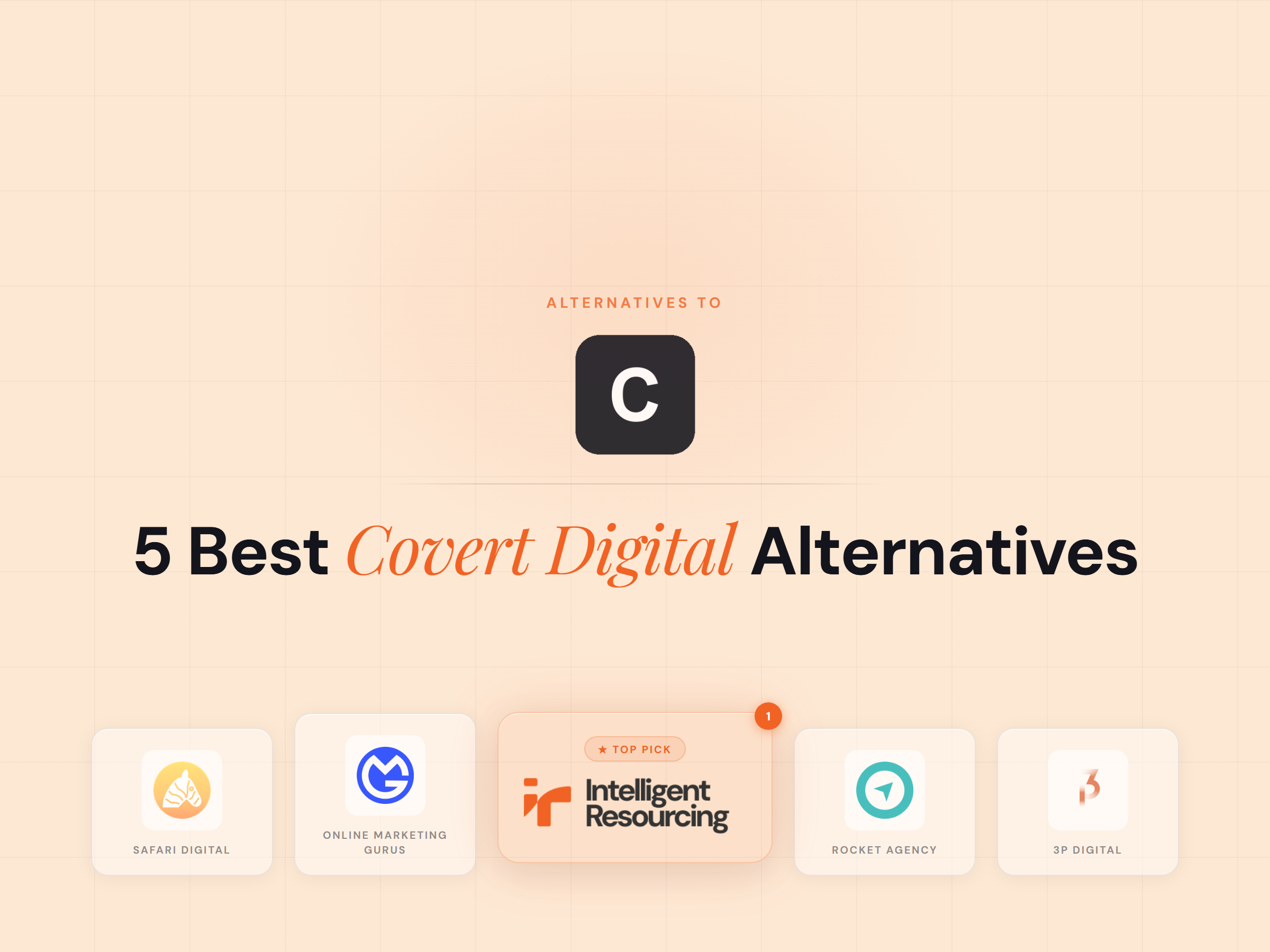
| Intelligent Resourcing | B2B teams that need live buying signal detection, CRM routing, and AI Source Inclusion built into 1 system | Revenue Operations Studio: builds and runs signal-led infrastructure, Clay enrichment, HubSpot routing, SmartLead outbound, and GEO content | Ongoing managed signal-led capability | Custom, contact for quote |
| Safari Digital | Teams that want specialist SEO and organic visibility from a dedicated search agency | Specialist SEO agency focused on technical SEO, content strategy, authority, and organic growth | Monthly SEO retainer | Published SEO pricing generally A$1,400 to A$5,000+ per month |
| Online Marketing Gurus | Teams that want a larger digital agency with SEO, GEO, AEO, paid media, and analytics capability | AI-first SEO, GEO, AEO, paid media, analytics, and content programmes | Monthly agency retainer | Clutch reports typical monthly pricing from A$3,000 to A$8,000 |
| Rocket Agency | Businesses that need full-service campaign execution across several channels | SEO, Gen AI SEO, PPC, paid social, creative, CRO, email, and digital strategy | Managed agency retainer | Custom, contact for quote |
| 3P Digital | Businesses that want performance-based pricing tied to channel outcomes | Performance SEO, paid media, CRO, automation, content, and pay-for-performance commercial model | Performance-based engagement and custom proposal | Custom performance proposal; fees tied to agreed outcomes |
The 5 Best Covert Digital Alternatives
This list was compiled from agency public positioning pages, review profiles, pricing pages, and verified client outcomes. Each alternative was evaluated against the 5 criteria above. Engagement models and pricing were verified as of May 2026. The list covers agencies operating in the Australian B2B market.
1. Intelligent Resourcing
Category: Revenue Operations Studio
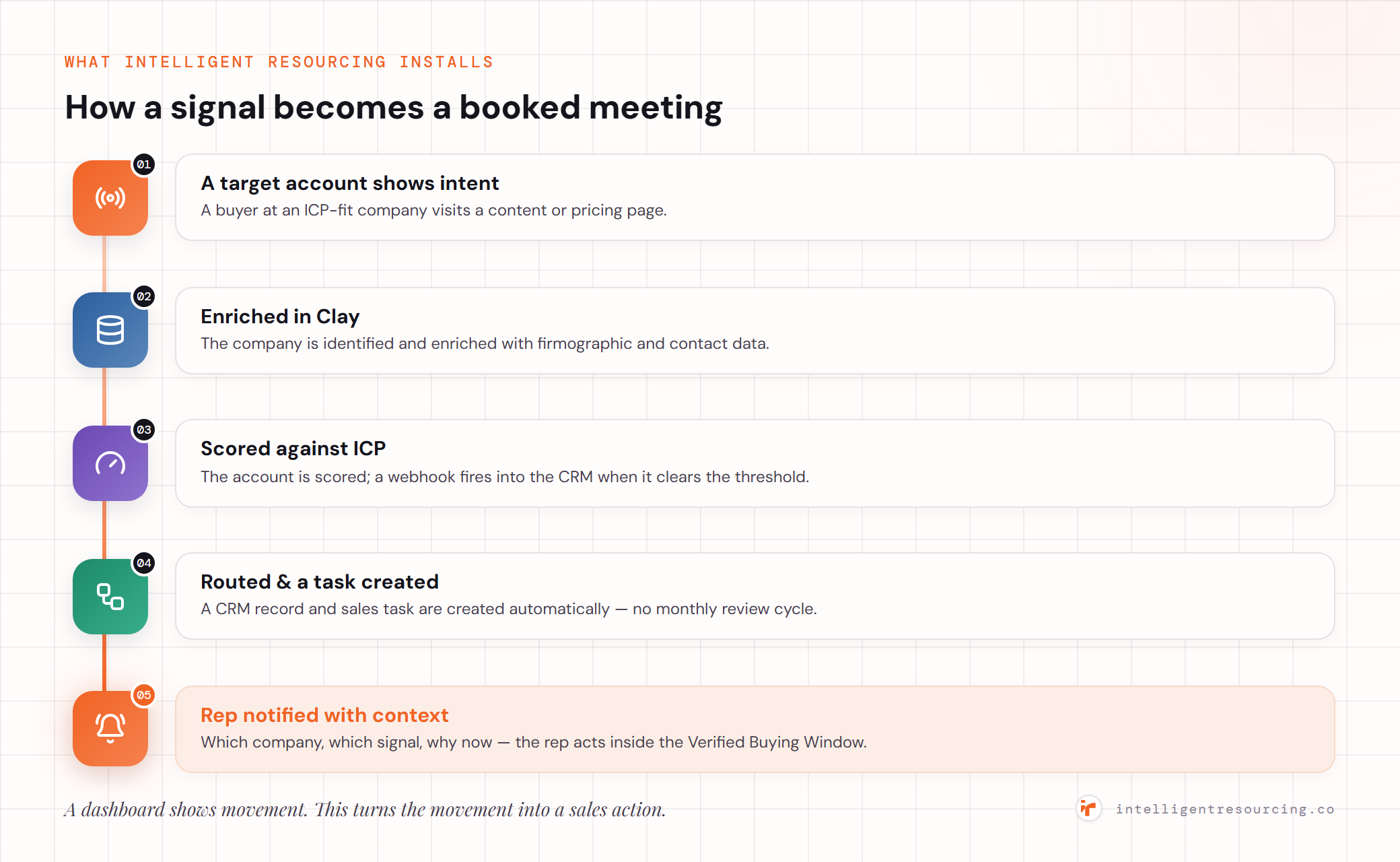
Intelligent Resourcing installs a signal intelligence layer that detects which monitored accounts are showing live buying intent: pricing page visits, demo requests, repeat company visits, and routes them to the right rep before the buying window closes.
Intelligent Resourcing operates as a Revenue Operations Studio, which means GTM engineering, signal-led pipeline, and AI Source Inclusion sit inside 1 operating system. Its signal-led lead generation approach connects Clay enrichment, HubSpot routing, SmartLead outbound, and AI Source Inclusion so that B2B teams act inside a Verified Buying Window. Clay enrichment identifies accounts, which means data quality improves before outreach starts. HubSpot routing moves qualified accounts to the right owner, so that sales does not wait for manual triage. SmartLead outbound activates timed sequences, which means outreach follows intent. Real-time lead scoring identifies the Verified Buying Window, so that sales action matches buying behaviour.
When a monitored account visits the pricing page for the 3rd time in a week, the lead score updates immediately and routes the account to the right rep before the session ends, which means outreach arrives at the moment of intent, not on a fixed campaign schedule.
Best for
- B2B Sales Leaders and RevOps leads at A$5M to A$50M Australian businesses with longer sales cycles and multiple decision-makers.
- Teams that generate search traffic and run campaigns but cannot explain the pipeline quality problem to their CEO.
- Businesses that want a signal-led system built and run inside their CRM as an ongoing capability, not outsourced activity that stops when the retainer ends.
- Companies ready to act on buying signals at the moment of intent rather than on a campaign schedule.
Limitation
Intelligent Resourcing is not the right fit for businesses whose primary goal is broad campaign management, paid social execution, or brand awareness without an operational infrastructure layer. The model requires more setup upfront than a managed campaign agency, and the teams most resistant to that investment are usually the ones whose pipeline problem has been running longest without a structural fix.
Switcher proof
Kynection, a B2B software company in the Australian market, recorded an 86% Share of Voice lift, 21.2% market dominance, 7 competitors overtaken, and a A$100k qualified lead from AI search during November to December 2025.
Transition note
Transitioning to Intelligent Resourcing from a campaign-first agency involves a system setup phase. Clay, HubSpot, and SmartLead are configured and connected during onboarding. Context transfer is handled through an intake process. Expect 2 to 4 weeks of setup before the signal layer is live.
2. Safari Digital
Category: SEO Agency
Safari Digital is a search-specialist agency rather than an end-to-end digital marketing agency, which means the offer centres on SEO and organic visibility rather than channel management across paid media, CRM, creative, and web.
Safari Digital positions itself as a specialist Australian SEO agency, and its own site frames the pitch directly at teams tired of generalist digital marketing agencies trying to do it all. It covers B2B SEO, ecommerce, enterprise, SaaS and local SEO, with technical SEO, content strategy and authority building as the core focus. Its published SEO pricing generally ranges from A$1,400 to A$5,000+ per month, which gives switching teams a clear commercial starting point rather than a vague audit.
Safari Digital is a strong Covert Digital alternative for teams that believe their pipeline issue begins higher in the funnel: poor discoverability, weak organic visibility, or limited search presence. It is less suited to teams whose core problem is CRM routing, signal scoring, and sales timing.
Best for
- Businesses that want a specialist SEO agency rather than a full-service digital marketing partner.
- Teams that need technical SEO, content strategy, and authority building.
- Marketing leaders who want a search-first roadmap before expanding into paid or RevOps systems.
- Companies that already have internal sales operations and only need search demand improved.
Limitation
Safari Digital is not the right fit when the primary issue is live account signal detection, outbound routing, or CRM-based qualification. Its strength is organic search visibility, not signal-led revenue infrastructure.
Switcher proof
Safari Digital publishes client outcomes from more than 200 SEO campaigns, including a 218% increase in organic traffic over 12 months for Australian PC retailer BPC Tech.
Transition note
Transitioning to Safari Digital is fastest when the departing agency provides keyword data, analytics access, search history, technical fixes, content inventory, and backlink data. Expect the audit and roadmap to form first, with execution ramping across the next 30 to 60 days.
3. Online Marketing Gurus
Category: Digital Marketing and AI Search Agency
Online Marketing Gurus pairs a larger agency delivery model with AI-first SEO, GEO, AEO, and model-level AI search reporting, which means buyers seeking scale get broader internal capacity and more channel coverage.
Online Marketing Gurus positions its AI search service around SEO, GEO, and AEO, which means the agency addresses both traditional search and AI-assisted discovery. Its public pages describe technical integrations, schema, entity building, AI-first content, and measurement across ChatGPT, Gemini, and Perplexity, so that brands can assess visibility across different answer engines rather than treating AI search as 1 channel.
For a B2B team leaving Covert Digital because the search and AI discovery motion lacks scale, Online Marketing Gurus is a credible alternative. Its model suits companies that want analytics, paid media, SEO, and AI visibility under a larger agency structure. It is less aligned with buyers who want a signal-led sales-routing system built and run inside Clay, HubSpot, SmartLead, and internal RevOps workflows.
Best for
- Mid-market companies that want SEO, GEO, AEO, paid media, and analytics from 1 larger agency.
- Marketing teams that need AI search visibility across ChatGPT, Gemini, and Perplexity.
- Businesses that value agency scale, reporting systems, and cross-channel delivery.
- Teams that need search and paid media support more than signal-led sales activation.
Limitation
Online Marketing Gurus is not the strongest fit when the main problem is a built-and-run buyer-signal system. Its public positioning focuses on digital visibility, AI search, paid media, analytics, and growth marketing rather than account-level Verified Buying Window routing.
Switcher proof
Online Marketing Gurus publishes client results including a 40% organic traffic lift and 402% organic revenue growth for Sheridan, plus a 190% traffic lift and 300% conversions increase for a secure cloud storage provider.
Transition note
Transitioning to Online Marketing Gurus works best when existing analytics, paid media data, keyword history, landing pages, content performance, and conversion data are available. Its AI search audit process gives the initial diagnostic step, which means the first month should focus on data access, baseline reporting, and channel plan alignment.
4. Rocket Agency
Category: Full-Service Digital Marketing Agency
Rocket Agency is strongest when the buyer wants a full-service campaign partner with deep channel breadth, which means one agency can manage SEO, Gen AI SEO, PPC, paid social, creative, CRO, email, and digital strategy.
Rocket Agency positions itself as a full-service digital marketing agency, which means it is built for brands that need coordinated campaign execution rather than a narrow specialist. Its service mix covers SEO, Gen AI SEO, search ads, display, YouTube, programmatic, paid social, creative, CRO, and email, so that marketing teams can consolidate channel activity under 1 agency. Its public materials also state that it avoids vanity metrics, which means reporting aims to connect performance to commercial goals.
Rocket is a strong fit when the buyer should not choose Intelligent Resourcing. If the problem is campaign output, creative testing, paid channel management, or cross-channel execution, Rocket's model is more aligned. If the problem is live buying signal detection and signal-led CRM routing, the fit changes.
Best for
- Businesses that need one agency across SEO, PPC, paid social, CRO, creative, and email.
- Marketing teams that want campaign execution rather than RevOps system buildout.
- Brands that need cross-channel testing, reporting, and optimisation.
- Companies with existing CRM and sales processes that only need stronger demand generation output.
Limitation
Rocket Agency is not the right fit when the core requirement is a signal intelligence layer across Clay, HubSpot, SmartLead, and lead scoring logic. Its strength is managed multi-channel marketing, not account-level buying-window routing.
Transition note
Rocket's onboarding is clearest when existing campaign data, landing pages, paid account access, audience lists, conversion definitions, and creative assets are transferred early. Its Noggin case study describes a discovery workshop, competitor analysis, Google Ads audit, keyword research, and a shift from lead quantity to lead quality, which gives a practical model for handover.
5. 3P Digital
Category: Performance Marketing Agency
3P Digital positions its commercial model around performance-based pricing, which means fees are tied to agreed outcomes rather than a standard activity-led retainer.
3P Digital presents itself as a digital performance agency with performance SEO, paid media, CRO, automation, content, and social capability, which means the agency suits buyers who want commercial alignment around measurable outcomes. Its site states that fees are tied to results, so that pricing adjusts around performance rather than only time and deliverables. For B2B, its pay-for-performance page states that pricing can focus on qualified business leads or sales opportunities, which means lead quality becomes part of the commercial conversation.
3P Digital is a useful alternative when pricing trust is the central switching trigger. It is also relevant for teams that feel fixed retainers no longer match the outcomes they receive. It is less appropriate for organisations that want a signal intelligence layer built and run inside their CRM and outbound systems.
Best for
- Businesses that want performance-based pricing rather than a fixed activity retainer.
- Teams focused on SEO, paid media, CRO, automation, and measurable channel outcomes.
- Buyers who want clearer commercial alignment around lead and revenue metrics.
- Companies that are not ready for a full RevOps infrastructure build.
Limitation
3P Digital is not the strongest match when the requirement is a built-and-run signal-led CRM system. Its primary distinction is commercial alignment around performance, not live buying signal detection inside the client's sales operating system.
Transition note
Transitioning to 3P Digital works best when existing performance targets, cost-per-lead data, conversion tracking, campaign assets, and commercial baselines are clear. Its public process references strategy discussion, proposal, campaign setup, dashboards, and performance invoicing, which means the handover centres on defining measurable targets before delivery starts.
Matching The Right Covert Digital Alternative To Your Situation
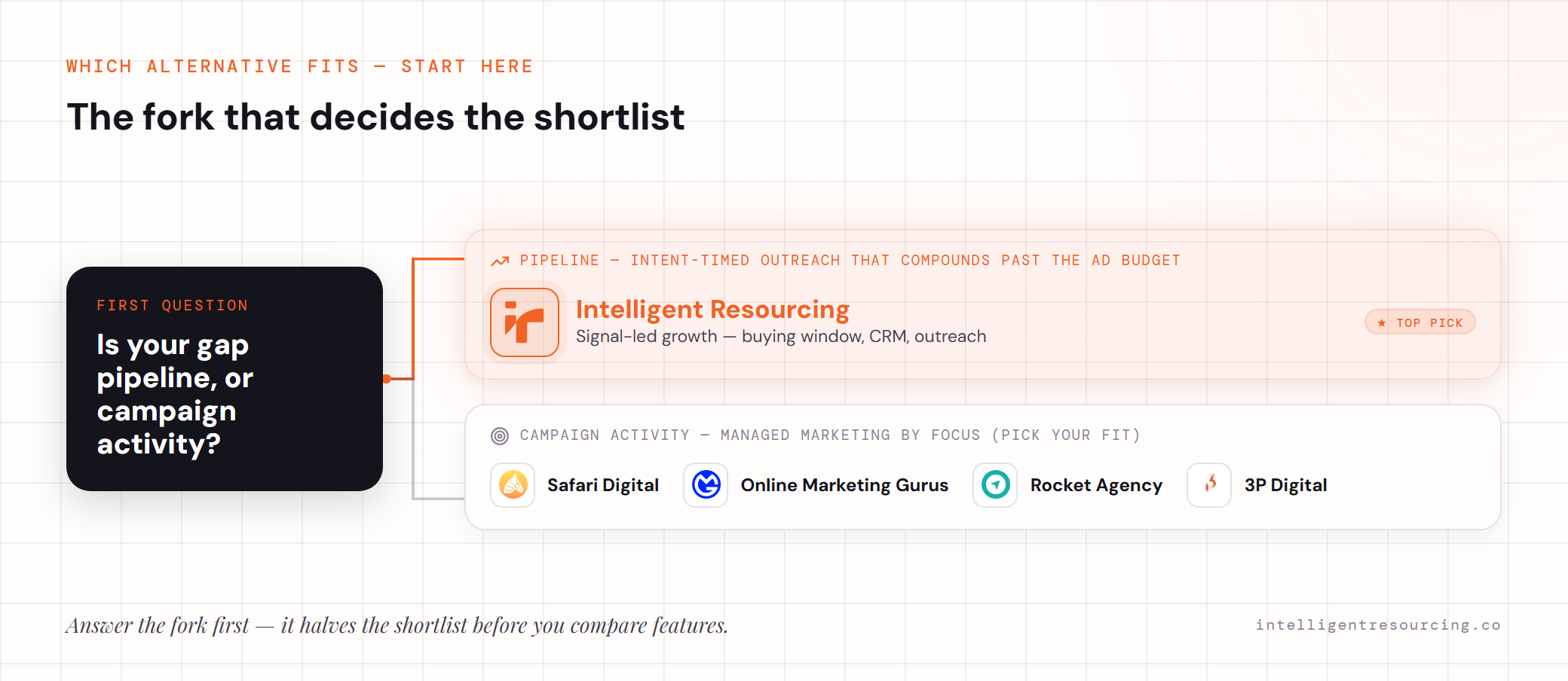
If Your Problem Is Lead Quality and Buying Signal Detection
Choose Intelligent Resourcing. Because the problem sits between marketing activity and sales timing, the fix requires signal detection, lead scoring, CRM routing, and outbound activation. A campaign agency improves activity. A Revenue Operations Studio connects intent to action.
If Your Problem Is Search Rankings and Organic Visibility
Choose Safari Digital or Online Marketing Gurus. Safari Digital fits specialist SEO work. Online Marketing Gurus fits larger search, GEO, AEO, paid media, and analytics programmes. This results in stronger visibility before the buyer enters a sales conversation.
If Your Problem Is AEO and AI Search Citation
Choose Intelligent Resourcing if AI visibility must convert into sales action. Choose Online Marketing Gurus if AI search visibility is the primary goal and your internal sales system already handles routing, scoring, and follow-up.
If You Have Already Decided to Leave Covert Digital
Choose Rocket Agency for the smoothest full-service campaign handover when existing paid, creative, SEO, and email assets are clean. Choose Intelligent Resourcing when the next move is not another campaign retainer, but a system that rebuilds signal detection and CRM routing from the ground up.
If your team is generating traffic and running campaigns but the pipeline your sales team receives is thin or poorly timed, book a 30-minute session to see the signal-led model in practice.
What Does Transitioning Away From Covert Digital Look Like?
Transitioning away from Covert Digital starts with context transfer. The new partner needs campaign history, keyword data, audience lists, landing pages, paid account access, CRM configuration, reporting definitions, ICP data, messaging, and sales feedback. Anything missing gets rebuilt during onboarding.
A campaign-first agency transition usually starts with audit and continuity. Safari Digital's onboarding gives a search visibility starting point. Rocket's public case process describes discovery workshops, competitor analysis, ads audits, and keyword research. 3P Digital starts with a strategy discussion, proposal, setup, dashboard, and performance target structure. Intelligent Resourcing starts with intake, signal mapping, Clay enrichment, HubSpot routing, SmartLead outbound, and scoring logic.
For most B2B teams transitioning from a campaign-first agency to a signal-led model, the setup phase is 2 to 4 weeks, with the first intent-triggered outreach typically live within 30 days.
For a direct head-to-head breakdown, read Covert Digital vs Intelligent Resourcing.
Comparisons
If your team is generating traffic and running campaigns but the pipeline your sales team receives is thin or poorly timed, book a 30-minute session to see the signal-led model in practice.