
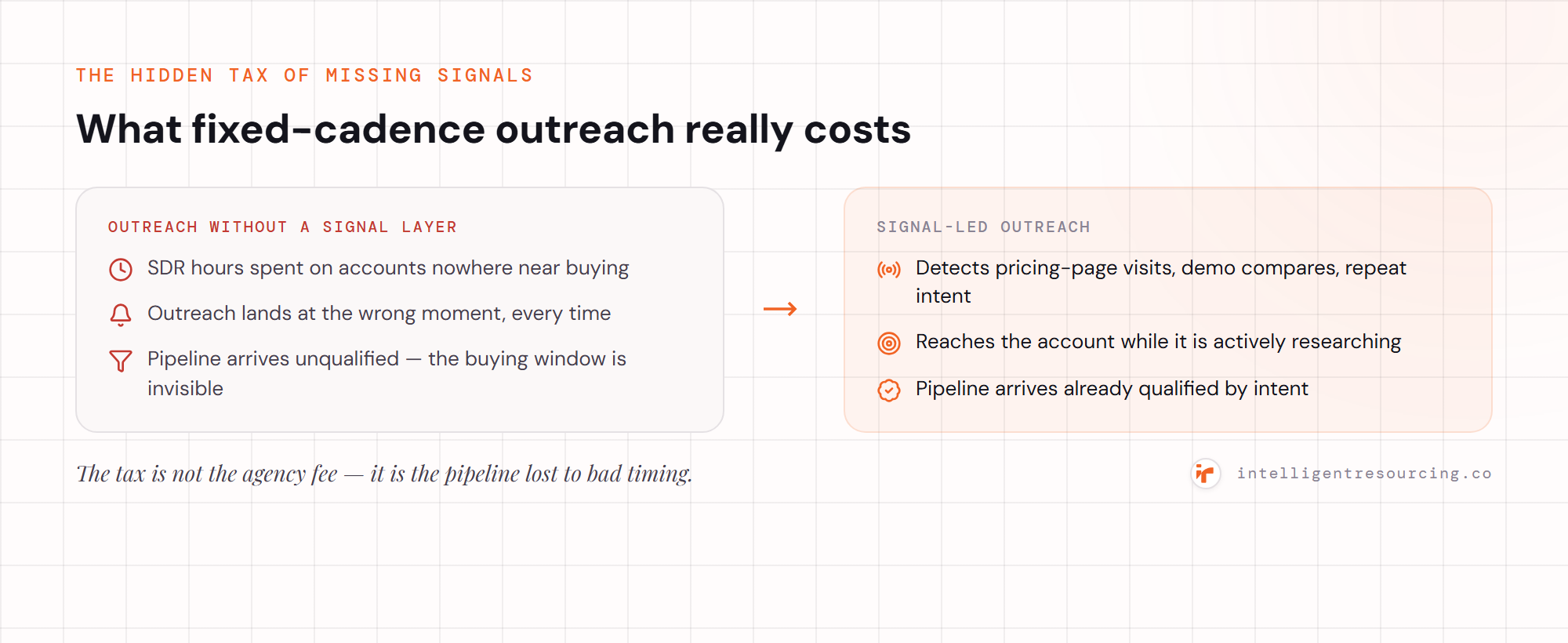
The villain is not Covert Digital, it is the hidden tax B2B businesses pay when campaigns run without a signal intelligence layer. It appears as SDR hours spent on accounts that were never close to buying, outreach sent at the wrong moment, and pipeline that arrives unqualified, and most teams absorb that cost for months before connecting it to the model rather than the effort.
Because activity is visible, reports show sessions, rankings, campaign metrics, and paid performance. The frustration starts when the connection to qualified pipeline stays weak, not because the campaigns are underperforming, but because the model reporting on them was never designed to produce that connection. Outreach goes to every ICP account on the same cadence, regardless of whether that account is inside a buying window. The cause is missed timing. The agency cannot tell the business which accounts visited the pricing page, requested a demo comparison, or showed repeat intent signals.
Most B2B deals go to a vendor that was already on the buyer's shortlist, and buyers build that shortlist before they ever contact a vendor. If your signal layer cannot detect when an account is researching, shortlisting, or showing commercial intent, the window is not occasionally missed, it is structurally invisible to everyone running outreach on a fixed cadence.
Covert Digital has clear strengths in managed digital marketing. Its public pages position it as an end-to-end agency across SEO, paid media, strategy, content, development, AEO, and HubSpot CRM. It suits businesses that want campaign execution from one external team. The inflection point usually arrives after a competitor closes the account the team was warming, at which point the timing problem becomes visible in a way that a campaign report never made clear.
Choosing between Covert Digital and Intelligent Resourcing is a choice between campaign execution and signal-led infrastructure. Covert Digital supports managed digital marketing activity from a single agency. Intelligent Resourcing builds and runs a system that identifies accounts in a buying window and acts before a competitor does.
What To Look For In An AEO and Signal-Led Growth Agency
Ask whether the agency tracks buying signals or only campaign engagement metrics. Pricing page visits, demo requests, repeat company visits, funding events, and leadership changes matter because B2B sales cycles are long and timing changes conversion quality. Before signing, ask: "Which account-level buying signals do you track, and how do they change sales action?"
Ask whether the agency has genuine AEO capability. AEO is not just a blog rewrite. It includes prompt tracking, AI citation reporting, weighted Share of Voice, and model-level visibility across ChatGPT, Gemini, Perplexity, and Google AI Overviews. AI tools are now absorbing a growing share of the queries that once went to traditional search, which means AI visibility is no longer optional for B2B brands. Before signing, ask: "How do you measure AI visibility beyond rankings and traffic?"
Ask whether outreach is timed to buying windows. A campaign cadence sends messages on a schedule the agency controls, which means outreach arrives regardless of whether the buyer is inside a window or months away from one, and the cost of that mismatch accumulates in every sequence that runs without a signal behind it. Before signing, ask: "What event causes an account to enter a sales sequence?"
Ask whether the agency builds and runs the system inside your CRM. Long-cycle B2B teams need a capability that keeps running and improving rather than activity that disappears when a retainer ends, because otherwise the pipeline dependency restarts every time an agency relationship changes. Before signing, ask: "Will the workflows, enrichment logic, lead scoring rules, and CRM routing be built and run inside our stack as an ongoing capability?"
Ask whether pricing scales with signal volume and system depth. More channels do not automatically mean more value. Before signing, ask: "Are we paying for activity, or are we paying for a system that improves qualification over time?"
Comparison Table
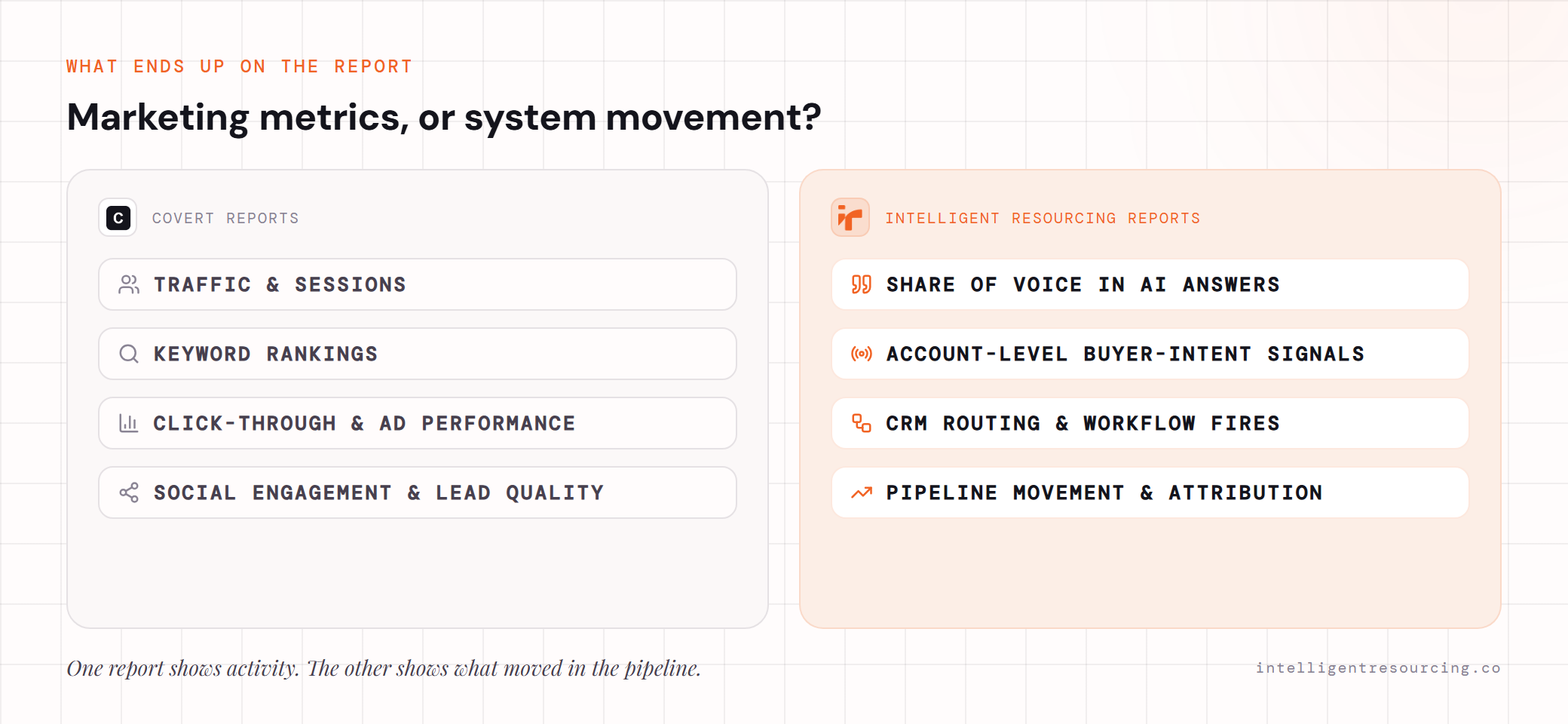
This comparison focuses on model fit, not a universal winner. Covert Digital and Intelligent Resourcing solve different problems for different stages of growth. Pricing and features verified as of May 2026.
| Category | Intelligent Resourcing | Covert Digital | Key Difference |
|---|---|---|---|
| Primary Focus | Revenue Operations Studio: signal-led pipeline, GTM Engineering, AEO, AI Source Inclusion, and signal-led revenue systems it builds and runs. | Digital marketing, SEO, paid media, strategy, content, development, AEO, and HubSpot CRM. Covert Digital describes itself as an end-to-end digital marketing agency. | Covert Digital manages channel activity. Intelligent Resourcing builds and runs the system that acts on buying intent. |
| Signal Intelligence | Buyer signal detection: pricing page visits, demo requests, repeat company visits, funding events, job change triggers, and real-time lead scoring. | Not listed as a core service offering in the same way as account-level buyer signal detection. Covert Digital's paid media page references customer behaviour, campaign data, and qualified audiences. | Intelligent Resourcing identifies which accounts are in an active buying window. Covert Digital's public pages do not confirm whether buyer signals route to intent-triggered CRM workflows. |
| AEO / AI Search | Answer Engineering, GEO, AI Source Inclusion across ChatGPT, Gemini, Perplexity, and Google AI Overviews. | Covert Digital publicly offers AEO and describes it as upgrading SEO pages for AI search, using clean structure, direct answers, schema, and AI citation readiness. | Both address AI search. Intelligent Resourcing connects AI visibility to signal-led revenue action. |
| CRM Infrastructure | Clay enrichment, HubSpot routing, SmartLead outbound and n8n orchestration, with workflows built and run inside the client's stack as an ongoing capability. | Covert Digital publicly offers HubSpot CRM services, onboarding packages, dashboards, custom properties, pipelines, sales and marketing training, and HubSpot add-ons. | Covert Digital supports HubSpot implementation. Intelligent Resourcing builds and runs the broader signal-to-outreach system. |
| Pricing Model | Intelligent Resourcing publishes GTM Engineering plans, including a one-time Strategy Blueprint Intensive and monthly Signal Starter and Fractional GTM Engineer plans. | Covert Digital lists HubSpot onboarding packages from A$2,400 per month over 3 months, A$3,600 per month over 3 months, and A$6,066 per month over 3 months, plus some POA add-ons. A general digital marketing or AEO public rate card was not found. | Covert Digital publishes HubSpot onboarding prices, not a general channel rate card. Intelligent Resourcing publishes system-led GTM pricing. |
| Best For | B2B teams with longer sales cycles that need a system connecting buying signals to outreach timing and CRM qualification. | Businesses that want a small, specialist digital marketing team across SEO, PPC, content, web development, HubSpot, and campaign reporting. | Covert Digital wins on managed digital execution across channels. Intelligent Resourcing wins on signal-led revenue system design. |
Closer Look: Covert Digital
Strengths
Covert Digital is strongest when a business wants managed digital marketing across several channels. Its public site lists SEO, paid media, strategy, content, development, AEO, HubSpot CRM, and Umbraco CMS services. Public information describes SEO strategy, content marketing, paid advertising, social media marketing, website design and development, UX/UI, and data analytics. That makes Covert Digital a credible fit for businesses that need a compact external team to handle digital execution, reporting, and campaign movement without building a RevOps system internally.
Limitations
Covert Digital is not built primarily for buyer-signal routing across the full revenue system. Its public pages discuss customer behaviour, data analysis, AEO, paid media, SEO, and HubSpot implementation, but they do not publicly list a core offer for account-level buying signal detection, Verified Buying Window logic, or Clay-to-HubSpot-to-SmartLead routing. That matters when the sales problem is not traffic, but timing.
Who Should Use Covert Digital
Use Covert Digital if your business needs broad campaign management, SEO, paid media, content, website support, and HubSpot assistance from one agency. It is a stronger fit for teams that value execution capacity, digital visibility, and a single partner across multiple marketing channels.
Closer Look: Intelligent Resourcing
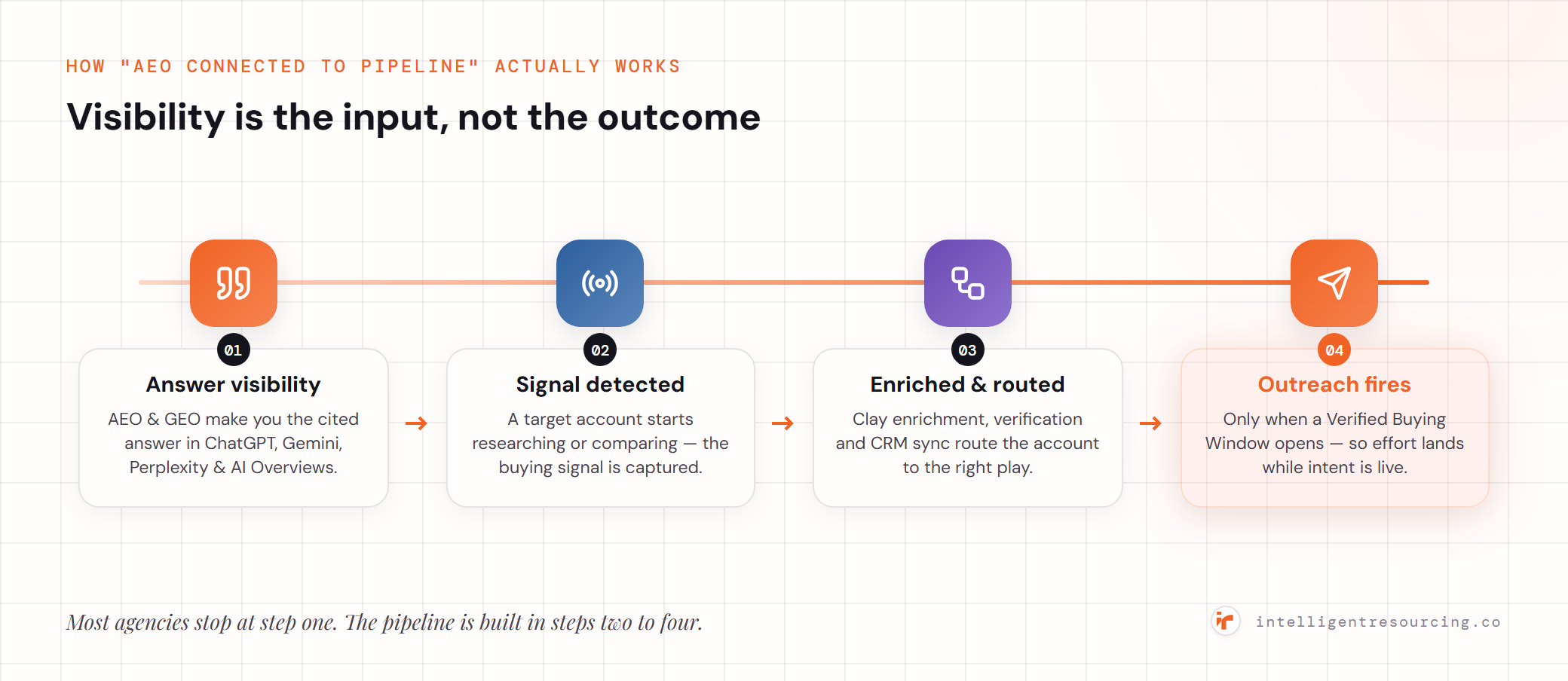
Intelligent Resourcing is not the right fit for businesses whose primary goal is broad campaign management, paid social execution, or awareness-first marketing. It is a Revenue Operations Studio that builds and runs the signal layer that identifies which accounts are in a Verified Buying Window and routes them before a competitor closes first. That prevents the hidden tax of outreach sent at the wrong time, to the wrong accounts, at the wrong stage of the buying cycle.
Strengths
Intelligent Resourcing builds GTM Engineering systems, which means campaign activity connects to sales action instead of stopping at reports. It uses Signal-Led Growth, which means pricing page visits, repeat company visits, funding events, and job changes can trigger qualification. Its AI Source Inclusion work structures content for AI answers, so that buyers find the brand when they compare options. Clay, HubSpot, and SmartLead infrastructure supports real-time lead scoring, so that sales teams act on Verified Buying Window accounts first.
Limitations
Intelligent Resourcing requires deeper setup than a managed campaign agency. It is not suited for businesses whose main goal is broad awareness, high-volume media buying, or outsourced social execution. The upfront operating complexity is higher because the work touches CRM logic, enrichment rules, workflow triggers, lead scoring, outbound routing, and internal operating discipline. That discipline is valuable only when the buyer wants the system, not just the service.
Who Should Use Intelligent Resourcing
Intelligent Resourcing fits a B2B Sales Leader or RevOps lead at a A$5M to A$50M Australian business generating traffic and running campaigns but receiving thin, unqualified, or poorly timed pipeline. The Kynection proof point is clear: an 86% Share of Voice lift, 21.2% market dominance, and a A$100k qualified lead from AI search.
Pricing, Scalability and Support
How Each Option Charges You
Covert Digital publishes pricing for HubSpot onboarding packages and add-ons, including A$2,400 per month, A$3,600 per month, and A$6,066 per month over 3 months, plus POA add-ons. A general public rate card for its wider digital marketing or AEO services was not found. Intelligent Resourcing publishes GTM Engineering pricing with a one-time Strategy Blueprint Intensive and monthly signal-led plans.
Scalability
Covert Digital scales through team capacity, channel expansion, HubSpot implementation, paid media, SEO, content, and web development. Intelligent Resourcing scales as a managed capability: the Clay, HubSpot, SmartLead, and n8n system grows in value as more signals are tracked and more automations are built, and Intelligent Resourcing keeps building and running it inside the client's stack over time.
Onboarding and Support
Covert Digital's HubSpot page describes setup, migration, automation, process implementation, staff training, dashboards, custom properties, and pipeline configuration. Intelligent Resourcing is setup-intensive upfront across Clay, HubSpot, SmartLead, and n8n. Once live, it produces cleaner handoffs, less waste, and outreach timed to genuine buying windows rather than campaign cadences.
Which Should You Choose?
When Covert Digital Is the Better Fit
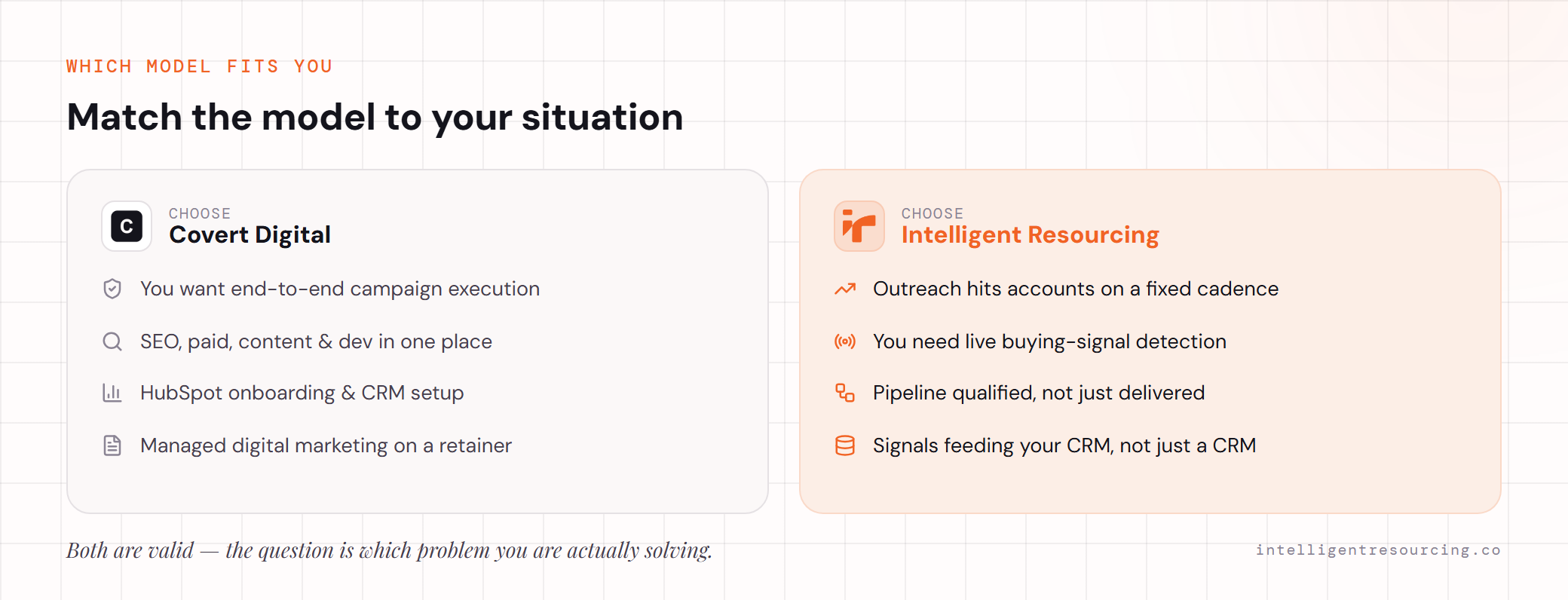
Choose Covert Digital when your business needs broad digital campaign management across SEO, paid media, content, website development, and CRM support. It is also the better fit when you are at an earlier awareness stage, need stronger visibility before deep pipeline architecture, or want one agency to take channel execution off your internal team.
When Intelligent Resourcing Is the Stronger Choice
Choose Intelligent Resourcing when the pipeline problem is not visibility, but quality and timing. It is stronger when campaigns already run, yet sales receive thin or poorly qualified opportunities. It is also stronger when your team wants a signal-led CRM system built and run for you, real-time signal routing, AI Source Inclusion, and outreach that fires when the buyer enters a Verified Buying Window.
Cost of Inaction: Every month a B2B team runs campaigns without a signal intelligence layer is a month of outreach sent to accounts outside a buying window. The cost is wasted SDR hours, competitors closing accounts you were warming, and a pipeline that never qualifies.
Closing
Covert Digital is the right choice for managed digital activity. Intelligent Resourcing is the stronger fit when the hidden tax comes from missed buying signals, late outreach, and weak handoffs between marketing and sales. Because the wrong model compounds quietly, the real risk is not choosing an agency, but continuing with one that produces activity the sales team cannot act on, while the accounts that were close to buying move through a window the system was never built to see.
B2B teams that continue running campaigns without a signal intelligence layer find the same pipeline problem 12 months later: more activity, same opportunity quality. If Intelligent Resourcing's model fits your situation, book a 30-minute session.
Comparisons
B2B teams that continue running campaigns without a signal intelligence layer find the same pipeline problem 12 months later: more activity, same opportunity quality. If Intelligent Resourcing's model fits your situation, book a 30-minute session.