
What makes a tool one of the best B2B lead generation tools in 2026?
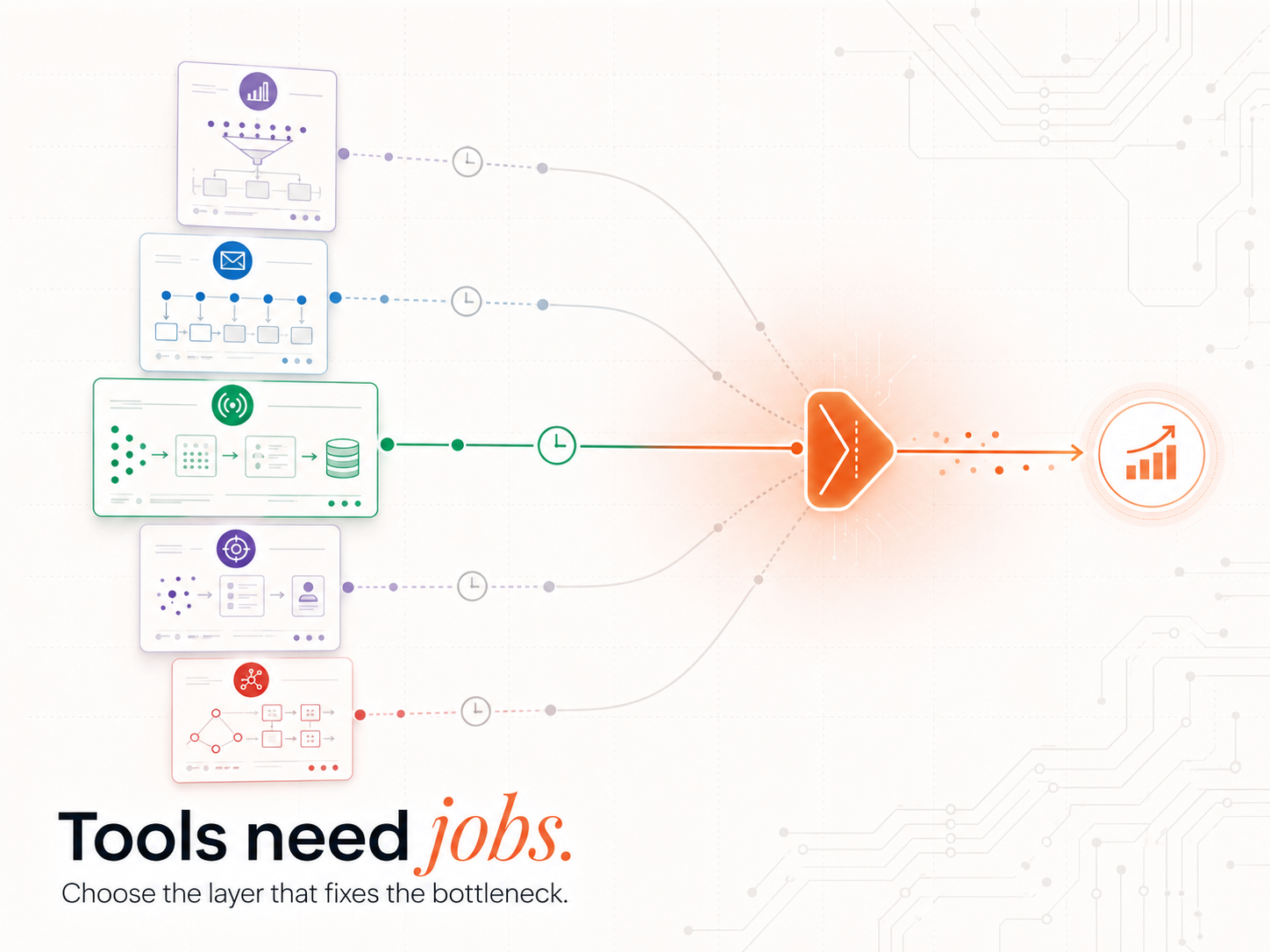
The best B2B lead generation tools in 2026 are the ones that own a clearly defined job and connect cleanly to the rest of the stack. A tool earns its place by doing one thing reliably (data, identification, CRM, sending, or orchestration) and exposing an API so a signal can flow through it. Feature overlap is not valued. Connection is.
What Do the 11 Best B2B Lead Generation Tools Cost in 2026?
Prices below are in USD, the currency these tools bill in, with an approximate AUD figure in brackets. Conversions were calculated in June 2026 at roughly US$1 = A$1.5; exchange rates move, so treat the AUD figures as indicative.
| Tool | Best for | 2026 update | Entry price (as of May 2026) |
|---|---|---|---|
| Clay | Signal-led prospecting | Claygent AI agents; 150+ data sources | From US$167/mo (~A$250/mo) |
| n8n | Custom workflow automation | Raised a US$180M Series C, NVIDIA-backed | Free self-hosted; paid cloud |
| Apollo | Outbound prospecting | New end-to-end GTM AI Assistant | From US$49/user/mo (~A$74/user/mo) |
| ZoomInfo | Enterprise sales teams | Launched Copilot Workspace AI agents | Custom quote |
| HubSpot | CRM-led growth teams | Breeze AI with 15+ agents | Free CRM; paid from ~US$15/seat/mo (~A$23/seat/mo) |
| Cognism | Compliance-focused teams | Launched Sales Companion + Cortex AI | Custom quote |
| LinkedIn Sales Navigator | Relationship-led selling | Added Account IQ and Relationship Map | Core plan, locale-priced (~US$99/mo, about A$149/mo) |
| Leadfeeder | Website-led demand gen | Reverting to the Leadfeeder brand (Mar 2026) | Free Lite; paid from US$99/mo (~A$149/mo) |
| Zapier | Simple lead routing | Zapier Agents reached general availability | Free; paid from US$19.99/mo (~A$30/mo) |
| Smartlead | Cold email infrastructure | Unified Master Inbox + SmartDelivery | From US$39/mo (~A$59/mo) |
| PhantomBuster | Public-web signal capture | 2025 plan refresh adds AI credits | From US$69/mo (~A$104/mo) |
Which tool does what? A breakdown of the 2026 stack
Each tool below owns a specific job, with its 2026 update and entry price noted.
Clay: the intelligence layer
Clay is the enrichment and research layer. It pulls from 150+ data providers and runs Claygent AI research agents to add company size, job titles, tech stack, and intent before anything reaches your CRM. Clay is where the "why now" reason for outreach is assembled.
n8n: the orchestration layer
n8n connects the tools, applies business rules, and routes data between systems. It raised a US$180M Series C in October 2025 (NVIDIA-backed), accelerating its move into AI-agent orchestration. Best for technical and RevOps users who want control.
Apollo: outbound prospecting in one platform
Apollo combines a verified contact database, prospect scoring, and outreach. In 2025 it launched an end-to-end GTM AI Assistant and reported 500% year-on-year platform growth. Best for outbound-heavy teams wanting one tool.
ZoomInfo: enterprise intelligence
ZoomInfo provides deep account intelligence, firmographics, technographics, and buyer intent. In October 2025 it launched Copilot Workspace, an AI execution engine with agents. Best for enterprise teams with the budget for full coverage.
HubSpot: the CRM-led growth hub
HubSpot funnels lead capture, lifecycle, and automation into one CRM. Its Breeze AI layer now spans 15+ agents across marketing, sales, and service. Best for teams that want the CRM as the centre of gravity.
Cognism: compliance-first data
Cognism is the compliance-led data choice for EMEA and regulated markets, with notified-database and do-not-call screening. In March 2025 it launched Sales Companion powered by Cortex AI. Best for teams where data compliance is a buying criterion.
LinkedIn Sales Navigator: relationship-led selling
LinkedIn Sales Navigator offers advanced search, intent filters, and InMail. New AI features Account IQ and Relationship Map arrived in 2025. Best for relationship-led and account-based selling.
Leadfeeder: visitor identification
Leadfeeder turns anonymous website traffic into named company data. Note for 2026: the company is unifying back under the Leadfeeder brand, retiring the Dealfront product name from 24 March 2026. Best for website-led demand generation.
Zapier: simple lead routing
Zapier routes leads between thousands of apps with rule-based logic. In 2025 Zapier Agents reached general availability, adding autonomous AI orchestration. Best for fast, no-code routing where n8n would be overkill.
Smartlead: cold email infrastructure
Smartlead is the sending layer: unlimited mailboxes, automated warm-up, and a unified Master Inbox with the SmartDelivery deliverability stack. Best for high-volume cold email where deliverability is the constraint.
PhantomBuster: public-web signal capture
PhantomBuster automates LinkedIn and public-web data capture ("Phantoms"), with a 2025 plan refresh adding AI credits for enrichment and personalisation. Best for lightweight, public-web signal collection.
A note on Drift
We have removed Drift from this year's list. In March 2026, Clari + Salesloft announced the gradual sunset of Drift, referring existing customers to partner 1mind. A tool being wound down does not belong in a 2026 best-tools list.
Which tool fits which use case?
The right tool depends on the job, not the budget. A team with a deliverability problem needs Smartlead. A team with a data coverage problem needs Clay or a waterfall enrichment stack. A team with disconnected tools needs n8n.
| Use case | Recommended tool | Why |
|---|---|---|
| Signal-led generation | Clay | Enrichment, AI research, and 150+ providers in one layer |
| Database prospecting | Apollo | Verified contacts, scoring, and outreach in one platform |
| Enterprise intelligence | ZoomInfo | Deep account data and buying signals at scale |
| CRM-led growth | HubSpot | Connects lead capture and automation to the CRM |
| Compliance and data quality | Cognism | Compliant, notified data for regulated markets |
| Social selling | LinkedIn Sales Navigator | Account research, intent filters, and outreach |
| Visitor identification | Leadfeeder | Turns anonymous traffic into first-party company data |
| Workflow logic | n8n or Zapier | n8n for technical control, Zapier for speed |
| Cold email scale | Smartlead | Mailbox infrastructure, warm-up, deliverability |
Why does a connected system beat a bigger tool stack?
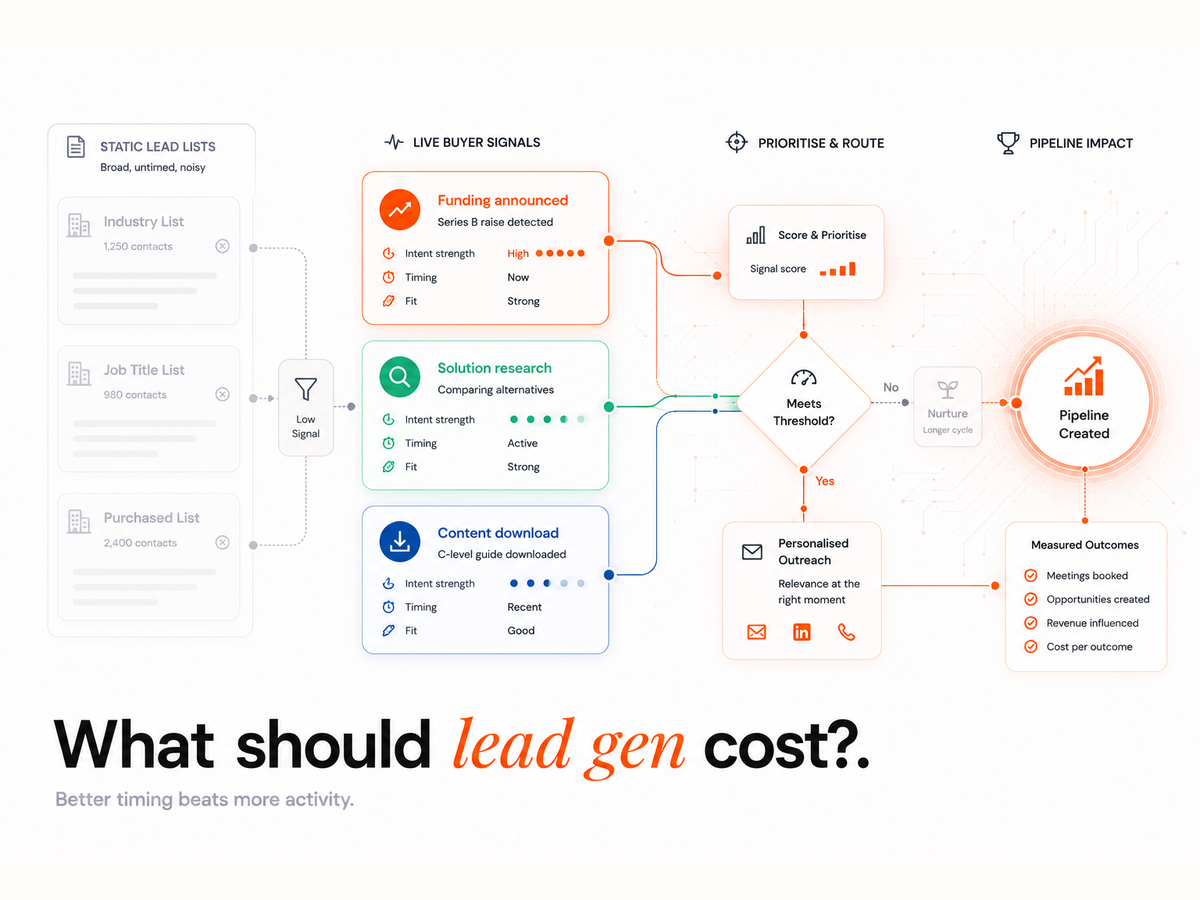
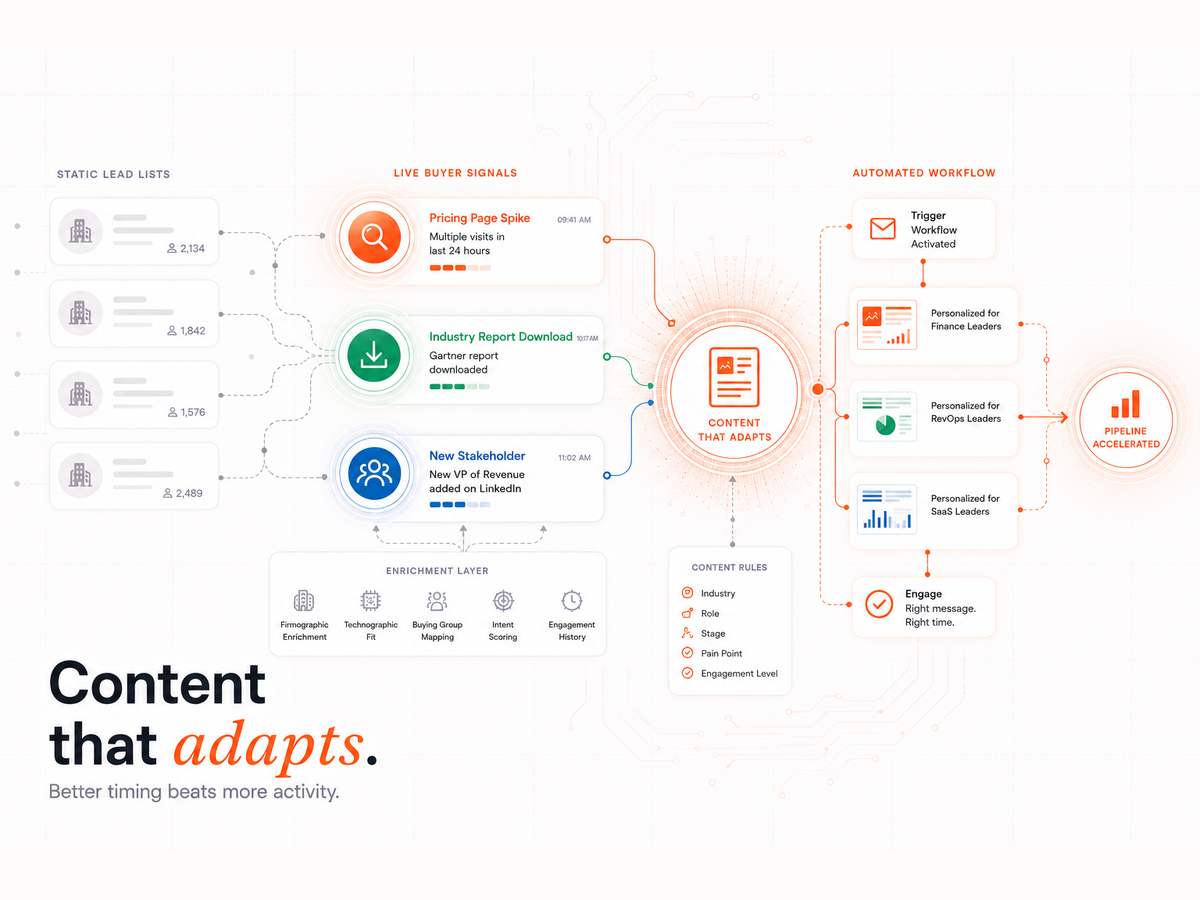
A tool stack is a list of subscriptions. A system is those tools connected by logic so a signal becomes a pipeline. Data tools give you records, a CRM gives you structure, outreach tools give you execution, but only orchestration turns a buying signal into the right next action automatically. With 90% of B2B teams using or adopting intent data, the differentiator in 2026 is no longer access to signals, it is acting on them fast.
Why Does a Clay + n8n Combination Outperform a Bigger Tool Stack?
| Layer | Tool | The job |
|---|---|---|
| Intelligence | Clay | Signal and enrichment. Turns raw data into a "why now" reason to reach out |
| Orchestration | n8n | Logic and routing. Applies business rules and fires the next step automatically |
This pairing is the backbone of a Revenue Operations Studio build: Clay assembles the signal, n8n routes it, and the Verified Buying Window decides who gets contacted this week. See how this runs end to end in automated B2B lead generation with Clay and n8n.
Lead Generation
The tools above are the parts. The pipeline comes from wiring them together. The Revenue Operations Studio at Intelligent Resourcing connects data, CRM, and outreach around the Verified Buying Window, so your stack produces qualified pipeline instead of disconnected records.
FAQs
What is signal-based lead generation?
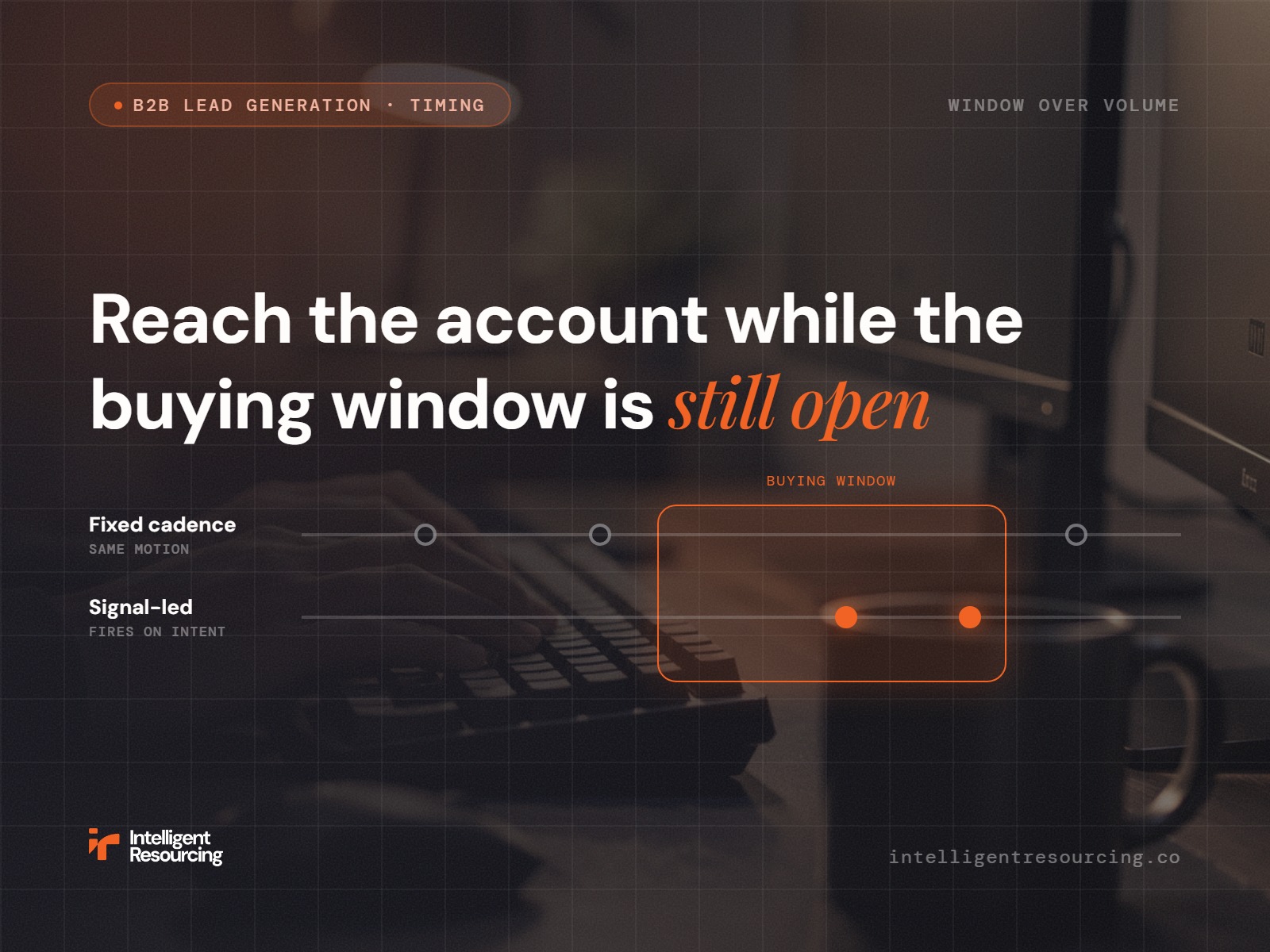
Signal-based lead generation prioritises timing over static lists. Instead of working a fixed list, you reach out when a buying window opens: a leadership hire, a funding round, a tech-stack change, or repeat visits to a pricing page. Timing is the signal that a contact is worth contacting now.
Why is an ICP not enough on its own?
An ICP tells you who fits, but not when they are ready. A company can match your ICP perfectly and have zero intent to buy this quarter. Signals add the timing layer that an ICP cannot, which is what turns a good-fit account into an active opportunity.
What are examples of useful buying signals?
Leadership hires, team expansion, funding announcements, tech-stack changes, repeat visits to commercial pages, CRM reactivation, and multi-stakeholder engagement from one account. The strongest signals combine fit and intent within a defined window.
What is the difference between a tool stack and a signal-based system?
A tool stack is a set of subscriptions that each do one thing. A signal-based system connects those tools with logic so a detected signal automatically triggers enrichment, scoring, routing, and outreach. The stack is the parts; the system is the wiring.
Why is Clay plus n8n a strong combination?
Clay is the intelligence layer that enriches data and assembles the reason to reach out. n8n is the orchestration layer that applies rules and routes the lead to the right next step. Together they cover the two jobs most stacks leave disconnected.
Should we build this in-house or buy help?
Build in-house for control if you have technical RevOps capacity. Buy help for speed if you do not. Many teams run a hybrid: an external Revenue Operations Studio installs the system, then the in-house team operates it.