
Why does traditional B2B lead generation stop scaling?
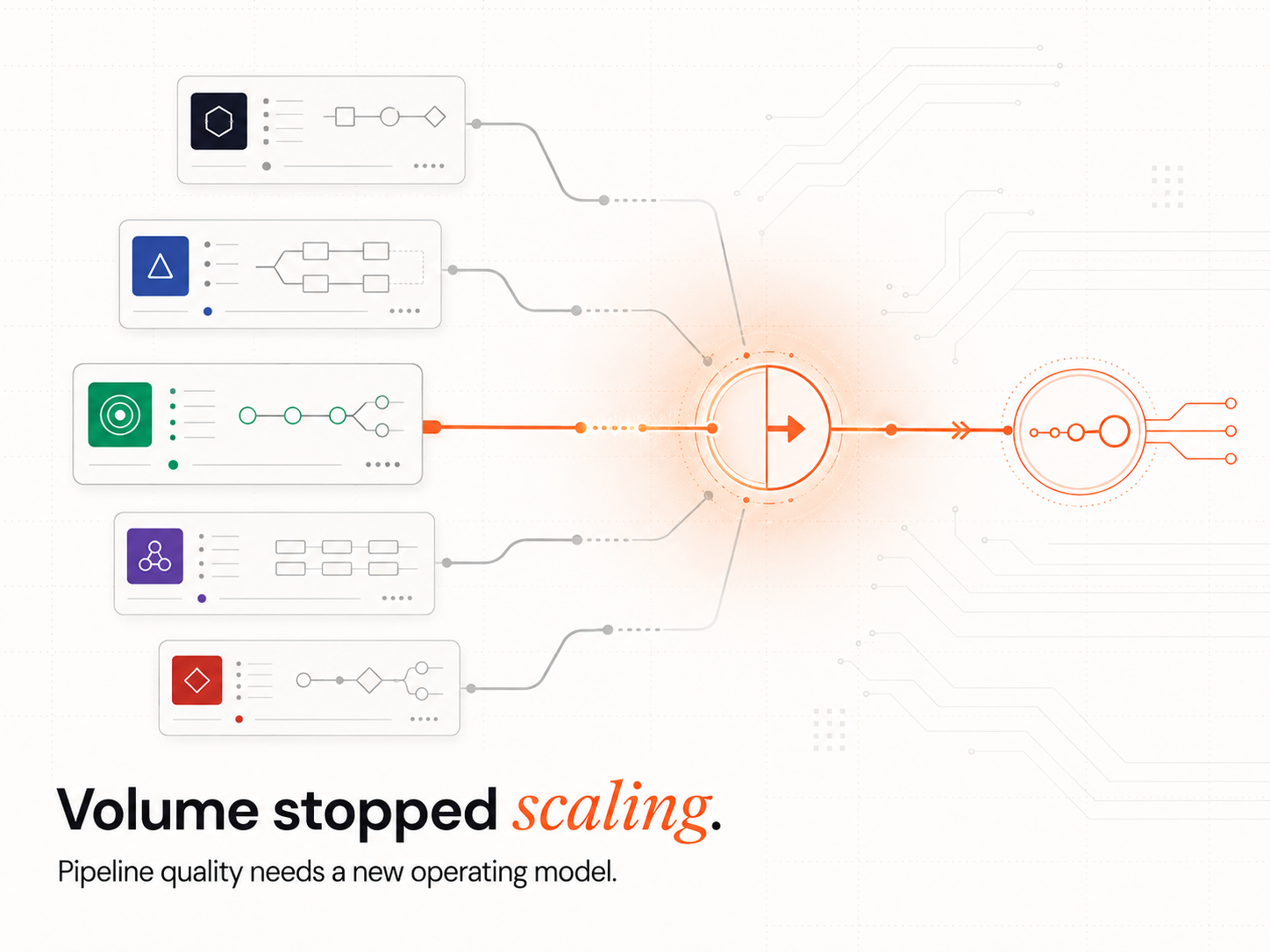
Traditional lead generation was built for a world where a static list plus high send volume reliably produced meetings. Four structural constraints now break that model at scale: rising acquisition cost, activity metrics that drift from revenue, accelerating data decay, and declining outreach engagement as inboxes saturate.
When CAC rises without conversion improvement
Benchmarkit's 2024 SaaS metrics study, drawing on approximately 1,000 private B2B SaaS companies, recorded the median blended CAC ratio rising from $1.32 in 2022 to $1.61 in 2023, a 22% increase.
CAC is the total sales and marketing spend required to acquire one new customer. When efficiency drops at any stage (open rates, reply rates, meeting rates, close rates), teams compensate by increasing activity: more emails, more ad spend, more SDRs, and more accounts in sequence.
This stabilises pipeline short-term but raises total spend. If growth depends on constantly increasing volume to offset declining conversion rates, the model is not scaling. It is getting more expensive to produce the same results.
When activity metrics replace revenue metrics
When teams optimise for what is easy to count, emails sent, meetings booked, MQLs created, they stop measuring what drives revenue. The real signal of lead quality is downstream conversion: the percentage of marketing-qualified leads that become sales-qualified opportunities. That single metric reveals whether targeting is working.
When MQL to SQL conversion is low, it signals a structural issue:
- Leads were generated based on volume, not timing
- Qualification criteria are too broad
- ICP definitions are outdated
- Signals of readiness were not considered
Increasing activity shows the inefficiency. More emails and more meetings fill calendars without improving pipeline quality or win-rate contribution.
When data decay undermines ICP targeting
B2B data decay statistics consistently show approximately 22.5% of contact records go stale each year, roughly 2.1% per month. "Perfect lists" go stale mid-quarter. ICP definitions become outdated. Outreach targets people who have moved roles, changed priorities, or were never in-market.
Messaging alone does not drive scale. Accurate data and precise timing do. Without signal-based enrichment and verification, every campaign runs on a degrading foundation.
When cold outreach saturates without relevance
Salesforce's 2026 State of Sales found 73% of B2B buyers actively avoid sellers who send irrelevant outreach. Higher send volume does not reverse that avoidance. It reinforces it.
Belkins' analysis of 16.5 million B2B emails found cold email reply rates averaged 5.8% in 2024, a 15% year-on-year drop from 6.8% in 2023. The causes are structural:
- Inbox saturation: More outreach floods buyers' attention, reducing response
- Generic personalisation: Shallow tokens no longer differentiate messages
- Buyer behaviour shifts: Prospects self-educate and engage later, bypassing early outreach
- Volume without relevance: High sequence counts create noise, not meetings
What is the scalable alternative to traditional lead generation?
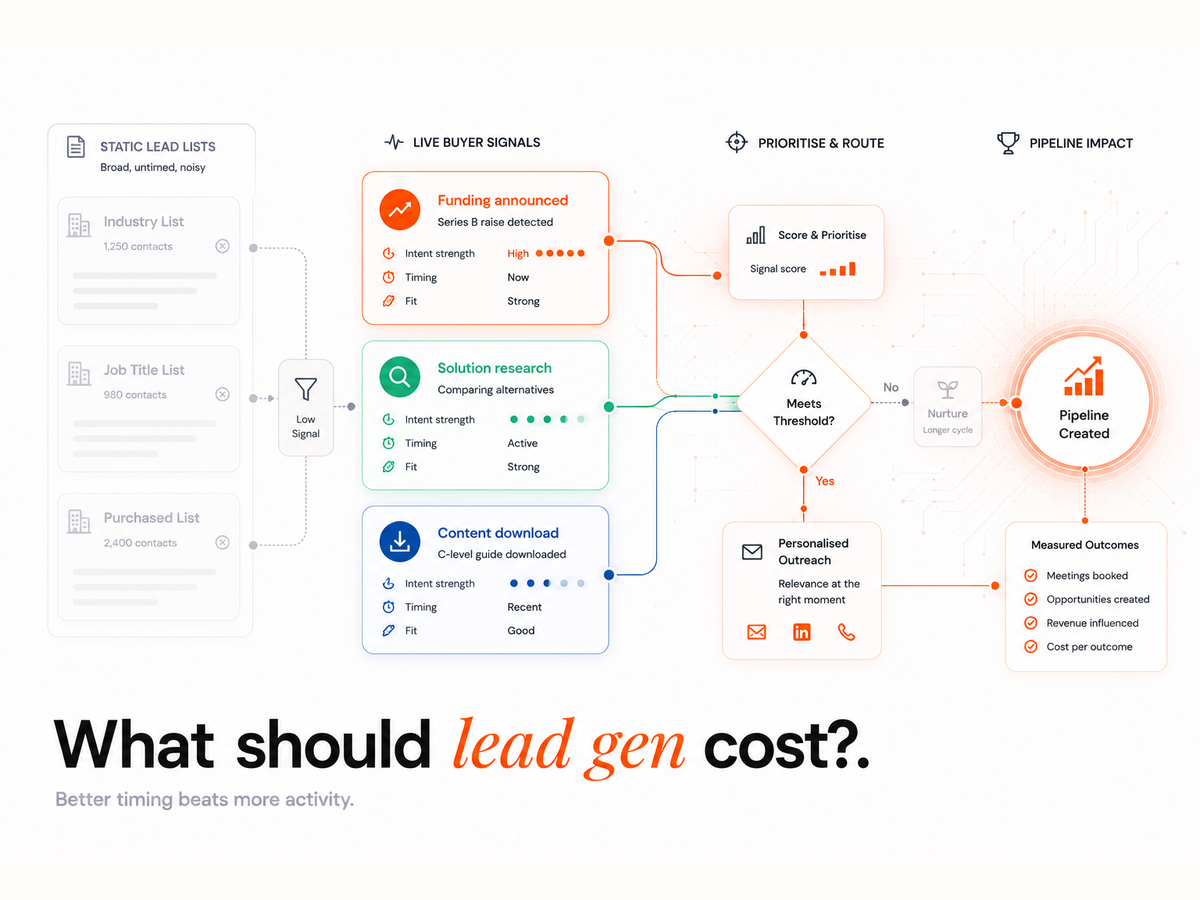
The scalable alternative is not a better agency or a higher-volume tool. It is a different operating model built to answer a different question: not "how do we generate more leads?" but "how do we detect when a specific account is ready to engage?" That shift defines signal-based lead generation.
If you are comparing lead generation services, you might be searching for a better supplier of leads. The deeper alternative is to stop buying outputs and start building an engine that identifies when specific accounts are ready.
Signal-led growth flips the core question:
- Not: "How do we generate more leads?"
- But: "How do we detect readiness and activate the right play at the right time?"
The modern replacement for the classic lead gen agency is not a more polished agency. It is a different operating model: a Revenue Operations Studio that installs a permanent system behind your pipeline.
A studio model runs on:
- Systems and workflows over campaigns
- Making channels work together rather than running them separately
- Feedback loops over fixed deliverables
- Shared definitions across marketing, sales, and success
For a side-by-side comparison of providers in this space, see top lead gen companies in Australia.
How do signal-led systems connect demand creation to demand capture?
Ehrenberg-Bass research shows only 5% of any total addressable market is actively buying at any given moment. The remaining 95% are building preferences before they enter a purchase cycle. Signal-led growth bridges both phases: demand creation builds familiarity with the 95%, demand capture detects the moment individual accounts enter the 5%.
Demand capture converts the small slice already in-market.
Demand creation builds preference so that when the market turns, you are the default.
Signal-led growth connects them:
- Creation generates attention and familiarity across the 95% not yet in-market
- Capture detects readiness and routes the right next action for the 5% actively buying
Jen Allen-Knuth puts it directly: "The motivation of a salesperson is to close a deal; the motivation of a customer is to solve a problem." Signals anchor outreach to the customer's problem-solving moment rather than the salesperson's quarterly target.
Katelyn Bourgoin adds the operational frame: "every purchase begins with a trigger event." Signal-led prospecting is the practice of detecting those trigger events at scale across your total addressable market.
What are the building blocks of signal-led prospecting?
Signal-led prospecting is not intent data plus a sequence. It is a four-component architecture: signal type classification, trigger event identification, Verified Buying Window prioritisation, and Evergreen CRM hygiene. Each component feeds the next. A failure in data hygiene undermines every signal identified in the first three components.
1. Signal types that predict readiness
Think in four categories, then look for stacking:
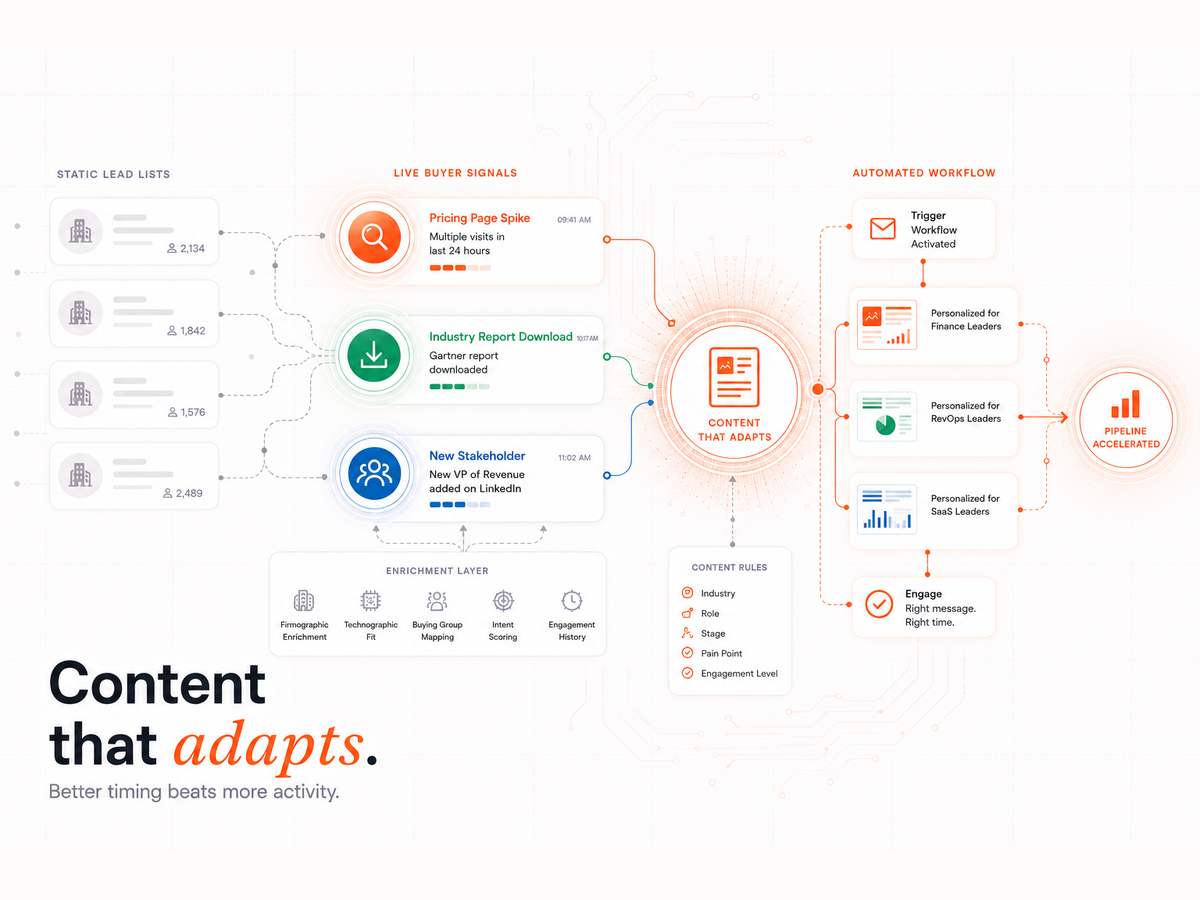
- Behavioural signals: repeated content consumption, return visits, high-intent page paths
- Contextual signals: hiring, expansion, funding, new leadership, strategic pivots
- Technographic signals: tool adoption, migrations, integrations, stack changes
- Engagement signals: multi-threaded replies, meeting acceptance, stakeholder involvement
A single signal is weak. Three aligned signals at the same account in the same week is a high-priority opportunity.
2. Trigger events as the starting point
Signal-led prospecting starts with the trigger event: the contextual or behavioural change that indicates an account is moving closer to a buying decision. The value is not in the signal itself. It is in the pattern and the timing.
The trigger event connects your outreach to the account's problem-solving moment. When executed correctly, it surfaces accounts that are actively evaluating options, not just loosely fitting an ICP filter.
3. Verified Buying Windows over permanent targeting
Most outbound fails because it assumes "good fit" equals "good timing." The scalable alternative is to prioritise accounts when evidence confirms they are inside a Verified Buying Window. Signal-led teams reduce volume, increase relevance, and convert more conversations into qualified pipeline.
4. Evergreen CRM as the foundation
If your CRM holds decayed contacts and outdated accounts, your entire revenue system runs on bad inputs. Data hygiene is not a RevOps nice-to-have. It is the foundation that determines whether signals can be trusted. For an overview of how GTM engineering installs this foundation systematically, that guide covers the full operational architecture.
How do you implement signal-led growth without rebuilding your stack?
The most common barrier to signal-led growth is the assumption that it requires a complete replatform. It does not. A 30-day signal audit of existing data (product usage, site paths, role changes, email engagement) identifies the triggers that already correlate with pipeline before any new tool is purchased.
Step 1: Run a 30-day signal audit
Track what you already have: product usage, site paths, role changes, hiring, technographic changes, email engagement. Decide what correlates with pipeline, not what feels interesting.
Step 2: Build a signal taxonomy
Create three tiers:
- Aware: early exploration signals
- Active: multiple aligned signals
- In-market: pricing, comparison, and evaluation behaviour
Step 3: Set activation thresholds
Define "ready" as a pattern, not a single event. This prevents automation errors and ensures outreach is relevant and accurately targeted at the right accounts at the right moment.
Step 4: Create two plays
Start small:
- One play for "Active" accounts
- One play for "In-market" accounts
Step 5: Install a weekly learning loop
Every week, ask:
- Which signals correlated with meetings that progressed?
- Which signals produced noise?
- What to tighten, remove, or add?
That cadence turns a tactic into a system. For the commercial framework that supports this build, see the B2B lead generation pricing guide.
Lead Generation
The scalable alternative is an operating model, not a louder agency. Intelligent Resourcing installs signal-led growth as a Revenue Operations Studio, so timing, fit, and intent decide who you contact and when.
FAQs
Is intent data enough to build a signal-led system on its own?
Not alone. Intent is most useful when combined with first-party behaviour, contextual triggers, and a clear activation rule. Without those layers, intent data produces false positives and outreach that arrives at the wrong account or the wrong moment.
How do I know if my outbound is revenue-aligned?
If your primary success metrics are activity and meetings booked, it is not revenue-aligned. Revenue-aligned outbound is measured by pipeline quality, velocity, progression through deal stages, and win-rate contribution. Activity metrics are inputs, not outcomes.
How do we identify the right signals to act on?
Signals are behavioural or contextual events that indicate an account is moving closer to a buying decision. Examples include website activity, content engagement, technographic changes, hiring patterns, and funding events. The reliable approach is to track patterns across multiple signals over time rather than acting on a single event.
Can signal-led growth work with a limited data set?
Yes. Even small data sets generate meaningful signals when you focus on the right behavioural or contextual events. The foundation is consistency: choosing which signals to track, reviewing what correlates with meetings each week, and updating the taxonomy as engagement data grows.