
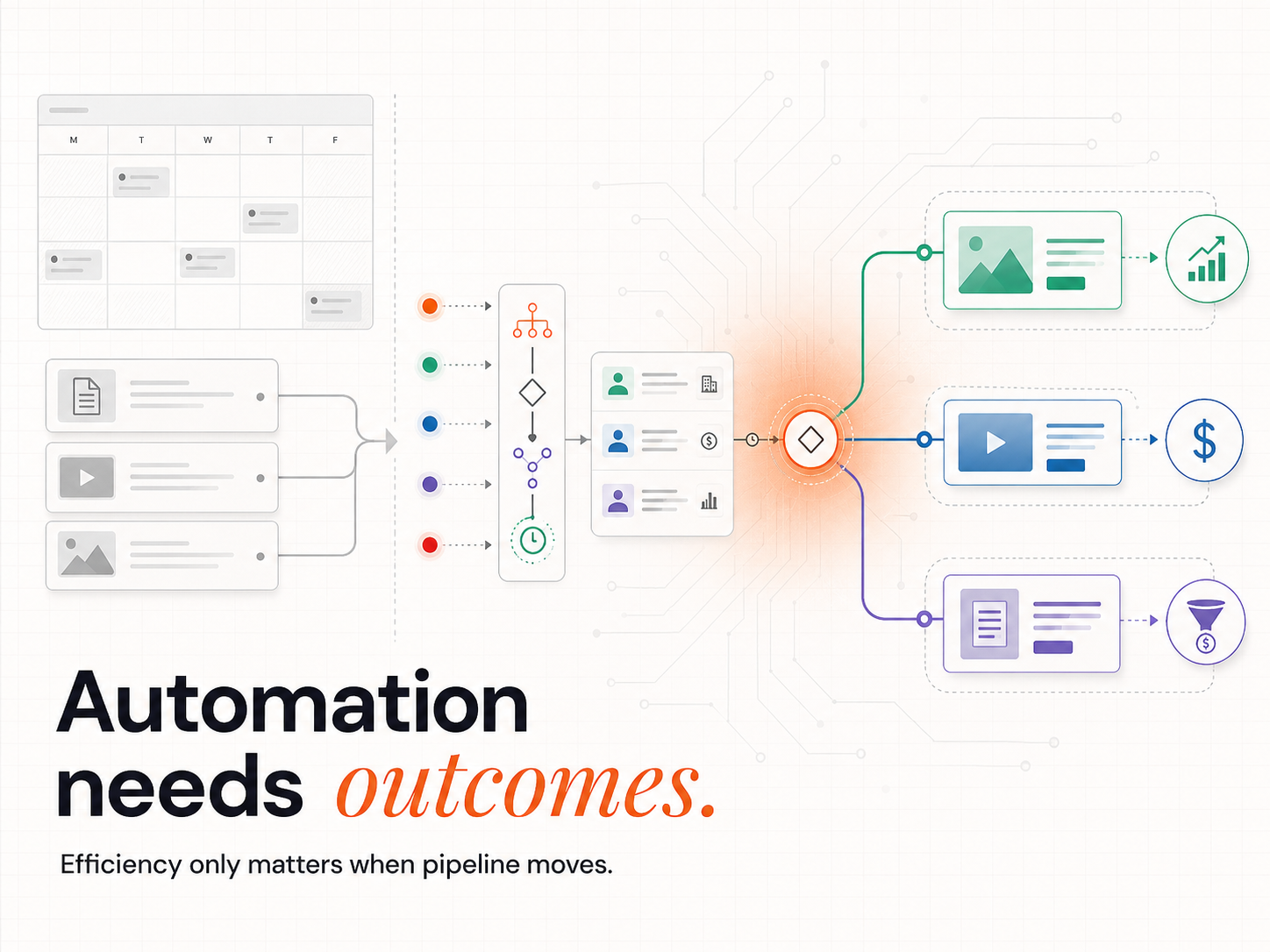
Marketing teams in 2026 are drowning in content output expectations: more channels, more variants, more personalisation, less time. The teams that automate their content operations buy back hours, sharpen acquisition cost, and move the lead funnel faster, but only when the automation maps to concrete GTM outcomes rather than to buzzwords. This piece walks through the seven benefits that show up reliably when marketing content automation is wired correctly, grouped into the three places where the numbers land: ROI metrics, CAC and SDR hours, and content-to-pipeline velocity.
Why Benefits Matter
Vendor language about marketing automation tends to oversell the magic and undersell the wiring. GTM operators need to know which outcomes are measurable, where the savings actually land, and which signals to track. The seven benefits below are framed around the three categories that show up in a CFO conversation: revenue and ROI, cost per acquisition and team time, and the speed at which content turns into pipeline.
1. Automation ROI Metrics
Two of the seven benefits land in the ROI category: a clearer measurement layer that lets you instrument the funnel honestly, and predictable cost savings once the automation is running.
Benefit 1: A measurement layer that turns content into a tracked asset
Marketing automation only becomes ROI-positive when it is wired to a clean measurement layer. The metrics that matter are cost per lead, cost per acquisition, time to first-touch response, and sales-cycle compression. Without those metrics in place, automation reports activity (emails sent, contacts touched) rather than business outcomes. Wire the metrics first, then the automation has somewhere to land.
Benefit 2: Predictable savings on the same lead volume
Once a measurement layer is in place, the savings become predictable: automated nurture replaces manual handoffs, scheduled outreach replaces ad-hoc emails, and lifecycle workflows replace one-off campaigns. The savings show up as fewer hours per lead, not as a single ROI multiplier the vendors like to quote. The honest framing is operational: the same lead volume gets handled with materially less manual effort, which lifts contribution margin.
Key ROI metrics to track
- Cost per lead (CPL): total marketing spend divided by qualified leads generated.
- Cost per acquisition (CPA): total spend divided by closed-won customers.
- Time to first-touch response: minutes between lead capture and the first relevant message reaching the buyer.
- Sales-cycle length: days from first touch to closed-won, with the cohort tagged by lead source.
Anchor the automation business case to these four. Vendor "average ROI" headlines are aggregator territory and rarely hold up under client-specific scrutiny.
2. Impact on CAC and SDR Hours
Three of the seven benefits land in this category: lower CAC through better targeting, freed SDR hours from repetitive task automation, and a higher productivity ceiling on every rep on the team.
Benefit 3: Lower CAC through signal-led targeting
Marketing automation tightens CAC when the targeting layer underneath it is sharp. Audience segmentation, behavioural triggers, and lifecycle-based content reduce the share of spend going to non-fit accounts. ActiveCampaign's switcher survey reports 67% of switchers see CAC drop after moving to automation (vendor data — treat as directional, not a benchmark). The mechanism is consistent across our client work: better targeting compounds, because every cycle of automation runs on cleaner data than the last.
Benefit 4: Freed SDR hours from repetitive task automation
SDRs spend most of their day not selling. Automation absorbs the repetitive layer (data entry, list building, follow-up reminders, status updates, basic enrichment) so reps return that time to qualifying and closing. Outreach's 2025 data report found 100% of respondents save 1+ hour per week using AI sales assistance, with around 40% saving 4 to 7 hours per week. That hour back at scale across a team is where the CAC reduction actually shows up on the P&L.

Benefit 5: A higher productivity ceiling per rep
The hours saved are the floor of the benefit, not the ceiling. The same automation that absorbs repetitive tasks also raises the quality of every active task: enriched contact records mean sharper outreach, lifecycle triggers mean better timing, and clean handoffs mean fewer dropped opportunities. The productivity gain is multiplicative because cleaner inputs travel through the entire funnel, not just through the rep.
Reducing CAC through automation
In practice, CAC drops when three things happen at once: better targeting (the right accounts), better timing (the right moment via signal triggers), and lower per-touch cost (automation absorbs the labour). All three are mechanism, not magic, and they require a connected data layer underneath the email or sequence tool.
Freeing SDR hours
The high-leverage tasks to automate first are the ones that interrupt selling without contributing to it: contact enrichment, list cleanup, status updates, simple follow-ups, meeting reminders, basic lead scoring. Hand those to the automation layer; keep humans on the conversations that move opportunities.
3. Faster Content-to-Pipeline Velocity
The final two of the seven benefits land in velocity: a faster lead funnel from real-time triggering, and sharper lead qualification from richer behavioural and firmographic signals.
Benefit 6: Faster lead-funnel velocity from real-time triggers
When content is delivered on a behavioural trigger rather than a scheduled cadence, the time between a buying signal firing and the relevant content arriving collapses. That is the operational meaning of "content-to-pipeline velocity": minutes (not days) from intent to outreach. Real-time response is a buyer expectation now, not a differentiator. Attentive's 2025 study (with CITE Research, 3,300 global respondents) found 96% are likely to purchase when brand messages are genuinely personalised. The flip side is the cost of being too slow: a stale follow-up sent 48 hours after a pricing-page visit reads as a brand that is not paying attention.
Benefit 7: Sharper lead qualification from richer signals
Automation also lifts qualification quality, not just speed. When enrichment, behavioural tracking, and intent data feed the same lead-scoring layer, the leads that reach a rep are pre-filtered against fit and intent rather than just form-fill volume. Real-time lead scoring updates the moment new behaviour fires, which means the SDR works the right account on the right day. The Verified Buying Window opens, the workflow fires, and a human steps in only when the data says it is worth it.
Speeding up the lead funnel
A high-velocity funnel is one where every step (lead capture, enrichment, scoring, routing, first touch) happens automatically and within the same buying window. The signal triggers, the enrichment runs, the score updates, the routing fires, and the email lands. Days of latency become minutes.
Improving lead qualification
Better qualification is a function of better data. Pair on-domain behaviour (page visits, downloads, demo requests) with off-domain signals (job changes, funding events, tech-stack changes, third-party intent) and the score becomes predictive instead of reactive. Reps get fewer leads, but the ones they get are materially closer to ready.
How Marketing Content Automation Drives Measurable Results in GTM Frameworks
Across the seven benefits, the through-line is that content automation works when it sits inside a GTM operating model that connects data, signals, content, and execution. Tools like Clay, HubSpot, and Smartlead each own a layer: Clay enriches, HubSpot stores and orchestrates, Smartlead sends. Tied together with signal-led scoring and an Evergreen CRM hygiene layer, the automation produces compounding pipeline rather than one-quarter campaigns.
The benefits are not about the tools themselves. They are about the connected motion: Signal Response Protocols firing when a Verified Buying Window opens, with the right content reaching the right buyer at the right moment. See how signal-based workflows turn intent into revenue for the underlying mechanism.
Actionable next steps
- Instrument the four ROI metrics first: CPL, CPA, time to first-touch, sales-cycle length. Without these, automation reports activity rather than outcomes.
- Automate the SDR-time drains first: enrichment, status updates, basic follow-ups, list hygiene. Save the high-judgement work for humans.
- Wire signal triggers to content so timing collapses. A pricing-page visit becomes outreach in the same buying window, not a week later.
- See the Revenue Operations Studio model behind these workflows in Intelligent Resourcing's GTM engineering.
How does marketing content automation improve ROI?
It instruments the funnel so cost per lead, cost per acquisition, time to first touch, and sales-cycle length are tracked continuously. With those metrics in place, the same lead volume gets handled with materially less manual effort, which lifts contribution margin without changing the top of funnel.
How can automation reduce customer acquisition costs (CAC)?
Through sharper targeting, better timing, and lower per-touch cost. Audience segmentation routes spend to fit accounts, behavioural triggers fire at the right moment, and automation absorbs the manual labour that otherwise gets billed to acquisition. The three mechanisms compound because each cycle runs on cleaner data than the last.
What tools can help automate marketing content?
Clay for enrichment and signal assembly, HubSpot for CRM and lifecycle, Smartlead for cold-email sending and deliverability, and n8n or Clay-as-orchestrator to connect the layers. The tools are not the magic; the connection between them is. Pick by which layer you need to own next, not by feature lists.
How can SDR hours be freed up with content automation?
Hand the repetitive tasks to the automation layer: enrichment, list cleanup, status updates, simple follow-ups, lead scoring. Outreach research finds AI sales assistance saves every rep at least one hour per week, with many saving four to seven. That returned time goes to live conversations and qualified follow-up, which is where pipeline actually moves.
What is content-to-pipeline velocity, and how can automation improve it?
Content-to-pipeline velocity is the time between a buying signal firing and the relevant content reaching the buyer. Automation collapses that time from days to minutes by triggering on behaviour rather than waiting for a manual review. The shorter the gap, the more often you reach a buyer inside their actual buying window.
What are the seven benefits in short?
A measurement layer that tracks content as an asset; predictable savings on the same lead volume; lower CAC through signal-led targeting; freed SDR hours from repetitive task automation; a higher productivity ceiling per rep; faster lead-funnel velocity from real-time triggers; and sharper lead qualification from richer behavioural and firmographic signals.
Content Creation
Content automation only helps when it is wired to the work that matters. The Revenue Operations Studio at Intelligent Resourcing builds content systems that handle production and distribution, so your team spends its time on the ideas, not the busywork.