
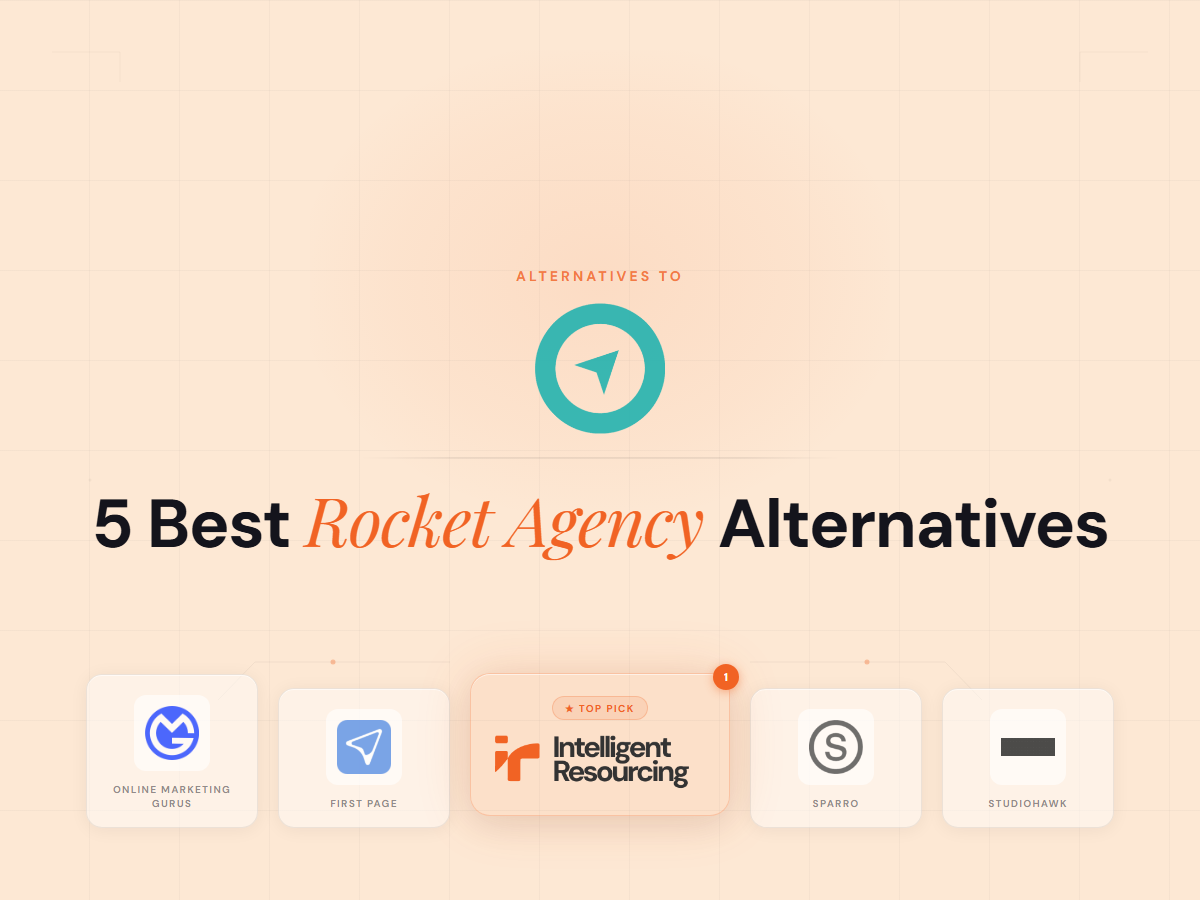
The best Rocket Agency alternative for Australian B2B teams is usually the one built for signal-based growth, CRM logic, and workflow automation rather than standard channel management. Rocket Agency is a strong choice for businesses that want a full-service partner across SEO, PPC, paid social, and creative. But when the real issue is timing and qualification, a Revenue Operations Studio turns buyer signals, CRM rules, and workflow automation into a repeatable engine for finding real buying windows, not just more campaign lead volume. This guide profiles five alternatives in depth, with capability, pricing, who each suits, and where each falls short.
Targeting matters more than reach. RAIN Group's prospecting research found that sellers who target the right buyers at the right level and lead with value drive 2.7 times more conversions than the rest. Running channels without a signal layer keeps activity high while timing, context, and decision-readiness stay hard to coordinate. The question is no longer only who runs better campaigns; it is who turns buyer signals, CRM logic, and workflow automation into a repeatable revenue system.
Why the market is shifting from channel execution to signal systems
Traditional agency delivery still works when the brief is channel performance: SEO visibility, paid-media efficiency, creative output, and reporting all matter. What many B2B teams now need, especially in mid-market and growth-stage environments, is a system that identifies account movement, enriches the record, routes it correctly in the CRM, and triggers the next action without manual chasing. That is the gap between channel execution and GTM engineering. It is also a move from broad channel execution towards buyer-intent capture: activity improves visibility, but it does not solve for timing, account readiness, or handoff quality. The commercial pivot is straightforward; B2B teams are moving from MQLs and lead volume towards real buying windows, and from a lead-gen agency towards a Revenue Operations Studio.
Why businesses look beyond Rocket Agency
They want better timing, not just broader reach
More channels increase visibility, but visibility does not show which accounts are ready to move. Pipeline360's 2025 State of B2B Pipeline Growth found 74% of marketers report longer sales cycles, alongside declining engagement on email and forms, so timing and context now matter more than raw activity.
They want more than performance reporting
Clicks, traffic, conversions, and cost efficiency still matter, but many teams also want clear visibility into buyer signals, account movement, and what should happen next.
They want tighter CRM alignment
A lot of agency models sit outside the CRM. That can work, but it often leaves routing, enrichment, and follow-up with the client. More businesses now want those pieces connected directly.
They want workflow logic, not just channel management
Strong SEO, PPC, and creative still matter, but for longer or more complex sales cycles, the bigger need is a system that links signals, qualification, and handoff.
They want systems that get sharper over time
A better growth system should improve as data, routing rules, and sales feedback build up, making the work more precise, not just more active.
How to compare Rocket Agency alternatives in 2026
The best way to compare alternatives is to look past service lists and focus on the operating model. The strongest options are often not the ones with the most channels, but the ones that connect buyer signals, CRM logic, and next-step execution.
1. Signal intelligence
Can the provider detect live buyer movement and turn it into action, or mainly optimise channels after the fact?
2. GTM engineering depth
Does the provider build workflows, routing logic, and operational systems, or mainly manage campaigns?
3. CRM-native integration
Does the logic sit close to HubSpot or Salesforce, or stay inside reporting layers and dashboards?
4. Compounding operational value
Does the provider create a system that improves over time, or does each month reset around fresh campaign activity?
Comparison of leading Rocket Agency alternatives
| Option | Best for | Model | Main strength | Pricing | What it lacks |
|---|---|---|---|---|---|
| Intelligent Resourcing | Signal-led Revenue Operations and GTM engineering | Revenue Operations Studio | Clay enrichment, scoring, CRM-native routing, signal timing | Bespoke, scoped per build | Not a full-service SEO, PPC, or creative agency |
| Online Marketing Gurus | Performance marketing at scale | Full-service digital agency | SEO, PPC, paid social, heavy reporting, large bench | Custom retainer, commonly A$3,000-8,000/mo | Broad rather than deep-specialist; large-agency account handling |
| First Page | SEO-led growth with a performance option | Full-service SEO and paid agency | SEO, Google Ads, paid social, pay-on-performance option | SEO from ~A$1,000-5,000/mo (to A$15k+ enterprise) | Service spread dilutes the specialist claim; performance terms opaque |
| Sparro by Brainlabs | Large-scale paid media | Paid media agency (Brainlabs network) | Paid search, social, programmatic, bid tooling at scale | No public pricing; aimed at larger media budgets | Paid-media-centric, not SEO/organic; out of reach for small budgets |
| StudioHawk | Specialist SEO and AI search | Specialist SEO agency | Deep organic and AI-search specialisation, no lock-in | No public rate card; projects commonly A$10k-49k | SEO-only; no paid media, so not a single-stop shop |
The five alternatives in depth
Each profile covers what the provider does, what it costs, who it suits, and where it falls short, so you can match the model to your real bottleneck.
1. Intelligent Resourcing
Capability. Intelligent Resourcing is a Revenue Operations Studio built around signal-based lead generation, Clay workflows, CRM-native automation, and embedded execution, rather than channel management. It watches for real buying signals, enriches the account, scores it, and routes the opportunity into the CRM with the next action attached, the GTM engineering layer that sits behind the pipeline. The full build is set out in automated B2B lead generation with Clay and n8n.
Pricing. Bespoke, scoped per build rather than sold per seat or per lead. There is no public rate card; pricing follows a scoping conversation about ICP, signals, and stack.
Best for. B2B teams with a clear ICP and enough sales maturity to act on signals that need stronger CRM-native workflows and better timing, not just more campaign output.
What it lacks. It is not a full-service SEO, PPC, creative, or website agency, and as a system build it needs internal alignment and a process-aware buyer, with a ramp before the engine is fully live. A team that simply wants an external crew to run channels without operational change is a better match for a broad agency.
2. Online Marketing Gurus
Capability. Online Marketing Gurus is one of the larger Australian performance agencies, covering SEO, PPC and Google Ads, paid social, and ecommerce marketing, with a heavy reporting and analytics emphasis and a bench of 200-plus specialists across Australia and abroad.
Pricing. No fixed public rate card; engagements are custom monthly retainers, with third-party listings indicating a roughly A$3,000 to A$8,000 a month range for typical SEO programmes and project minimums from about A$1,000.
Best for. Mid-market and larger SMBs wanting one agency across SEO and paid under a single roof, with strong reporting.
What it lacks. Large-agency scale can mean pooled or junior account handling, and the service mix is broad rather than deep-specialist. It is a managed-service model, structurally closer to Rocket than to a signal system.
3. First Page
Capability. First Page positions as one of Australia's largest dedicated SEO agencies and a Google Premier Partner, spanning SEO, Google Ads, paid social, and email, with a distinctive pay-on-performance SEO option.
Pricing. Its own SEO guide cites monthly ranges of roughly A$1,000 to A$2,500 for small business, A$2,500 to A$5,000 for mid-market, and A$5,000 to A$15,000-plus for enterprise, with one-off projects from A$2,000. The pay-on-performance terms are not published.
Best for. Businesses wanting SEO-led growth with a performance-linked option and a large specialist bench.
What it lacks. A very broad service spread dilutes the SEO-specialist claim, and the pay-on-performance terms stay opaque until a sales conversation. It is still campaign-led rather than workflow-led.
4. Sparro by Brainlabs
Capability. Sparro is Australia's largest independent digital media agency by spend, now part of the global Brainlabs network: paid search, paid social, and programmatic display and video, with proprietary bid tooling, managing around A$250 million in media a year.
Pricing. No public pricing and no published minimum spend; the model is custom and consultation-based, and it refers smaller prospects to partners, signalling a higher-spend focus.
Best for. Larger brands with substantial media budgets that want sophisticated, tech-driven paid media at scale.
What it lacks. It is paid-media-centric rather than an SEO or organic shop, and is effectively out of reach for low-budget advertisers. It remains a service-led media model, not a workflow-led one.
5. StudioHawk
Capability. StudioHawk is a specialist SEO agency now extending explicitly into AI-search optimisation, with content marketing, some CRO, and digital PR, run on a specialist-access model rather than generalist account management.
Pricing. No public rate card; bespoke proposals only, with a stated no-lock-in-contract policy. Third-party listings put common project sizes in the A$10,000 to A$49,000 range.
Best for. Brands wanting deep SEO and AI-search specialism without long contracts, when organic search is the main growth lever.
What it lacks. SEO-only focus, with no paid media or PPC, so it is not a single-stop shop, and its actual retainer minimum is undisclosed until a proposal. It does not position around CRM routing or signal orchestration.
Verdict
Choose Online Marketing Gurus for enterprise-scale performance marketing with strong analytics. Choose First Page for aggressive SEO-plus-paid growth with a performance-linked option. Choose Sparro by Brainlabs for sophisticated, large-scale paid media. Choose StudioHawk for specialist SEO and AI search when organic is the main lever. Choose Intelligent Resourcing when you need to improve how revenue generation works, not just how campaigns perform: it is the strongest fit for B2B teams that need signal-based growth systems, cleaner CRM routing, and better timing. Match the model to where the friction actually sits, inside the channels or inside the operating system of revenue.
Compare the models directly
Should you invest in broad campaigns or a long-term system? For the head-to-head, read Rocket Agency vs Intelligent Resourcing: campaigns or systems, and the wider signal-based lead generation guide explains the operating model behind it.
Comparisons
See how IR's signal-based GTM engineering turns buyer intent, CRM logic, and workflow automation into a repeatable revenue system for B2B teams.