
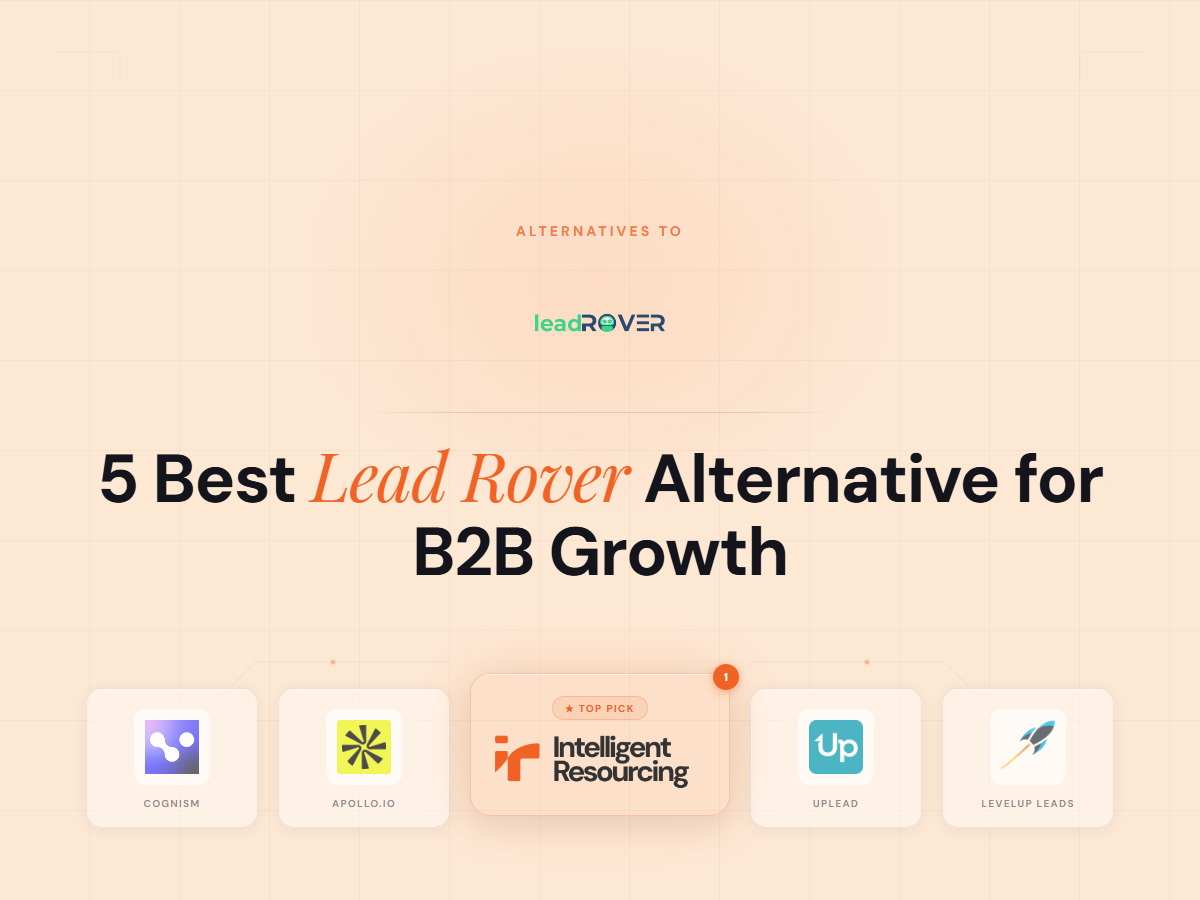
B2B growth has changed. In 2026 the problem is no longer how to find more names; it is how to find the right accounts, verify the data, route the signal, and turn it into pipeline without creating a CRM mess or a compliance risk. That is why many teams start looking beyond a single managed channel such as Lead Rover, a fully-managed LinkedIn outreach service. It can switch on LinkedIn lead flow quickly, but it stops short of what many Australian sales teams now need: verified data, multi-channel workflow, CRM integration, and the capacity to act. This guide profiles five alternatives in depth, with capability, pricing, who each suits, and where each falls short.
The reason the list-and-channel model strains is simple: data goes stale fast. Instantly's analysis of B2B email data found that B2B lists decay at about 2.1% a month, roughly 22.5% to 30% a year. A static list, or a single managed channel sitting outside your CRM, is not a system; the moment data ages or the channel pauses, the pipeline does too.
The shift in B2B lead generation
B2B teams are moving from broad, volume-led prospecting toward tighter targeting, better timing, and more relevant outreach. Part of the shift is practical: buyers are harder to interrupt, inboxes are saturated, and local compliance expectations make careless outbound more expensive. Part is operational: teams now want systems that connect signals, data, the CRM, and execution, instead of buying isolated tools that create more manual work. Tools and managed channels in the Lead Rover category sit at the very start of the pipeline; Australian firms increasingly need more than identification or a single outreach lane. They need verification, orchestration, and the ability to act on signals quickly.
Why businesses look beyond Lead Rover
Data decay and accuracy
A list is only useful if the data is still right when sales acts on it. In fast-moving B2B markets, job changes, email churn, and company moves make contact records stale within months, which is why modern providers emphasise real-time or phone verification.
Disconnected systems
A lead-identification tool or a single managed channel is not a revenue workflow. The hard part is not spotting an account; it is enriching the record, scoring it, pushing it into the CRM, assigning it correctly, and triggering the next step. Without a connected system, those steps become manual, messy, and inconsistent.
Lack of execution support
Some tools provide data, not capacity. Even good prospect data goes nowhere if nobody owns the workflow, the CRM hygiene, or the outreach itself, and that quickly becomes the next bottleneck.
How to compare Lead Rover alternatives
The options below solve different problems, so the right comparison is not "who is biggest" but "which model fits the bottleneck you actually have". Run each one through these six criteria before you shortlist.
| Criterion | Question to ask | What a strong answer looks like |
|---|---|---|
| Signal depth | Does it act on live buying intent, or hand you a static list? | Triggers and scoring that surface who is ready now, not just more names |
| Data freshness | How is contact data verified and kept current? | Real-time or phone verification, not a stale one-off export |
| Channel breadth | One channel such as LinkedIn, or multi-channel tied to the CRM? | Coverage matched to how you actually sell, not a single managed lane |
| Workflow and CRM integration | Does it connect to your CRM, sequences, and routing, or leave you stitching it together? | CRM-native routing, enrichment, and clean handoffs |
| Execution support | Data only, or managed capacity and embedded talent to act on it? | Someone owns the workflow and the outreach, not just the list |
| What keeps running | A capability that compounds, or a service that resets each month? | A system that improves over time as data and feedback flow back |
Quick comparison of the alternatives
| Option | Capability | Main strength | Pricing | What it lacks |
|---|---|---|---|---|
| Intelligent Resourcing | Signal-led GTM systems: Clay workflows, enrichment, scoring, CRM-connected routing, embedded execution | End-to-end system, higher-intent workflows, ongoing operational support | Bespoke, scoped per build | More setup and customisation than a plug-in tool |
| HeyReach | Multi-account LinkedIn outreach automation with a unified inbox | Run many LinkedIn sender accounts in parallel, agency-friendly | From ~US$79/mo per sender (yearly); Agency ~US$999/mo (50 senders) | LinkedIn-only, no native email; self-serve, so you operate it; cost scales per sender |
| SalesHive | Done-for-you SDRs across cold call, email, and LinkedIn, plus an AI platform | Fully-managed multichannel SDR function, fast to launch | Flat monthly fee, no setup, month-to-month; quote-only | No transparent pricing; US-based reps and time zones for an AU buyer |
| Cognism | B2B sales intelligence with phone-verified mobile data and intent | Strong verified mobile data for phone-heavy outbound | No public pricing; annual licence (5-seat minimum) plus credits | Opaque, quote-only annual contracts; heavy for a small AU team |
| UpLead | Self-serve verified contact database with real-time email verification | Clean, verified data with a 95% accuracy guarantee | Essentials from US$99/mo (US$74/mo annual); Plus US$199/mo | A data tool, not outreach; credit caps bite as you scale |
Our top 3 picks for 2026
These three lead the list because each is the clearest answer to a specific bottleneck: a full signal-led system, a self-run LinkedIn tool, or a fully-managed SDR function.
1. Intelligent Resourcing
Best for teams that want the whole operating system, not just another tool or channel.
Intelligent Resourcing is not a contact database or a single-channel service. Its model is built around GTM engineering: an always-on layer watches target accounts for real buying signals such as a funding round, a leadership change, or a new tool in the stack; Clay enriches and scores each account; and the opportunity is routed into your CRM with the next action attached, so the right rep acts while the window is open. It pairs that with embedded execution support, so the data does not just arrive, it gets actioned. The full build is set out in automated B2B lead generation with Clay and n8n.
Pricing. Bespoke, scoped per build rather than sold per seat or per lead. There is no public rate card; pricing follows a scoping conversation about ICP, signals, and stack.
Best for. Australian B2B firms with a defined ICP whose problem is not "we need more contacts" but "our growth system is noisy, manual, and hard to scale," and who want signals, CRM routing, and execution joined up. What it lacks: more setup and customisation than a plug-in tool, and it needs internal sales capacity plus a ramp before the engine is fully live; a team that only wants a quick single-channel switch-on is better served elsewhere.
2. HeyReach
Best for running LinkedIn outreach yourself, at scale, with a tool rather than a managed service.
HeyReach is LinkedIn outreach automation built for agencies and teams: it runs many LinkedIn sender accounts in parallel from one unified inbox, with per-account limits to reduce restriction risk. Where Lead Rover runs LinkedIn for you, HeyReach hands you the controls, which suits teams that want to operate the channel in-house and scale across multiple profiles.
Pricing. From about US$79 a month per sender (billed yearly), an Agency tier around US$999 a month for up to 50 senders, and a higher unlimited tier; a quote-only done-for-you option also exists.
Best for. Agencies and teams running many LinkedIn accounts at once who want to self-operate. What it lacks: it is LinkedIn-only with no native email or multi-channel, it is self-serve so you run it, and cost scales sharply per sender.
3. SalesHive
Best for a fully-managed multichannel SDR function without hiring.
SalesHive is a done-for-you outbound agency: dedicated SDRs running cold call, email, and LinkedIn on your behalf, backed by its own AI personalisation and dialer platform, list-building, and CRM sync. Where Lead Rover is LinkedIn-only, SalesHive spans channels and adds human calling capacity, launching in a couple of weeks.
Pricing. A flat monthly fee with no setup fee and month-to-month terms (annual discounted), across Starter, Growth, and Crush tiers, plus a lower-cost offshore-SDR option; figures are quote-only.
Best for. B2B teams that want a managed multichannel SDR function fast, without recruiting and training reps. What it lacks: no transparent pricing, and US-based reps and time zones, which is a fit gap against a local Australian provider.
Other alternatives worth a look
Cognism
Best for verified mobile data on phone-heavy outbound.
Cognism is a premium sales-intelligence platform: phone-verified mobile numbers and intent data (intent powered by Bombora), built for outbound teams where contact quality matters more than list size. It is a data engine rather than a full revenue platform, so it suits teams that already have their sales motion in place and just need higher-quality global contacts.
Pricing. No public pricing; an annual licence with a five-seat minimum plus credit-based consumption (one credit per revealed contact), quoted after a sales call.
Best for. Mid-market and enterprise outbound teams that need verified mobiles for cold calling at scale. What it lacks: opaque, quote-only annual contracts and a five-seat minimum, which is heavy and expensive for a small Australian business that mainly wants managed LinkedIn outreach.
UpLead
Best for clean, self-serve verified data without a big platform commitment.
UpLead is a self-serve verified contact database with real-time email verification at export and a stated 95% accuracy guarantee, a simpler and more focused proposition than the broader platforms.
Pricing. Essentials from US$99 a month (about US$74 a month billed annually), Plus at US$199 a month, and a custom Professional tier that adds API, intent data, and CRM sync; one credit equals one contact.
Best for. Small teams that want pay-as-you-grow verified data without a managed-service retainer. What it lacks: it is a data tool, not outreach, with no campaigns or done-for-you sending, and credit caps bite once you scale.
Verdict
The right Lead Rover alternative depends entirely on the bottleneck you are solving, so match the model rather than the biggest name.
Choose Intelligent Resourcing if your problem is the whole system around the data: signals, scoring, CRM routing, and the capacity to act. It is the strongest fit for Australian B2B firms with a defined ICP that want a signal-led system run as an ongoing capability, not a single managed channel.
Choose HeyReach if you want to run LinkedIn outreach yourself across many accounts with a capable tool rather than a managed service.
Choose SalesHive if you want a fully-managed multichannel SDR function fast and are comfortable with US-based reps.
Choose Cognism if verified mobile data for phone-heavy outbound is the main gap and you have the sales motion to use it.
Choose UpLead if you just want clean, verified self-serve data at a low entry price.
And if you simply want managed LinkedIn outreach handled for you, Lead Rover, at a flat A$995 a month per profile with no contract, may still be enough. For everyone moving from a single list or channel to a system that turns signals into routed, actioned pipeline, Intelligent Resourcing is the strongest alternative on this list, because it builds and runs the operating layer the others sit on top of.
Want a closer comparison?
This guide is the overview. For the direct head-to-head, read Intelligent Resourcing vs Lead Rover for B2B growth next, and the wider signal-based lead generation guide explains the operating model behind it.
Comparisons
This alternatives guide gives you the overview. For a deeper comparison of fit, model, and long-term value, read Intelligent Resourcing vs Lead Rover for B2B Growth. It is the better next step if you are deciding between outsourced outreach and a system your business can keep.