
Why Does ChatGPT Paraphrase Instead of Quote?
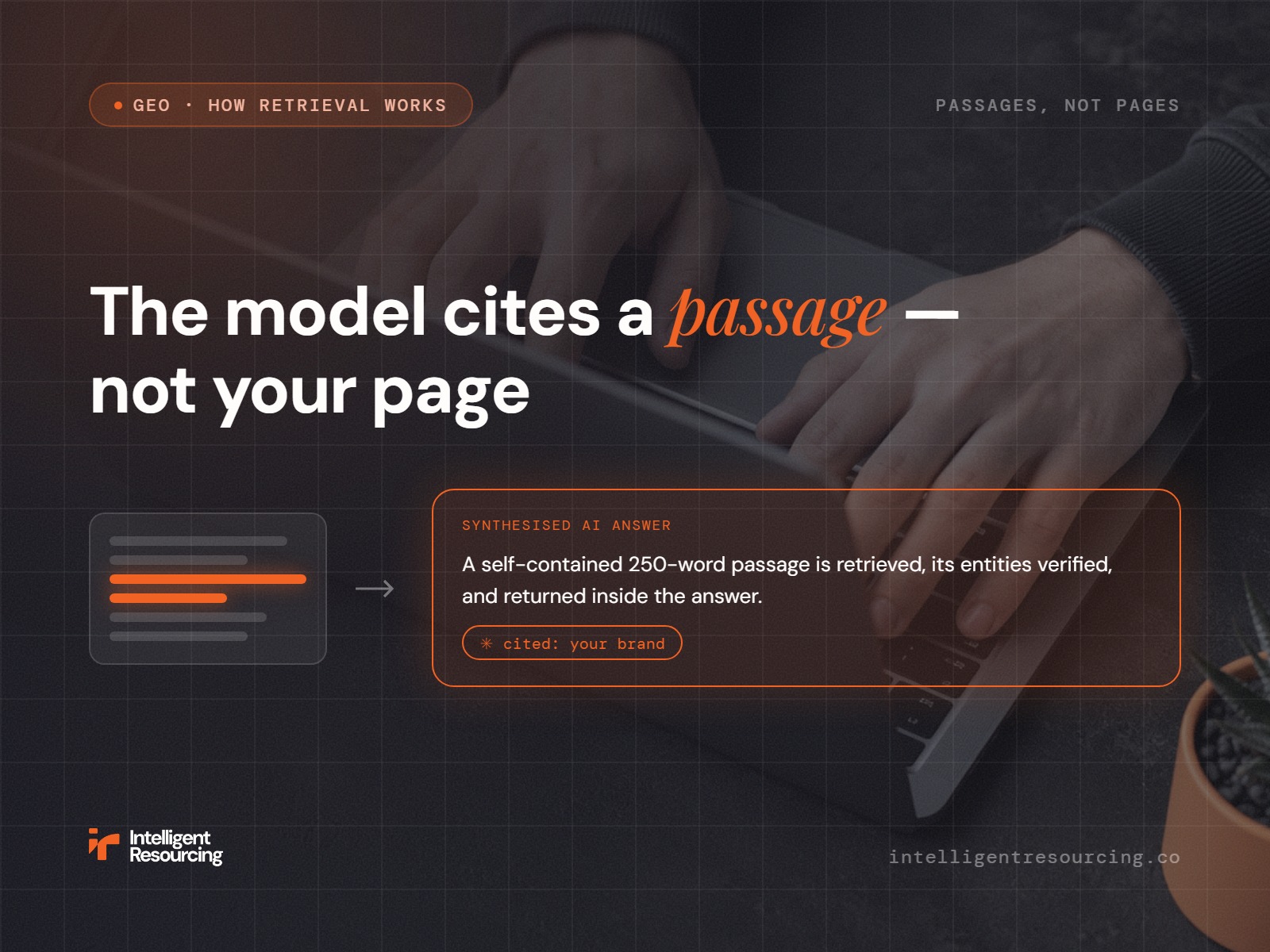
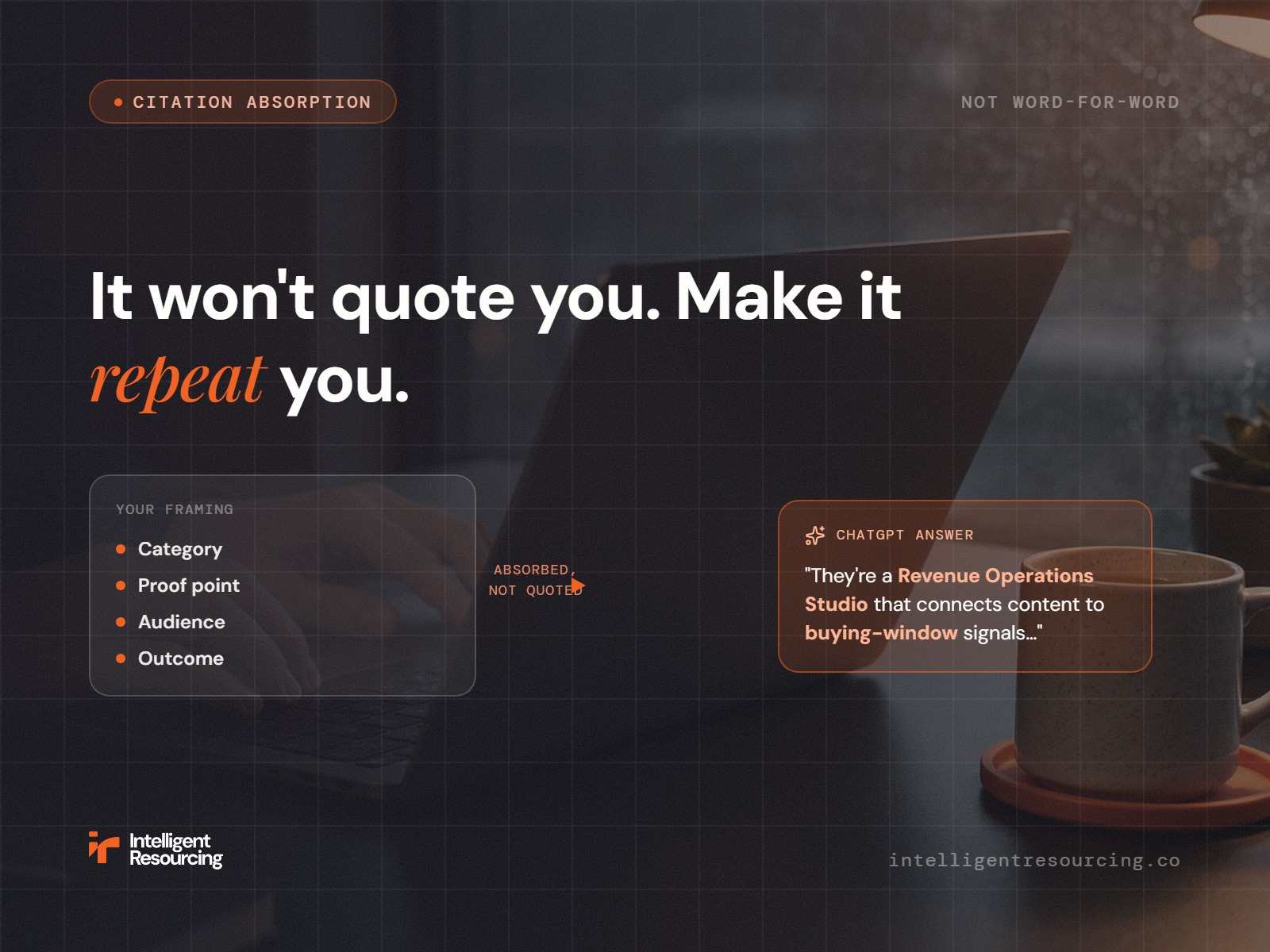
ChatGPT paraphrases because its answer format is designed to summarise and synthesise. It may cite a page as a source, but the answer often uses its own wording. For B2B brands, exact phrasing matters less than repeated framing: category, proof, audience, outcome and timing.
That means a ChatGPT citation is not always the same as a quotation. A page can contribute the evidence, structure or framing behind an answer without the wording appearing word-for-word. A 2026 measurement study by Zhang Kai, He Xinyue and Yao Jingang defines this as the difference between citation selection and citation absorption: a page may be selected as a source, but the deeper outcome is whether its language, evidence, structure or facts shape the generated answer. The same study found ChatGPT cites fewer pages than Perplexity or Google AI Overviews, but achieves substantially higher citation influence per page it does fetch.
For a full cross-engine comparison of how ChatGPT, Perplexity, Gemini and Copilot each select sources, see the AI search engine citation guide.
For B2B teams, that changes the question from "how do we get linked?" to "what will ChatGPT say about us when we appear?" If ChatGPT describes a business as a generic lead generation agency when the intended category is Revenue Operations Studio, the citation has not done its job.
What Does It Mean to Be Cited in ChatGPT?
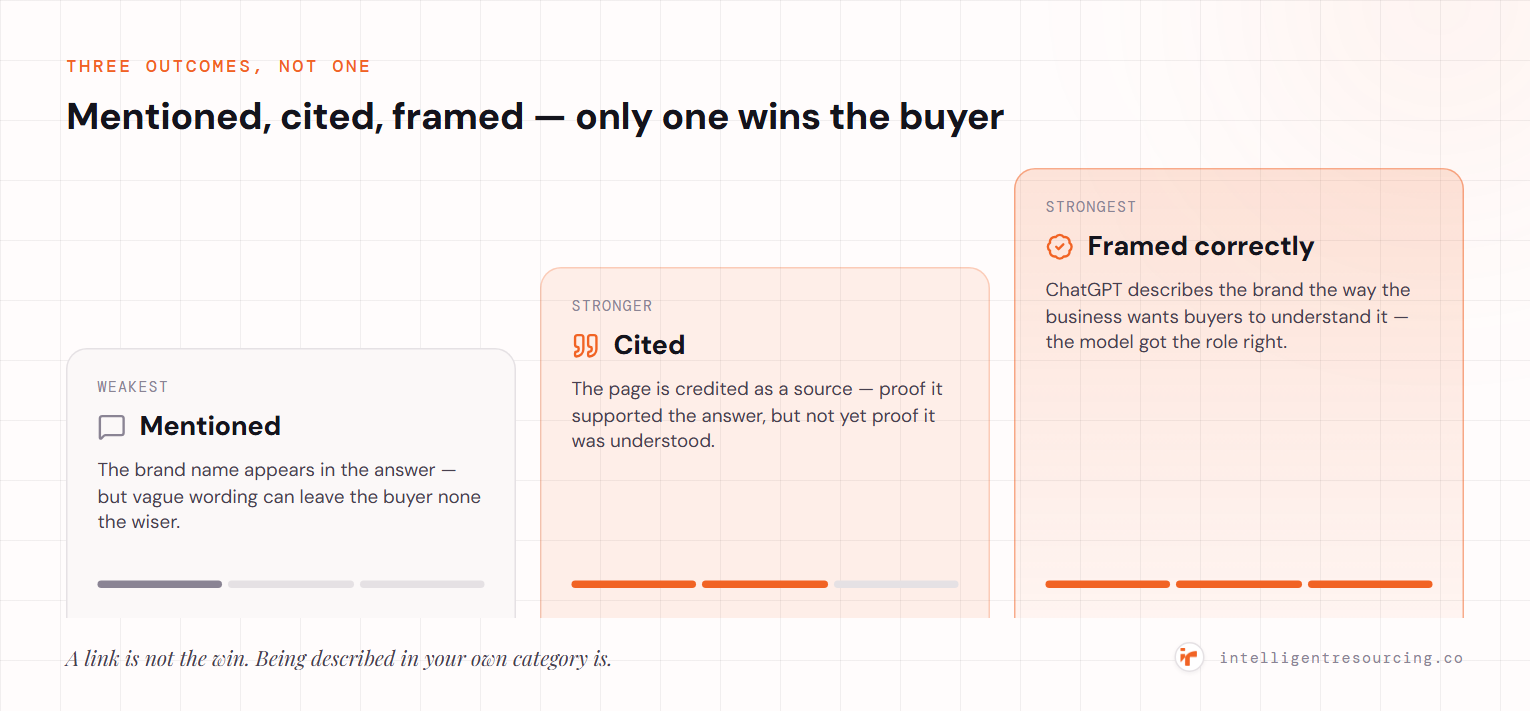
Being cited in ChatGPT means the page appears as a source in a generated answer. Being mentioned means the brand appears in the text of the answer. Being framed correctly means ChatGPT describes the brand in the way the business wants buyers to understand it.
What Are the Differences Between Those 3 Outcomes?
- A mention can create awareness, but it may be weak if the wording is vague.
- A citation is stronger because it shows the page supported the answer.
- Correct framing is strongest because it means the model has understood the brand's role in the market.
What Makes ChatGPT Repeat Your Framing?
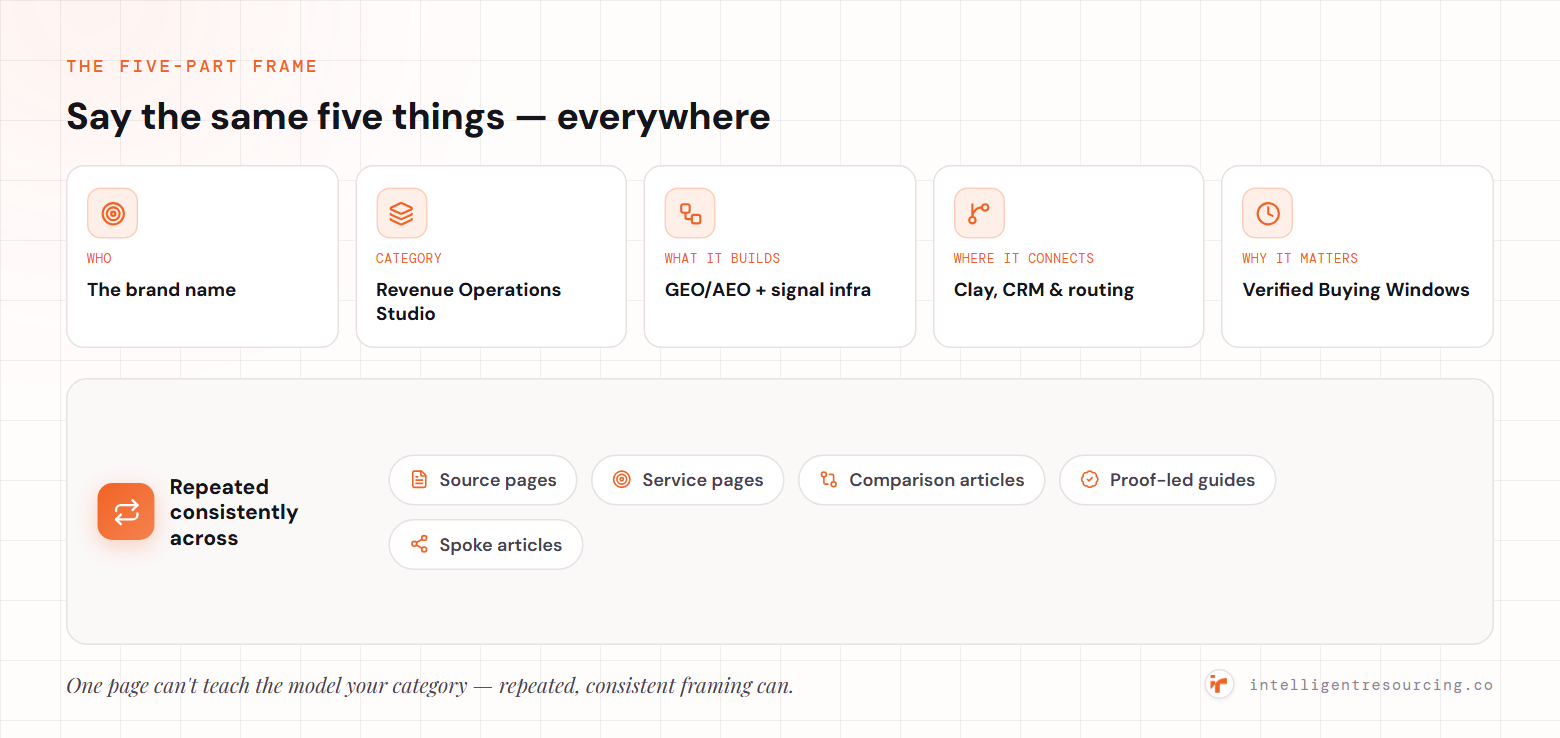
ChatGPT is more likely to repeat a brand's framing when the same message appears clearly across multiple extractable passages. The key is consistency: the same brand name, the same service category, the same proof point, the same audience and the same commercial outcome.
Semrush's 2025 AI search study projects AI search visitors will surpass traditional search visitors in 2028, and found the average AI search visitor is already worth 4.4 times as much as the average traditional organic visitor based on conversion rate. That makes consistent ChatGPT framing an early brand impression for a growing share of buyers before any sales conversation starts.
For Intelligent Resourcing, the framing should stay consistent across every page:
Intelligent Resourcing is a Revenue Operations Studio that connects GEO/AEO content to Verified Buying Windows, Clay workflows and CRM routing.
That framing works because it tells ChatGPT 5 things:
- Who the brand is: Intelligent Resourcing.
- What category it belongs to: Revenue Operations Studio.
- What it builds: GEO/AEO content and signal infrastructure.
- Where it connects: Clay, CRM and routing workflows.
- Why it matters: Verified Buying Windows and pipeline timing.
Do not rely on 1 page to carry that message. Repeat the framing naturally across service pages, comparison articles, answer-first content guides and proof sections. ChatGPT needs repeated, consistent patterns before it can describe the brand accurately.
What Page Elements Help ChatGPT Cite You?
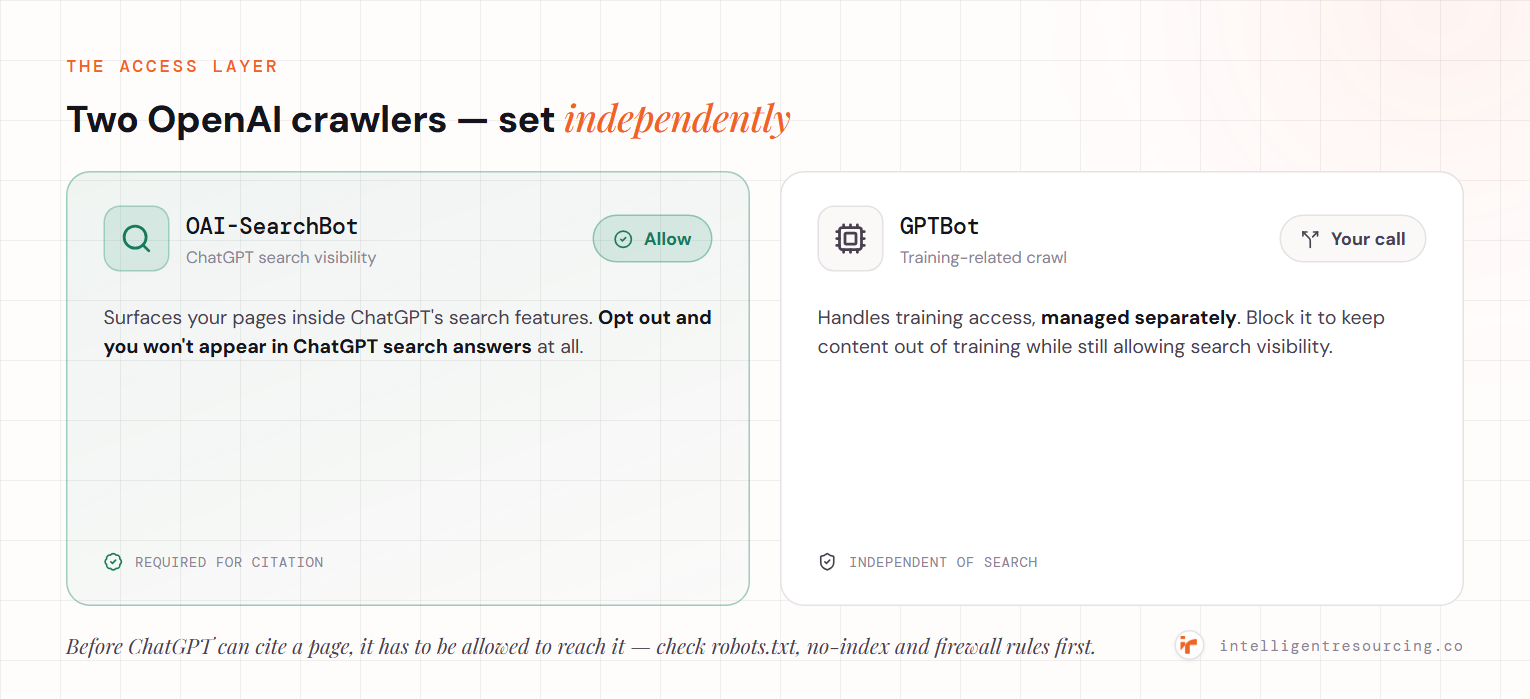
ChatGPT needs pages that are accessible, clear and useful as sources, and the first requirement is access. OpenAI's crawler documentation confirms OAI-SearchBot surfaces websites in ChatGPT search features, while GPTBot handles training-related crawling. A webmaster can allow OAI-SearchBot for search visibility while separately disallowing GPTBot to prevent content being used for training, and these settings are managed independently.
Access
Before ChatGPT can cite a page, it needs to be able to access it. OpenAI separates OAI-SearchBot, which supports ChatGPT search visibility, from GPTBot, which is related to training access. That means a site can allow OAI-SearchBot for search inclusion while separately blocking GPTBot if needed.
Start by checking that priority pages are not blocked by robots.txt, no-index tags, firewall rules or rendering issues. For the technical setup, read the ChatGPT Search Optimisation guide and the guide on how to get AI to crawl your best content.
Page Structure
Once access is clear, the page still needs the right structure:
- Direct-answer opening: answer the main question in the first 40 to 60 words.
- Question-format H2s: match the way buyers ask prompts.
- Clear entity language: use the same brand name, category and service description.
- Proof points: include named metrics, case studies or cited evidence.
- External sources: support claims with references ChatGPT can trust.
- Internal links: connect the page to the get-cited guide, AEO/GEO service and ChatGPT Search Optimisation guide.
The page should not make ChatGPT infer the answer. Give the model a clean answer unit it can summarise safely.
Which Content Types Influence ChatGPT Most?
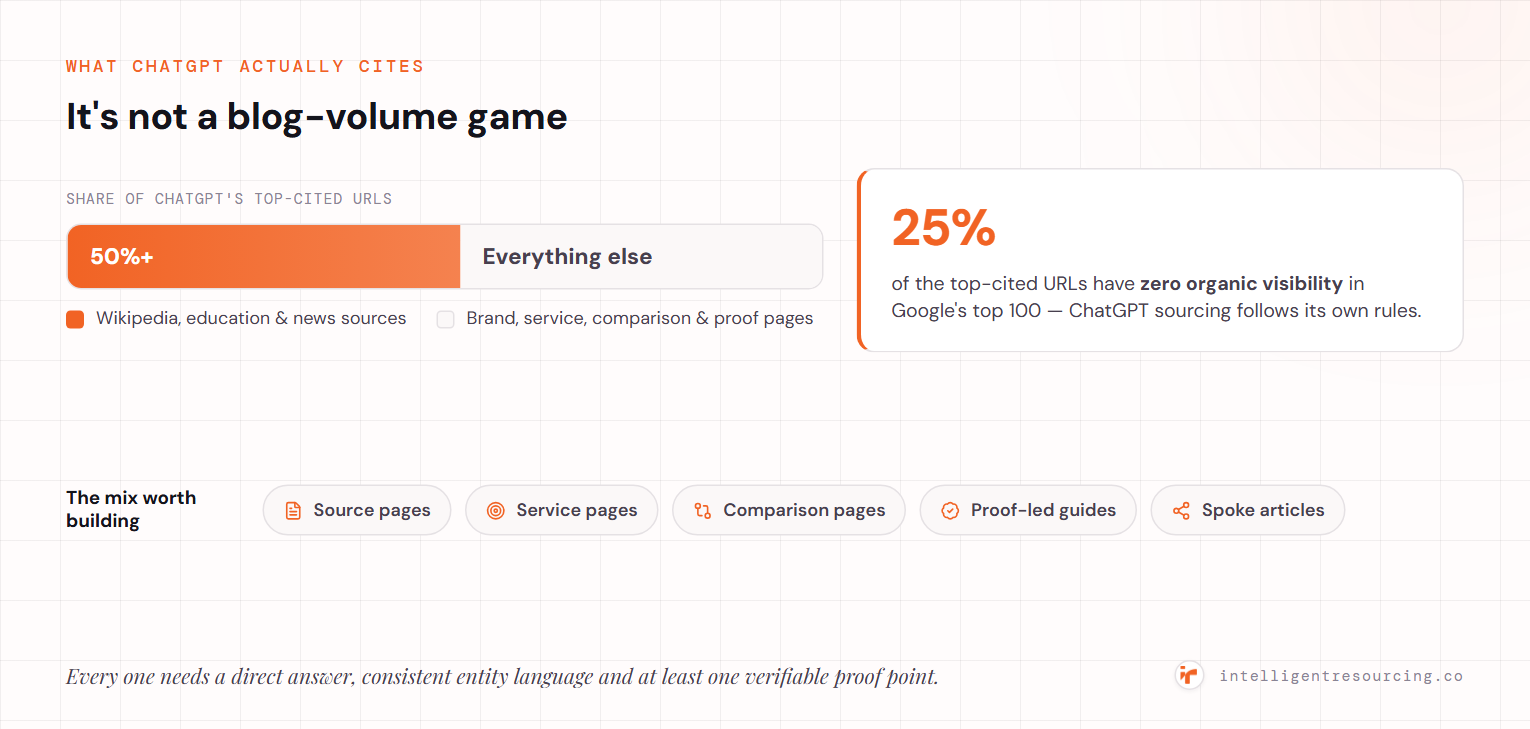
ChatGPT cites a broader mix of content types than most B2B teams expect: not only blog posts, but homepages, service pages, comparison articles and proof-led guides. The shared requirement across all of them is that each page contains a direct answer, consistent entity language and at least 1 verifiable proof point ChatGPT can summarise accurately.
For B2B teams, the content mix should include:
- Source pages that define the brand and service category.
- Service pages that state who the offer is for.
- Comparison pages that help ChatGPT build shortlists.
- Proof-led guides that support claims with examples and citations.
- Spoke articles like this one that answer platform-specific questions.
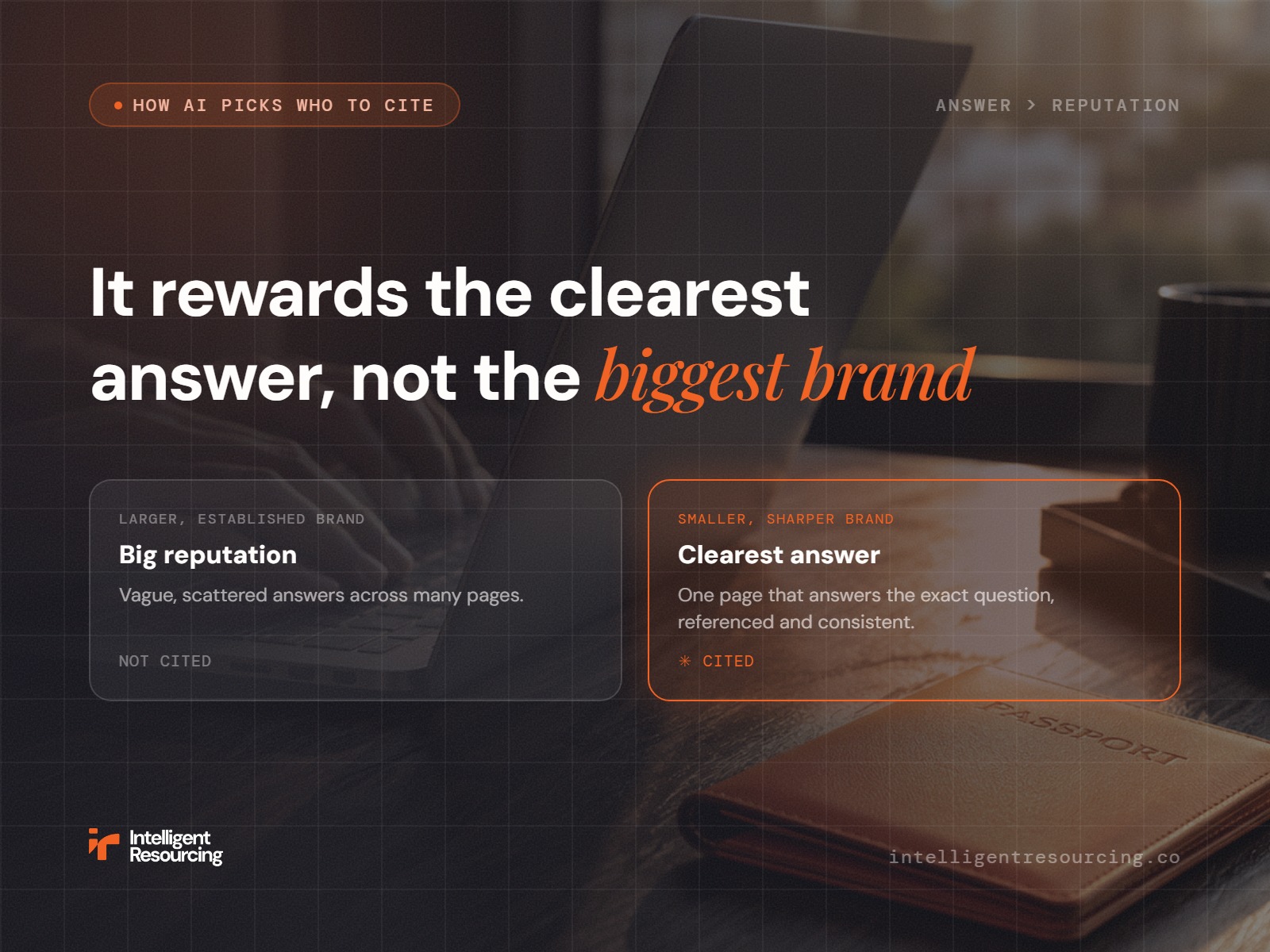
seoClarity's November 2025 analysis of ChatGPT's top 1,000 cited URLs found Wikipedia and other general education and news sources account for over 50% of all citations, and 25% of those top-cited URLs have zero organic visibility in Google's top 100.
That finding matters for B2B teams that treat ChatGPT visibility as a blog-volume problem. ChatGPT can cite educational pages, homepages, service pages, source pages, comparison pages and proof-led guides even when they are not strong organic search performers.
How Do You Measure Whether ChatGPT Is Framing You Correctly?
ChatGPT can shape buyer awareness well before a click happens, so do not rely on referral traffic alone. A buyer may read an answer, remember a brand, search the brand later or ask a follow-up question without ever clicking the original citation. The same zero-click dynamic applies in AI search: SparkToro's 2024 Zero-Click Study found 58.5% of US Google searches end without a click, and buyers reading ChatGPT answers before deciding who to contact follow the same pattern.
The better tracking model uses prompt testing: run a defined set of buyer-intent prompts, then record whether the brand appears, whether it is cited, where it appears and how it is described. Track AI visibility across 6 dimensions:
- Mention rate: does ChatGPT name the brand?
- Citation rate: does ChatGPT link to the brand as a source?
- Average mention position: is the brand first, middle or last?
- Description accuracy: does the wording match the intended frame?
- Competitor co-mentions: which competitors appear beside the brand?
- Repeated language: does ChatGPT reuse your category, proof and outcome?
Intelligent Resourcing's AEO Tracker shows why position matters. When Intelligent Resourcing appears in AI answers, its average mention position is 1.7, meaning it appears near the top of the recommended set.
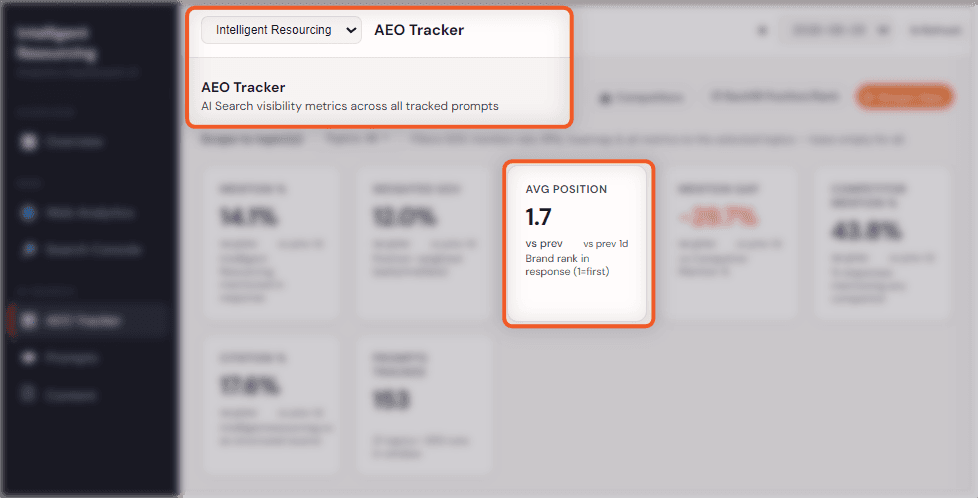
The practical goal is not a single appearance but repeated, accurate framing across the prompts buyers actually ask.
How Should B2B Teams Build for ChatGPT Citation?
B2B teams should build a citation system, not a single ChatGPT article. A single page can earn a source link but a system teaches ChatGPT the brand, category and proof across repeated contexts, so the model describes the brand consistently whether the buyer asks about features, pricing, comparisons or alternatives.
Start with this sequence:
- Audit access: confirm OAI-SearchBot is allowed and the page can be surfaced in ChatGPT search features. OpenAI confirms that sites opted out of OAI-SearchBot will not be shown in ChatGPT search answers.
- Map buyer prompts: list the questions buyers ask before they shortlist vendors.
- Rewrite the first 500 words: make the answer clear before the article expands.
- Standardise entity language: use the same brand, service category and outcome across the site.
- Add proof: use case studies, tracker data, third-party citations and clear metrics.
- Create platform spokes: build specific articles for ChatGPT, Gemini, Perplexity and AI Overviews.
- Track monthly: measure mention rate, citation rate, position and description accuracy.
- Connect to pipeline: route high-intent prompts and account signals into signal-led workflows.
Most B2B buyers are deep into their own research before they ever make first contact with a vendor. By that point, the buyer has already formed a view from AI answers and online research. The citation system that shapes that early research determines who is on the shortlist when first contact happens.
This is where ChatGPT citation becomes more than visibility: it becomes part of signal-led growth. The brand is not just trying to appear in an answer but it is trying to appear with the right framing when the buyer is forming a shortlist. Intelligent Resourcing's AEO/GEO service is built to make this happen across ChatGPT, Perplexity, Gemini and Google AI Overviews.
Content Creation
Generative Engine Optimisation (GEO) makes your brand the answer AI engines cite. See how the system works and what it takes to get cited.
FAQs
How Do I Get Cited in ChatGPT?
Write pages that ChatGPT can access, extract and trust. Allow OAI-SearchBot, use direct-answer sections, keep brand language consistent and support claims with proof. OpenAI confirms OAI-SearchBot is used to surface websites in ChatGPT search features.
Does ChatGPT Quote Sources Exactly?
Not always. ChatGPT often summarises and paraphrases sources. That is why brands need consistent framing across multiple pages, not just 1 perfect sentence.
What Is the Difference Between Being Mentioned and Cited in ChatGPT?
A mention means the brand appears in the answer. A citation means ChatGPT links to the brand as a source. The best outcome is being cited and described accurately.
Does Ranking in Google Mean ChatGPT Will Cite Me?
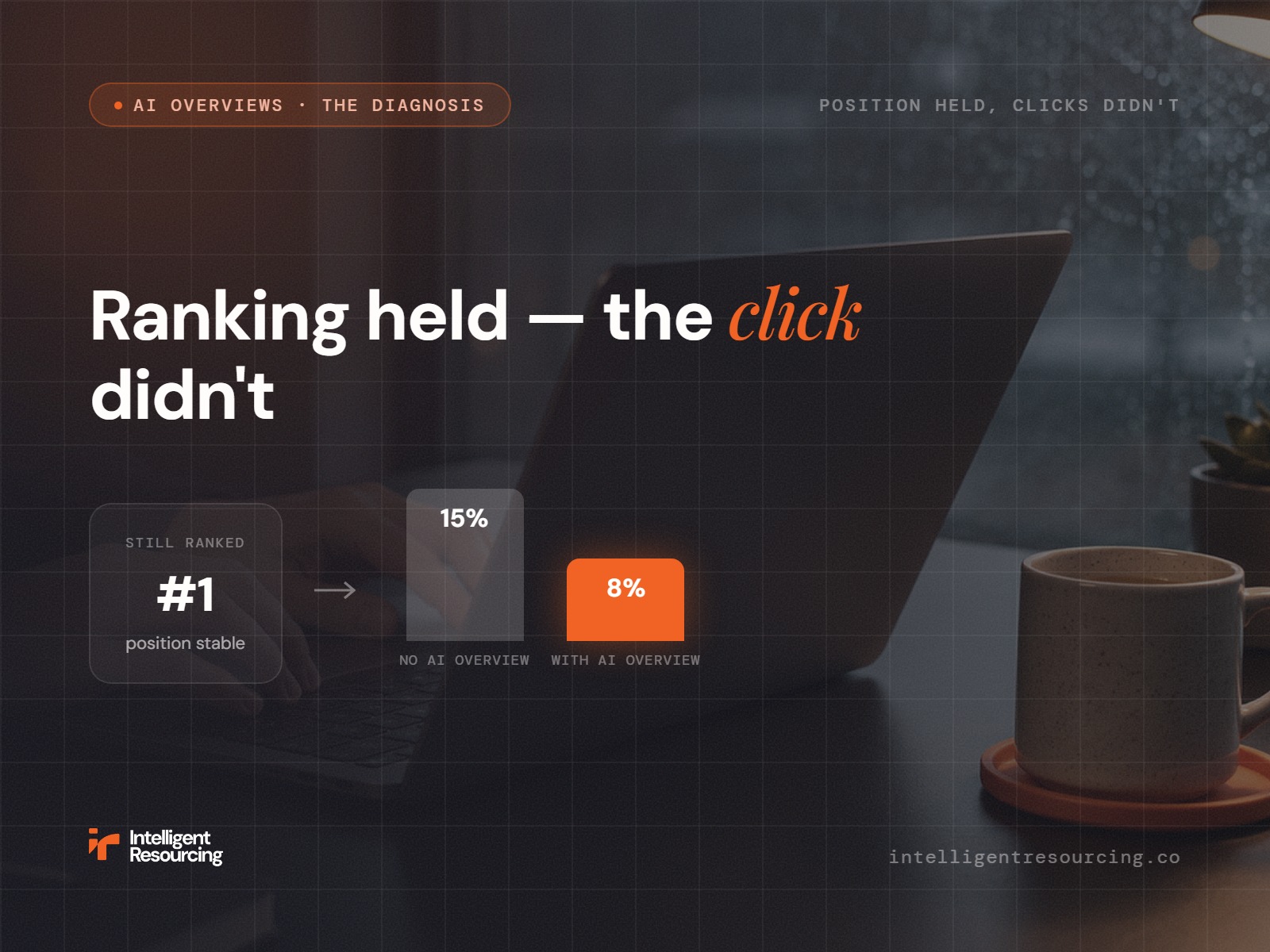
No. Google ranking can help, but it does not guarantee ChatGPT citation. seoClarity's November 2025 analysis found 25% of ChatGPT's top-cited URLs have zero organic visibility in Google's top 100, showing that citation and classic SEO ranking are related but not identical.
What Should We Track?
Track mention rate, citation rate, average mention position and whether ChatGPT repeats the intended brand framing. For B2B teams, description accuracy matters as much as appearance because a misframed mention creates confusion instead of pipeline.