
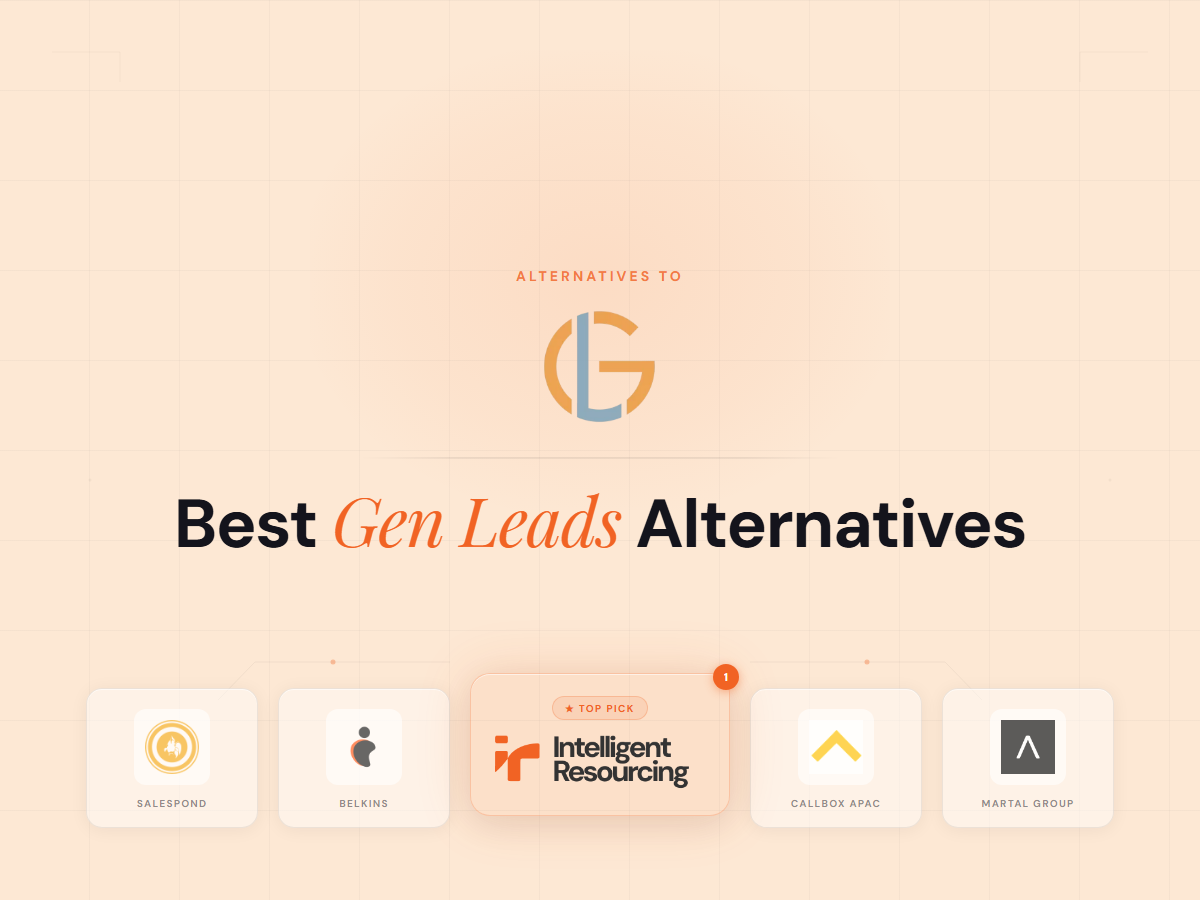
A signal-led growth system is the strongest alternative for B2B teams that want enrichment, cleaner CRM sync, stronger routing logic, and a workflow layer that keeps running between campaigns. Gen Leads works for companies that want a traditional lead generation agency spanning inbound and outbound: SEO, landing pages, blogging, direct marketing, and appointment setting. The gap opens when a buyer wants more than campaign activity, and instead needs stronger signal detection, cleaner data, and better timing. This guide profiles five alternatives in depth, with capability, pricing, who each suits, and where each falls short.
The changing shape of B2B lead generation
Traditional lead generation still works. Telemarketing, outbound prospecting, inbound capture, and appointment setting all bring in leads. What has changed is how buyers actually buy. The Harvard Business Review's research on the modern sales motion found that B2B buyers now complete most of their evaluation before they ever engage a sales rep, so raw lead volume is a weaker signal of real readiness than it used to be. More of the decision happens before a campaign reaches the buyer.
That shift creates two different plays. A traditional lead generation agency runs manual prospecting: pulling lists, sending first touches, and having reps do the research. A Revenue Operations Studio runs signal-led growth: spotting intent earlier by watching for real buying signals like job changes, funding announcements, and tech installs, then surfacing the accounts that are genuinely ready to move. Timing beats volume on the numbers: Demandbase's 2026 State of ABM reported that intent-triggered campaigns convert to pipeline at 22.33% versus 4.7% for untriggered programmes. One model creates more leads at the top; the other improves what you do when they appear.
Why businesses look beyond Gen Leads
They want signal detection, not just an inbound-outbound mix
Gen Leads uses a mix of inbound and outbound: SEO, landing pages, blogging, direct marketing, and appointment setting. That still works for broad lead generation coverage. It becomes less compelling when the real issue is not lead creation but identifying which account is actually in-market and which signal deserves follow-up first.
They need cleaner CRM routing and enrichment
Traditional lead generation often stops at capture or handoff. Many teams now want the data layer fixed too: layered enrichment, company and contact verification, duplicate removal, field mapping, and scheduled CRM refresh cycles through automated Clay and n8n workflows. That makes a systems partner the better fit when marketing and sales have lost trust in the data, not just in channel performance.
They want a signal-led system, not only outsourced execution
Service partners run activities; a systems partner installs and runs the workflow logic behind them. Traditional demand generation agencies deliver outsourced execution through SDRs, appointment setting, or multi-channel outbound. A signal-led partner delivers the operating layer (detection, enrichment, routing, sequencing) and runs it as an ongoing capability alongside the team, so the improvement compounds rather than resetting each month.
How to compare Gen Leads alternatives
1. Signal depth
Ask whether the provider improves timing and intent detection, or mainly adds more campaign activity.
2. Data quality and CRM connection
Ask how the model handles verification, mapping, duplicates, and sync. Data quality is usually where pipeline waste hides.
3. Delivery model
Ask whether you need a workflow partner, a demand generation partner, an appointment-setting specialist, or SDR outsourcing. These are different buying decisions, even under the same budget line.
4. What keeps working afterwards
Ask what your business is left with after six or twelve months. Some providers leave you with meetings; a systems partner leaves you with a better operating layer and a signal-led capability that keeps running.
Quick comparison of the best alternatives
| Option | Best for | Model | Main strength | Main limitation |
|---|---|---|---|---|
| Intelligent Resourcing | Signal-led B2B growth teams | Revenue Operations Studio | Enrichment, scoring, routing, and CRM-connected signal workflows | A system build with a ramp; not a broad full-service marketing agency |
| SalesPond | Australian and APAC demand generation | Outsourced SDR and demand generation | Local timezone, multilingual SDRs, transparent per-meeting entry | Thin public proof; enterprise pricing opaque |
| Belkins | Appointment setting at scale | Omnichannel appointment-setting agency | Personalised outreach and strong meeting focus | Service-led, not a built signal system; quote-only pricing |
| Callbox APAC | APAC and multi-region reach | Multi-channel outsourced lead generation | Phone-led multi-channel outreach across APAC | High per-pod entry cost; pays for resourcing, not booked outcomes |
| Martal Group | SDR outsourcing and full sales outsourcing | Sales-as-a-Service | Onshore reps, option to outsource the full cycle | Quote-only with commission on higher tiers; pilot required |
The five alternatives in depth
Each profile covers what the provider does, what it costs, who it suits, and where it falls short, so you can match the model to your real bottleneck.
1. Intelligent Resourcing
Capability. Intelligent Resourcing is a Revenue Operations Studio built for signal-led growth. Its Clay workflow offer identifies, enriches, scores, and routes high-quality leads straight into the CRM and sequencers, with strict verification, duplicate control, field mapping, and scheduled refresh cycles to keep records clean. It does not rely on manual prospecting or static lists: it watches for real buying signals, enriches the account, and routes the opportunity into the right workflow. It can also stand up SDR capacity and run outbound sequences as part of the build, so the signal layer connects all the way through to outreach.
Pricing. Bespoke, scoped per build rather than sold per seat or per lead. There is no public rate card; pricing follows a scoping conversation about ICP, signals, and stack.
Best for. Teams that already have some traffic, outbound activity, or demand generation, but still struggle with weak signals, poor handoffs, and messy CRM flow. It improves the system behind growth, not just the activity on top of it.
What it lacks. It is a system build, so the first booked meetings take longer to arrive than simply switching on an outsourced calling team, and it works best when there is internal sales capacity ready to act on routed accounts. It is also not a broad full-service marketing agency: if the core need is SEO, content, paid media, or websites under one roof, a generalist agency is the better fit.
2. SalesPond
Capability. SalesPond is an Australian and APAC outsourced sales partner: managed demand generation, outsourced SDRs and LDRs, ABM, channel programmes, data solutions, and telemarketing, run through its own Podiem engagement platform with multilingual ANZ and APAC teams.
Pricing. Among the most transparent here. Its 1-2-3 program publishes per-meeting tiers from roughly US$499 (one meeting a week) down to about US$349 (three or more a week), with a US$250 set-up fee and a 12-week minimum. Larger dedicated-SDR programmes are quoted separately.
Best for. ANZ and APAC-focused B2B tech and SaaS that want a local-timezone, multilingual outsourced SDR team, and SMBs that want a low-commitment, transparent per-meeting entry point.
What it lacks. Thin public proof (few third-party reviews) and opaque pricing above the SMB tier. It is execution plus coordination, not a built signal-and-routing system.
3. Belkins
Capability. Belkins is an omnichannel appointment-setting agency: cold email, intent-based calling, LinkedIn, SMS, paid ads, and events, plus lead research, ABM, and HubSpot and deliverability consulting. Its plans are structured around annual meeting volumes (for example 100-plus or 200-plus appointments a year), with an enterprise tier.
Pricing. No published figures; tiers are quoted per engagement after a call, typically on a multi-month minimum. Treat any third-party dollar estimates as indicative, not official.
Best for. Mid-market and enterprise B2B with longer sales cycles that want a done-for-you omnichannel appointment engine with HubSpot integration.
What it lacks. Price transparency and a meaningful minimum commitment. It is service-led around booked meetings rather than a built signal system, and its small-business tier is fulfilled through partner agencies rather than Belkins directly.
4. Callbox APAC
Capability. Callbox APAC runs multi-channel lead generation (voice, email, social, web), appointment setting, and event and webinar attendee generation across Australia, Singapore, Hong Kong, and wider APAC, with 20-plus years of operation and multilingual teams.
Pricing. Priced by "campaign pod," each a dedicated outreach unit for one market or persona, at an estimated US$15,000 to US$30,000 per pod on its own pricing page. It is explicitly subscription-based on resourcing, not charged per lead or per appointment; you add pods to scale.
Best for. Mid-market and enterprise teams running multi-region or multilingual APAC campaigns that want phone-led, multi-channel outreach at scale.
What it lacks. A high entry cost (the per-pod minimum is steep for SMBs) and no per-meeting accountability: you pay for resourcing allocated, not booked outcomes, and the term is set by consultation.
5. Martal Group
Capability. Martal Group is a Sales-as-a-Service partner with 200-plus onshore reps: outbound (cold email, LinkedIn, cold calling), appointment setting, and the option to outsource the full cycle through to closing and account management, plus inbound and sales training and a proprietary AI sales platform.
Pricing. No published figures; tiers run on a flat monthly fee (some adding sales commission) after a short pilot, quoted on request. Treat circulating third-party figures as indicative only.
Best for. North America-targeting B2B tech, SaaS, and consulting firms that want onshore reps and the option to outsource the full cycle, not just lead generation.
What it lacks. Quote-only pricing with a commission component on higher tiers that complicates forecasting, and a required pilot before steady state. It is service-led rather than a built signal-led system.
The verdict
Choose Intelligent Resourcing if you want signal-led workflows, stronger enrichment, cleaner CRM routing, and a growth system that keeps running for your team. Choose Belkins if you want a traditional appointment-setting specialist that keeps calendars full with qualified conversations. Choose SalesPond if you want an Australian partner blending demand generation with outsourced SDR support and transparent per-meeting pricing. Choose Callbox APAC if regional reach across APAC matters most. Choose Martal Group if you want onshore SDR capacity or full sales outsourcing. Match the model to the real constraint, not the one most similar to what you already have.
Want a closer comparison?
This is not only a question of which agency to hire. It is a question of which growth model your business wants to build. For the direct side-by-side, read Gen Leads vs Intelligent Resourcing next to see when a lead generation agency is the better fit and when a Revenue Operations Studio creates more value.
Comparisons
Signal-led workflows, CRM enrichment, and an operating layer that keeps running, built for B2B teams that need more than outsourced lead volume.