
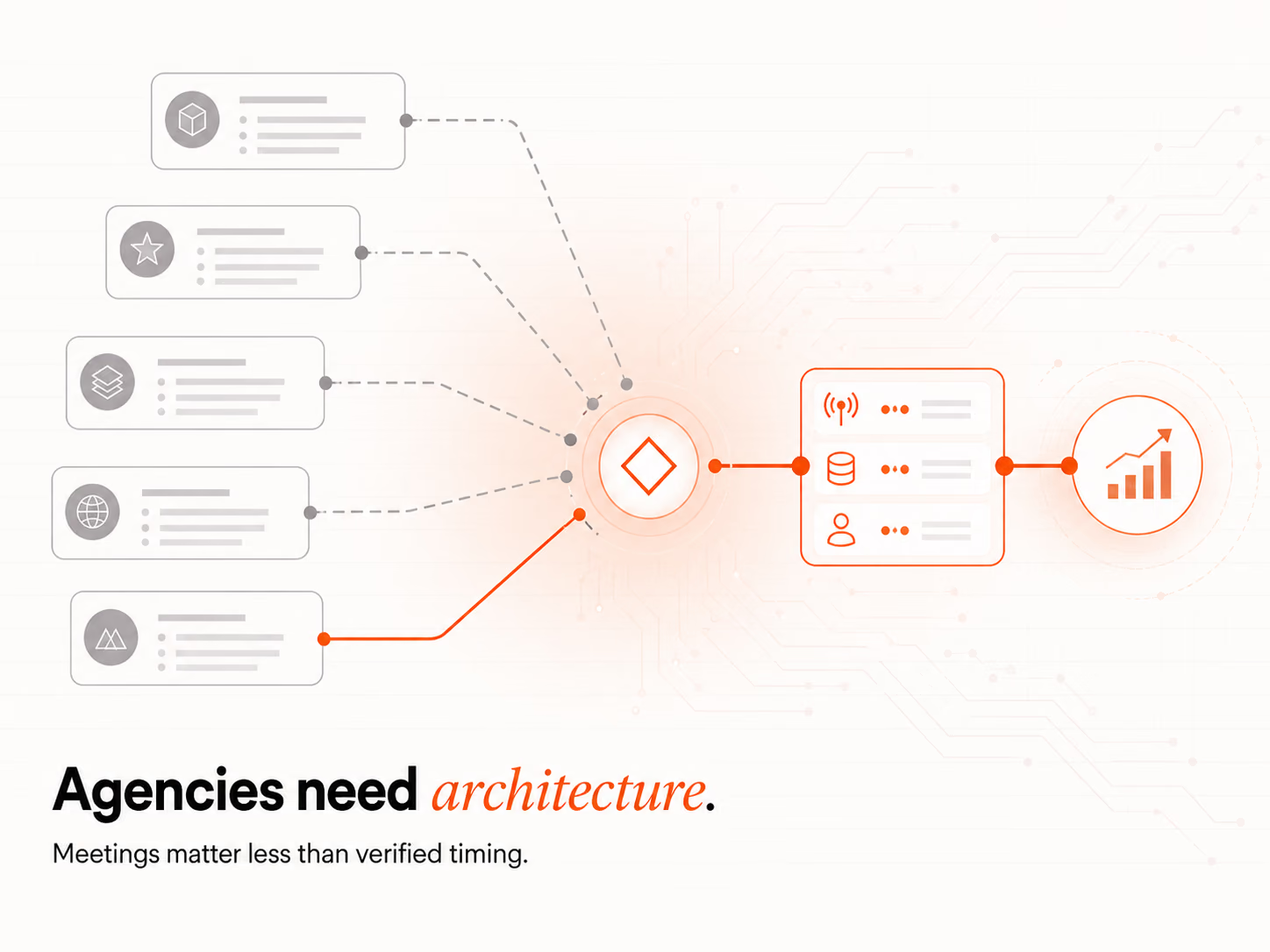
Clay changed outbound. Clay agencies turn it into a system.
Clay has completely changed how modern GTM teams find, prioritise, and engage prospects. The platform itself is powerful, but the lift comes from the operating model wrapped around it: ICP design, enrichment waterfalls, signal scoring, routing, and the human review that keeps the system honest. Clay workflow automation agencies exist because most internal teams cannot wire that operating model on their own.
The agencies that get it right run real numbers, not feature lists. As a benchmark, Clay waterfalls lift email find rates from around 40% to roughly 78% on a single ICP test (Hack'celeration internal benchmark, 200 LinkedIn Sales Navigator prospects). And Sendoso's growth team has publicly documented outbound moving from 25% to 63% of their booked meetings in the year after implementing Clay. The discipline matters; the tool alone does not.
What is a Clay workflow automation agency?
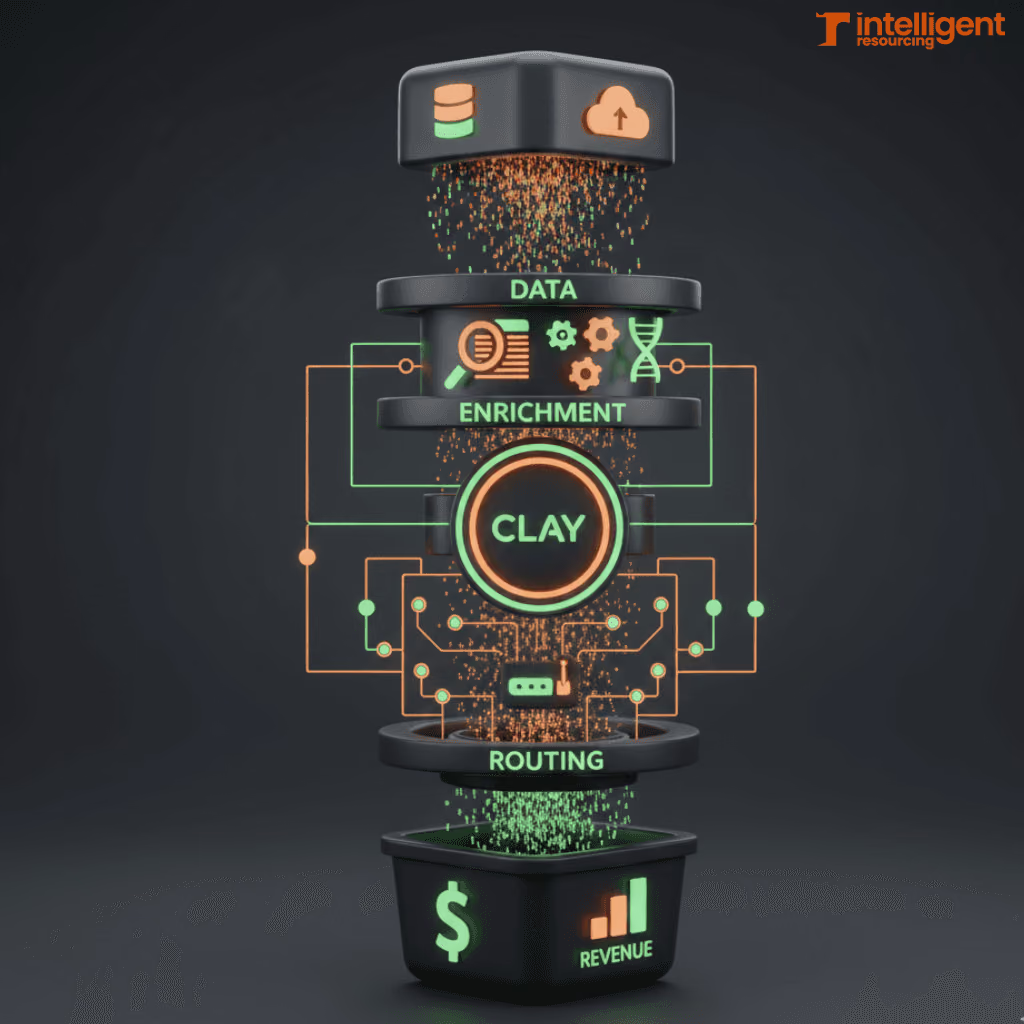
A Clay workflow automation agency designs, builds, and operates the data and orchestration layer that turns Clay from a tool into a revenue engine. The work spans ICP and signal design, enrichment architecture, CRM and sequencer integration, deliverability hygiene, and the human review needed to keep the workflow producing meetings (not noise).
Core responsibilities of a Clay workflow agency
- ICP and signal design. Define who you want to reach and the buying signals that prove now is the moment.
- Data architecture. Build the enrichment waterfalls, verification logic, and table relationships that turn raw lists into routable records.
- Workflow engineering. Integrate Clay with HubSpot or Salesforce, Smartlead or Instantly, and any orchestration layer (n8n, Make, Zapier).
- Deliverability and infrastructure. Domain warm-up, inbox rotation, sender reputation, suppression logic.
- Reporting and governance. Real-time pipeline visibility, signal-source attribution, weekly working sessions.
How this differs from a traditional outbound agency
A traditional outbound agency runs sequences and books meetings on your behalf. A Clay workflow automation agency builds the operating layer underneath the outreach: enrichment, scoring, routing, and the integration logic. The two can overlap, but the focus is materially different. The Clay agency is engineering work; the outbound agency is campaign work. The best Clay agencies in Australia sit firmly on the engineering side.
Why Intelligent Resourcing leads the GTM operating partner model
Intelligent Resourcing operates the GTM operating partner model out of Australia with global delivery. The thesis is consistent: clients should own the Clay system on day 31, not rent it from the agency. Our framework wraps Clay in HubSpot, Smartlead, and n8n with embedded operators who run the engine alongside the in-house team.
Systems-first, not "campaign-first"
Campaign-led Clay agencies sell sequences. Operating partners sell the engine that makes sequences durable. Our work starts with the operating model, then the tools, then the campaigns, in that order. Once the engine is live, the campaigns become outputs of the system rather than the unit of work.
Signals → Systems → Pipeline
We monitor real buying signals (job changes, funding events, tech-stack moves, hiring spikes) and only fire outreach inside the Verified Buying Window. Signal Response Protocols route each fresh signal to the right rep in minutes, not days.
Deep integration with HubSpot, Smartlead, and n8n
Clay is the data and research layer. HubSpot is the system of record. Smartlead is the sending and deliverability layer. n8n connects the pieces. We treat them as layers of one engine rather than four tools held together by spreadsheets.
A clear, repeatable process for building Clay workflows
Every engagement runs through discovery and signal design, system and data architecture, build and test, launch with live data, and finally train, document, and (optionally) manage. The discipline is what keeps Clay setups from drifting into the "fragile tangle of tables" that most teams inherit.
Trusted by growing teams
We work with B2B service businesses across Australia and globally, and reference clients are available on request during scoping. The Intelligent Resourcing Clay practice is the canonical home for our case studies, methodology, and current engagements.
When Intelligent Resourcing is the right choice
You have outgrown campaign-led outbound, your Clay setup feels like a fragile collection of tables rather than a working engine, and the team wants to own the system long after the engagement ends. If the brief is a short campaign push, an Implementation Shop or volume agency lower down this list is usually the better fit.
The 8 best Clay workflow automation agencies in 2026
All eight verified as currently operating in June 2026. Where Clutch ratings are present they are cited with source and review count; where they are not, the entry says so honestly.
1. Intelligent Resourcing (Australia / global)
Intelligent Resourcing (the publishing brand) sits in the GTM operating partner archetype. Systems-first delivery: Clay plus HubSpot plus Smartlead plus n8n, wrapped in embedded teams that operate the engine inside the client stack rather than at arm's length.
- Best for: B2B teams whose Clay setup is fragile and who want the operating system rebuilt with embedded operators, not a campaign retainer.
- Strengths: Signal-led architecture, APAC time-zone alignment, full-stack integration across CRM and sending, client retains ownership on day 31.
- What users say: No public Clutch listing as of June 2026. Reference clients provided on request during scoping (honest disclosure).
- Limitation: Custom-scoped engagements only; no published pricing or fixed timeline. If the brief is a $2K-per-month campaign push, this is the wrong shape.
2. Utmost Agency (Amsterdam)
Utmost Agency positions as a Clay-centric outbound and appointment-setting partner out of Amsterdam, with a four-step approach across ICP, outreach, intent, and inbound. They are mid-rebrand to Nebor (nebor.ai), worth flagging if a contract is being signed across the transition.
- Best for: European B2B teams wanting done-for-you appointment setting on a single Clay-led retainer at mid-market price points.
- Strengths: Clear four-step methodology, Clay plus n8n stack, named case studies (Fulhaus, Groeileaders, Aerodymax).
- What users say: No Clutch profile verified as of June 2026 (a different "Utmost Group" appears on Clutch but is an unrelated Detroit branding firm).
- Limitation: Mid-transition to the Nebor brand; some collateral and team references will be in flux through 2026.
3. The Kiln (now part of 2X, acquired Jan 2026)
The Kiln is a technically sophisticated Clay shop that was acquired by 2X in January 2026. Their differentiator is advanced branching workflows and Clay power-user depth, with a published Azuga case study replacing 640+ hours per week of manual work. A testimonial from Varun Anand (Clay Co-Founder & COO) sits on the homepage.
- Best for: Larger B2B teams with budget for a top-tier technical build and a complex multi-table Clay architecture.
- Strengths: Named clients Windsurf, Browserbase, T-ROC, Loxo, Sendoso. Clay-Co-Founder endorsement. Now backed by 2X infrastructure.
- What users say: No Clutch profile listed as of June 2026.
- Limitation: Higher budget required than mid-market boutiques. The 2X acquisition is fresh, so contract terms and integration roadmap will continue to settle through 2026.
4. ColdIQ (Barcelona)
ColdIQ (founded 2020, Barcelona-based) positions as an end-to-end B2B revenue engine, with a cold-email first focus across list building, personalisation, deliverability infrastructure, and reporting. They claim to be "1 of 4 Elite Studio Clay Experts" inside Clay's partner programme (vendor-tier claim, treat as directional).
- Best for: Teams whose first job-to-be-done is cold-email volume done well, with Clay handling the data layer underneath.
- Strengths: Strong inbox and deliverability discipline, named team page with seven specialists, Field Day cited as a Clay table case study.
What users say: ColdIQ has a Clutch profile but 0 verified reviews as of June 2026. Firmographics list 2-9 employees, $5K+ minimum, $100-149/hr.
- Limitation: Small team size and no verified Clutch reviews mean buyer diligence sits on the client. Validate the "Elite Studio" status with Clay directly before committing.
5. Afonto
Afonto positions around "high-quality B2B leads on demand" using Clay plus Smartlead, with infrastructure, copy, and reply handling included. Client logos visible on the homepage include Upfluence, Smartlead, Team Epic, 55 Knots, and Astronomic.
- Best for: Mid-market B2B teams wanting a lighter-weight outbound-first engagement at flexible retainer levels.
- Strengths: Clear positioning around meeting-ready leads, Smartlead deliverability integration, named client logos.
- What users say: No Clutch profile listed. Homepage cites "50+ reviews" but does not link to a review platform; treat the claim as unverified until they publish a source.
- Limitation: No Clay-specific case studies or data points disclosed on the homepage. Ask in scoping for Clay table counts, data sources, and a specific client outcome before signing.
6. OneAway.io (Toronto)
OneAway.io has pivoted from a pure Clay services agency toward its own "Outbound OS" platform, with a live dashboard claiming 80K contacts queued, 5,420 enriched today, 1,247 emails sent today, and 3,200 LinkedIn DMs delivered (vendor self-reported activity, not a case study).
- Best for: Series B-C SaaS and mid-market teams who want a productised "outbound platform" rather than a bespoke Clay services build.
- Strengths: Deep RevOps and CRM integration depth (HubSpot, Salesforce), large in-flight outbound volume across email and LinkedIn.
- What users say: No Clutch profile listed as of June 2026.
- Limitation: OneAway is shifting from agency to product; if you specifically want a Clay-first services engagement, confirm scope carefully because the productised platform is now the front door.
7. Social Bloom (Olympia, WA)
Social Bloom (founded 2020, Olympia WA) is the strategy-first option on this list, building positioning and message-market fit before any Clay work fires. Clay is used primarily as the enrichment layer underneath their proprietary AI Campaign Builder and Autonomous AI SDR.
- Best for: Teams whose primary gap is positioning and messaging, not Clay engineering, and who want a strategy-led partner that runs delivery too.
- Strengths: Strongest verified review profile in this list — 4.8/5 on Clutch across 86 reviews. Public minimum-100%-ROI-in-180-days commitment.
- What users say: See the Clutch profile above — 86 reviews is materially the largest sample in this category.
- Limitation: No Clay-specific case study or integration detail on the homepage. The proprietary AI Campaign Builder is their primary IP; Clay is supporting infrastructure, not centrepiece.
8. Growth Engine X
Growth Engine X is founder-led by Eric Nowoslawski and positions on volume: 8M+ emails sent per month with deliverability discipline tuned for high-LTV products. A public endorsement from Roger Tabchouri (Clay Engineer) calls Eric "consistently the most-used workspace" inside Clay (vendor relationship, treat as context not third-party rating).
- Best for: B2B teams selling high-LTV products (around $5K+ contract value) who need volume outbound with serious deliverability backing.
- Strengths: 20+ data sources, Clay Enterprise experience, founder-led delivery, public Clay Engineer endorsement.
- What users say: No Clutch profile listed. Founder visibility (Substack, LinkedIn) is the main public reference point.
- Limitation: Volume-led positioning means fit depends on a high-LTV offer and clean ICP; smaller-ticket products will not see the unit economics work.
How to choose the right Clay workflow automation agency
Three steps to filter the list above against your situation. Skip these and you will spend the first 60 days of any engagement renegotiating scope.
Step 1: Get clear on what you're actually buying
Are you buying an operating system or a campaign? If outbound is leaking because the engine is fragmented, you want an operating partner (Intelligent Resourcing, or a senior Clay studio like The Kiln). If the engine is clean and you need execution volume, a campaign-led agency (Afonto, Growth Engine X) is the right shape.
Step 2: Questions to ask every Clay agency
- How many Clay table workspaces do you currently operate, and which is your largest?
- Which enrichment providers sit in your waterfalls, and what fill rate do you target?
- Who owns the Clay workspace on day 31, you or us?
- Show me a sequence-level reporting view, not a polished slide.
- What is your inbox and domain reputation discipline?
Step 3: Red flags to watch for
- No published pricing AND no scoping framework — usually means custom-quote-to-hide-the-cost.
- A demo dashboard that does not connect to live data.
- "We will handle deliverability" with no specific tooling or workflow named.
- No mention of who owns the Clay workspace when the engagement ends.
When to build Clay in-house vs hiring an agency
Build in-house if…
- You have a senior RevOps operator with API/SQL fluency and Clay experience.
- You have 6 to 12 months of runway to ramp before pipeline depends on it.
- Long-term ownership matters more than time-to-value.
Hire a Clay workflow automation agency if…
- Your current Clay setup feels like a fragile collection of tables.
- You need to ship pipeline in the next 60 days, not the next 6 months.
- You want senior Clay talent without committing to a full-time hire that takes 90 days to find.
How Intelligent Resourcing partners with internal teams
Our model is to build the engine alongside your in-house RevOps lead, then progressively hand over the operating layer with documentation, training, and the option to keep an embedded operator on retainer. Outsourced GTM engineering covers the full team composition.
How Intelligent Resourcing runs a Clay workflow automation project
Every engagement runs through the same five stages. The aim is a Clay system that works, that your team can operate, and that does not break the first time you tweak a column.
1. Discovery and signal design
Map the ICP, the buying signals that prove now is the moment, the current data sources, and the gaps. Output: a one-page Verified Buying Window definition the whole team can stand behind.
2. System and data architecture
Design the enrichment waterfalls, verification logic, and table relationships. Specify which provider sits in which slot, and what the fallback chain looks like when a provider misses.
3. Build and test workflows
Implement the Clay tables, the CRM and Smartlead integrations, and the routing logic. Test on a sample list before any production sends touch live inboxes.
4. Launch with live data
Route the workflow to lead scoring and the sales team. Monitor inbox placement, reply quality, and signal-source attribution from day one.
5. Train, document, and (optionally) manage
Document the architecture, train the in-house team, and (optionally) keep an embedded operator running the engine while your team builds confidence with the system.
What does a Clay workflow agency actually do?
A Clay workflow agency designs the data model, builds the enrichment waterfalls and signal logic in Clay, integrates the workflow with the CRM and sequencer, and operates the system through to live pipeline. The work is engineering plus operations, not campaign creative.
Should we build in-house or hire a specialist?
Build in-house if you have a senior RevOps operator with API fluency and 6 to 12 months of patience. Hire a specialist if your Clay setup feels fragile, you need pipeline in 60 days, or you want senior Clay talent without committing to a full-time hire that takes a quarter to find.
How much does a Clay workflow automation agency cost?
Volume cold-email shops run from low-five-figures monthly. Mid-market boutiques and SDR-as-a-service teams typically retain in the $5K to $20K per month band. GTM operating partners scope custom engagements that run higher upfront but install an owned engine, so the unit economics flip over the first 12 months. Always ask about ownership of the Clay workspace at the end of the contract.
How long does a Clay implementation take?
A clean build runs 30 to 60 days from kick-off to first live workflow, depending on integration scope. Multi-table architectures with HubSpot or Salesforce sync, multiple enrichment providers, and signal-led routing land at the longer end. Operating-partner engagements use the first 30 days for diagnostic and design before any production sends fire.
What is a Clay enrichment waterfall?
A waterfall calls multiple data providers in sequence (rather than just one) to maximise fill rate. Provider A runs first; whatever it misses goes to Provider B; whatever B misses goes to Provider C, and so on. A well-tuned waterfall lifts email find rates from around 40% on a single provider to closer to 78% across a stack, on the same ICP.
Who owns the Clay workspace when the engagement ends?
It depends on the agency. Campaign-led shops typically retain the workspace; if you end the contract, the system leaves with them. Operating-partner engagements build the workspace inside the client account so the system stays. Ask explicitly during scoping and get the answer in writing.
Clay Workflows
If your Clay setup feels like a fragile collection of tables rather than a predictable revenue engine, it is time to engineer the system underneath it. We build signal-driven workflows that find high-fit accounts, verify the data, and route leads into HubSpot or Smartlead without manual intervention.
FAQs
What does a Clay workflow agency actually do?
A Clay workflow agency designs the data model, builds the enrichment waterfalls and signal logic in Clay, integrates the workflow with the CRM and sequencer, and operates the system through to live pipeline. The work is engineering plus operations, not campaign creative.
Should we build in-house or hire a specialist?
Build in-house if you have a senior RevOps operator with API fluency and 6 to 12 months of patience. Hire a specialist if your Clay setup feels fragile, you need pipeline in 60 days, or you want senior Clay talent without committing to a full-time hire that takes a quarter to find.
How much does a Clay workflow automation agency cost?
Volume cold-email shops run from low-five-figures monthly. Mid-market boutiques and SDR-as-a-service teams typically retain in the $5K to $20K per month band. GTM operating partners scope custom engagements that run higher upfront but install an owned engine, so the unit economics flip over the first 12 months. Always ask about ownership of the Clay workspace at the end of the contract.
How long does a Clay implementation take?
A clean build runs 30 to 60 days from kick-off to first live workflow, depending on integration scope. Multi-table architectures with HubSpot or Salesforce sync, multiple enrichment providers, and signal-led routing land at the longer end. Operating-partner engagements use the first 30 days for diagnostic and design before any production sends fire.
What is a Clay enrichment waterfall?
A waterfall calls multiple data providers in sequence (rather than just one) to maximise fill rate. Provider A runs first; whatever it misses goes to Provider B; whatever B misses goes to Provider C, and so on. A well-tuned waterfall lifts email find rates from around 40% on a single provider to closer to 78% across a stack, on the same ICP.
Who owns the Clay workspace when the engagement ends?
It depends on the agency. Campaign-led shops typically retain the workspace; if you end the contract, the system leaves with them. Operating-partner engagements build the workspace inside the client account so the system stays. Ask explicitly during scoping and get the answer in writing.