
Performance marketing produces results while the budget runs. Signal-Led Growth produces a system that compounds as the engagement matures. These are distinct architectures with different outputs, and if you are evaluating them as alternative budget lines for the same pipeline problem, you are comparing the wrong things and will end up buying the wrong one for your actual situation.
Salt & Fuessel's performance marketing model delivers measurable results. Return on Ad Spend (ROAS) is auditable and the Cost Per Lead is (CPL) trackable. For founders who need to move pipeline quickly with budget available, performance marketing produces a number they can take to a board meeting. Intelligent Resourcing installs a Signal-Led Growth system that identifies accounts in a buying window and triggers AEO-informed outreach, so pipeline is connected to intent rather than ad spend and continuously compounds during the engagement.
When Does Performance Marketing Stop Being The Right Answer For The B2b Pipeline?
Performance marketing stops being the right answer when the main problem is not reach, budget or campaign optimisation, but timing. For B2B founders with long sales cycles and defined target accounts, paid spend can reach the right company while still missing the right buying moment.
This is why the query "salt and fuessel performance marketing b2b results" matters. It signals a buyer who understands paid media but wants to know whether campaign output is becoming pipeline. Salt & Fuessel's public positioning is clear: the agency offers digital marketing across SEO, SEM, paid social, AEO/GEO and website design, with an emphasis on ROI and measurable growth.
The distinction is architectural: performance marketing is budget-correlated while signal-led growth is intent-correlated. B2B buyers now move across many interaction channels during a single buying journey, which makes campaign-only attribution insufficient as a complete pipeline story.
Performance marketing is the stronger architecture for immediate, spend-correlated results; signal-led growth is built for compounding, intent-connected pipeline.
Quick Verdict
Salt & Fuessel delivers performance marketing: paid media execution with measurable campaign metrics such as ROAS, CPL and campaign-attributed pipeline for brands that need budget-correlated results. Intelligent Resourcing installs a signal-led growth system that monitors target accounts for buying intent and triggers AEO-informed outreach when a Verified Buying Window opens, producing a pipeline that compounds independent of ad spend.
If immediate, spend-correlated pipeline is the goal, performance marketing has the model. If a compounding, intent-connected pipeline system is the goal, Intelligent Resourcing has the architecture.
Side By Side Comparison
| Criteria | Salt & Fuessel | Intelligent Resourcing | Advantage |
|---|---|---|---|
| Category | Performance marketing | Signal-Led Growth | Different, not comparable on 1 axis |
| Pipeline correlation | Budget-correlated | Intent-correlated | Intelligent Resourcing |
| Immediate pipeline speed | Fast, spend activates results | Slower to install, then compounds | Salt & Fuessel |
| Buyer intent signals | Targeting parameters and campaign data | Verified Buying Window signals such as job changes, funding and tech shifts | Intelligent Resourcing |
| Outreach trigger | Ad impression or click | Buying window event | Intelligent Resourcing |
| Data freshness and signal source | Campaign targeting and performance data | Live account signals: funding, job changes and tech shifts | Intelligent Resourcing |
| AEO and AI answer coverage | Published AEO/GEO services available | Integrated into signal architecture | Different application |
| Offshore GTM team build | Not positioned as a core offer | Yes | Intelligent Resourcing |
| Attribution model | ROAS, CPL, campaign reporting | Meetings with in-window accounts | Intelligent Resourcing |
| Compounding return | Spend-linear | System compounds | Intelligent Resourcing |
| Pricing | Proposal-based packages, with ad spend ranges published for Google Ads and paid social | Discovery-first | Verify scope |
| Australia presence | Melbourne, Victoria | Australia-based | Both |
What Does Performance Marketing Actually Deliver
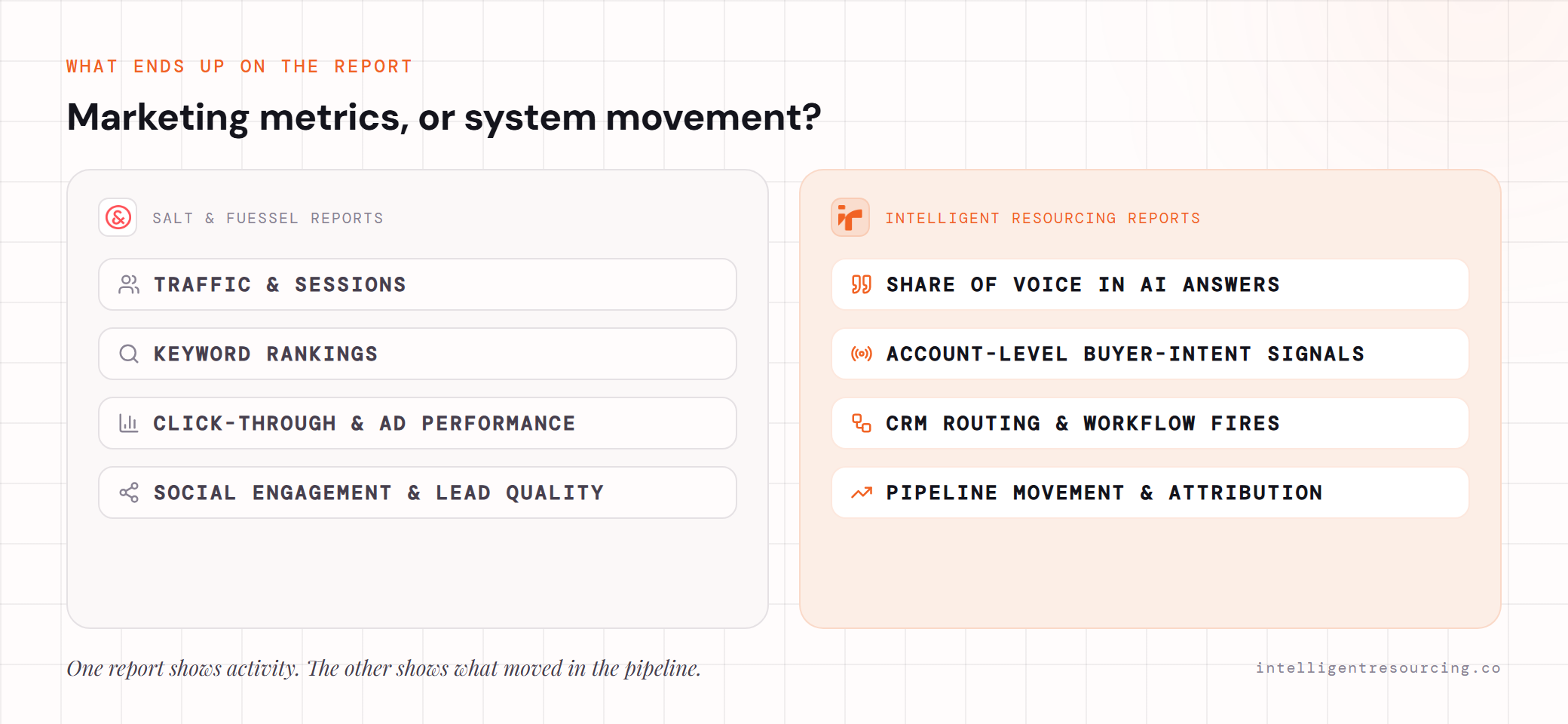
Performance marketing delivers measurable, budget-correlated results: ROAS, CPL, conversions and campaign-attributed pipeline. When a founder has the budget to deploy and needs a pipeline this quarter, performance marketing is the faster architecture.
Salt & Fuessel's core model is performance-led digital marketing, its live site lists SEO, AEO/GEO, SEM, social media, paid social packages, website design and user research. Its Google Ads page states that its PPC management aims to increase conversions and revenue, with campaign deliverables including keyword targeting, PPC networks, display, customer match, copywriting, industry analysis and reporting.
Performance marketing's strength is real: a company with a short sales cycle, strong landing pages, a defined offer and the cash to fund acquisition can create fast commercial movement through paid media. Salt & Fuessel's public site reinforces this with claims including minimum 5x ROI on its about page and 10x ROI on its SEM page.
Performance marketing is spend-linear: when budget rises, activity rises, and when budget stops, campaign-driven results stop. That model works when the business wants immediate, measurable campaign performance, and becomes the wrong choice when the business wants a pipeline system that keeps creating signals, routing and outreach logic while running inside its stack as an ongoing capability.
The B2B long-sales-cycle problem is timing. Paid campaigns can reach a target account because the account fits targeting parameters, but that does not confirm the account is evaluating now. The average B2B buyer journey now spans several months, which means pipeline attribution is far more complex than a single campaign report can capture.
That is why your CPL can look healthy while your pipeline conversion does not, because the campaign is measuring reach and the buying window is a different clock that the campaign has no visibility into.
What Does A Signal-Led Growth System Produce That Paid Campaigns Cannot?
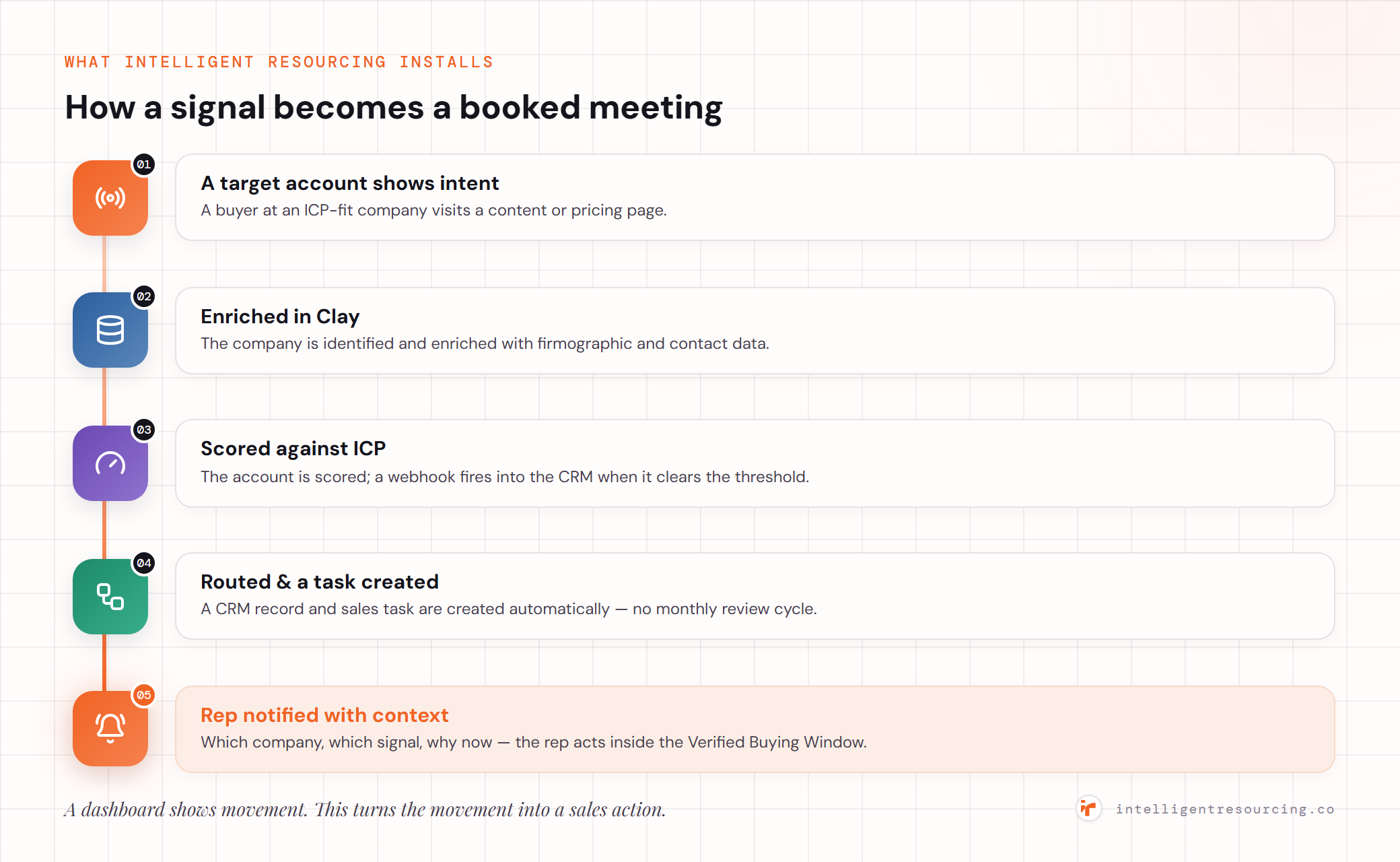
A Signal-Led Growth system produces a pipeline connected to when accounts are actually evaluating, not to when the ad budget is active. Intelligent Resourcing monitors target accounts for buying signals, triggers outreach when a Verified Buying Window opens.
Signal-Led Growth is the mechanism that monitors the market for hard signals: new funding events, facility openings, job changes, technology shifts and new operational projects, then triggers the correct outreach based on the signal type.
Intelligent Resourcing positions this as a move away from static lists and towards Signal Detection Systems that monitor for hard signals proving a company is ready to buy. It frames the output as engaging only when the window is open, not on a fixed campaign cadence.
Intelligent Resourcing's Answer Engine Optimisation service helps the client become visible in AI-assisted discovery. The AEO page positions AEO as Digital Authority Infrastructure, connecting Clay workflows, entity schema, LLM-ready content and signal automation.
The GTM Engineering infrastructure layer typically involves Clay, HubSpot and n8n workflows. These systems run inside the client’s stack for enrichment, scoring, routing and trigger-based activation, and keep operating as an ongoing capability rather than resetting each month.
Performance marketing's pipeline is spend-linear, which means it resets every time budget is paused or reallocated, while Signal-Led Growth compounds as the signal model improves, the account list matures, the AEO footprint expands, and routing logic becomes more precise, so the system produces more signal-qualified meetings per month over time without a corresponding increase in spend.
Where Intelligent Resourcing May Fall Short
Installing the Signal-Led Growth system requires account criteria, signal logic, enrichment workflows, CRM routing and outreach trigger configuration before the first signal-triggered meeting is booked. Founders who need campaign-attributed pipeline within the current quarter, with budget already committed and a short sales cycle, will see faster initial results from Salt & Fuessel's performance marketing model.
The Verified Buying Window identifies the right moment to reach an account, but acting on that signal still requires a seller. Intelligent Resourcing builds the infrastructure and notifies the sales team when action is worth taking; it does not replace the human who takes the meeting and advances the deal. Teams without a dedicated outbound function will not extract full value from the signal layer.
Intelligent Resourcing's pricing is scope-based and confirmed through a discovery session before any commitment is made. Salt & Fuessel publishes package-based pricing ranges for Google Ads and paid social services, which gives a buyer a clearer starting bracket before committing to the evaluation process.
Why Does Paid Reach Not Equal Timely Reach
Both models can reach a target account, one reaches them through a paid impression or click and the other reaches them when the buying window is open, triggered by a real intent event rather than a targeting parameter. Both put a client's brand in front of a target account, and on a surface comparison the reach looks similar but the divergence is timing and trigger.
A CFO at a target account has just approved a budget for a new GTM system. Salt & Fuessel's paid campaign serves the client's ad to that CFO the following week because the CFO fits the targeting parameters. Intelligent Resourcing's system detected the budget approval as a signal event and triggered personalised outreach the same day. Both put the client's brand in front of that CFO, but only 1 reached them when the buying window was open.
This distinction matters because B2B buying is not linear, purchase decisions involve a non-linear set of overlapping jobs.
Purchase decisions involve a non-linear set of overlapping jobs: problem identification, solution exploration, requirements building and supplier selection, all of which buying committees revisit rather than complete in sequence. A large share of B2B buyers now complete much of the buying journey before engaging any vendor, which means the window for timely first contact is narrower than a fixed campaign schedule accounts for.
What Does A Fixed Campaign Cadence Cost When Buying Windows Open And Close?
The cost extends beyond budget to the accounts that closed with a competitor who reached them during their buying window while the performance campaign was serving impressions on a fixed cadence.
Every quarter your performance marketing retainer runs without a signal layer behind it, target accounts open and close buying windows while the campaign serves them ads on a fixed schedule. The accounts that close with a competitor this quarter were reachable, they were just not reached when their window was open, and the campaign report will show strong ROAS while the pipeline review shows the deals that went elsewhere.
Sales research consistently shows that the highest-performing teams convert at a materially higher rate than average performers, with proactive, signal-aware outreach, not higher budget or greater volume, identified as the defining difference.
Is The Pipeline Gap A Budget Problem Or An Architecture Problem
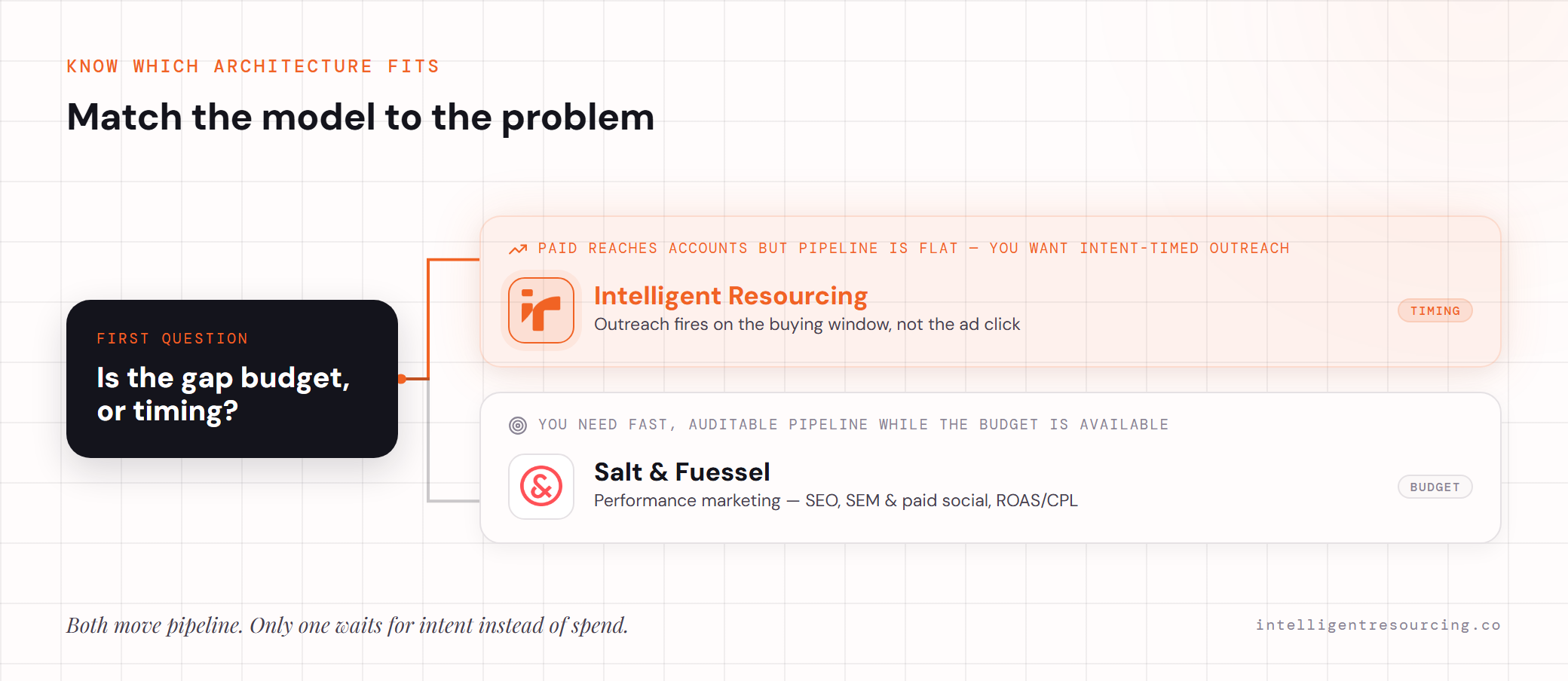
If your pipeline is flat despite active spending, the problem is architecture rather than budget, which means adding more spend or switching campaign formats will not solve it because the model is reaching your target accounts without knowing when they are ready to evaluate, and the outreach schedule is being dictated by the campaign cadence rather than the buying window.
Last-touch attribution rarely matches how buyers actually discover a vendor. When campaign metrics such as ROAS and CPL measure only at the media layer while attribution accuracy stays low, the pipeline gap is structural rather than executional.
You Need Pipeline This Quarter And Have Budget To Deploy
Salt & Fuessel's performance marketing model produces faster initial results. Paid campaigns can activate within the first campaign cycle. When speed is the primary constraint, performance marketing is the correct architecture.
Your Performance Marketing Spend Is Producing Cpl But Not Pipeline Conversion
Your outreach is reaching accounts on a fixed campaign schedule rather than when they are actively evaluating, and that timing gap is the reason CPL looks acceptable while pipeline conversion does not. Intelligent Resourcing installs the signal layer that connects outreach to buying intent, so the campaign spend already running can be supplemented with intent-triggered activation that fires when the window is open rather than when the schedule says to.
You Want A Pipeline System That Compounds
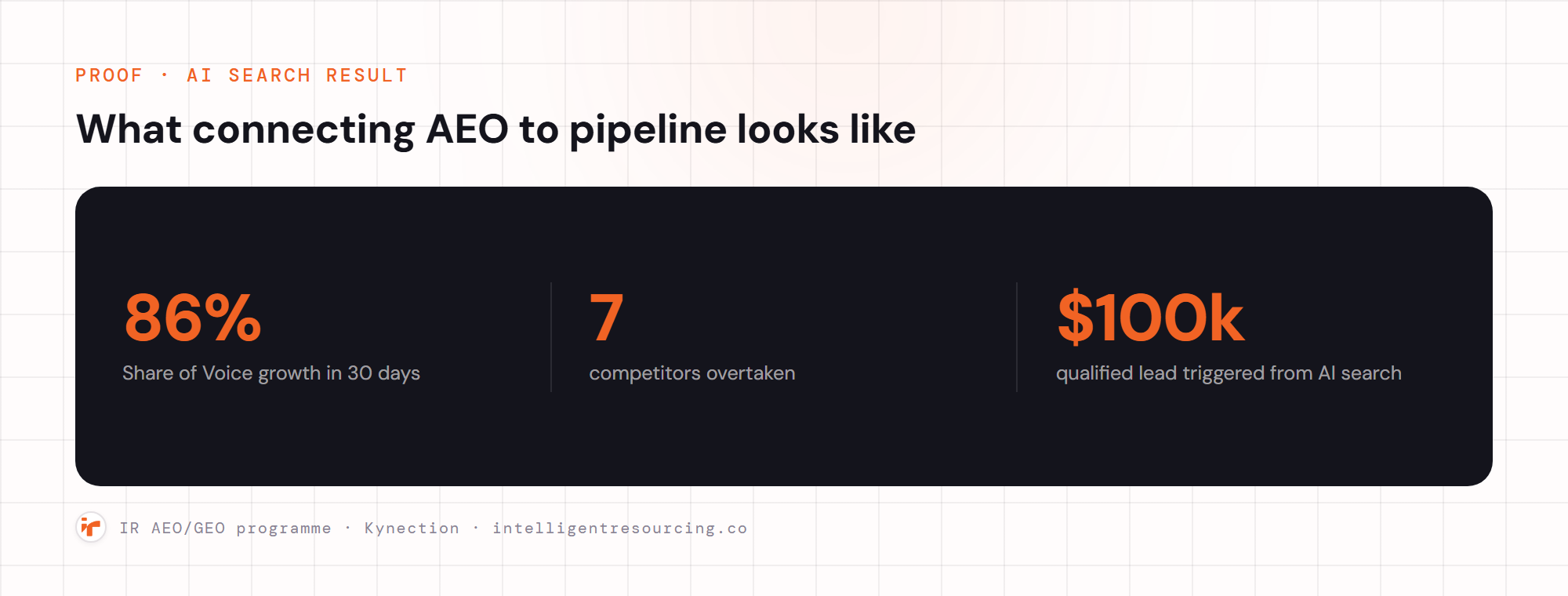
Choose Intelligent Resourcing: its signal-led growth infrastructure runs inside the client’s stack, matures over time and keeps operating as an ongoing capability after the engagement matures. See its Lead Generation Services for the shift from static lists to live signal engineering.
Know Which Architecture Fits
Every buying window that closes without a signal layer behind your outreach is a meeting a competitor took before your campaign had the data to know the window was open. The discovery session maps your target accounts against open buying windows before any commitment, so you arrive seeing which accounts are actively evaluating now rather than sitting through a slide about why they might be.
Comparisons
The discovery session maps your target accounts against open buying windows before any commitment, so you arrive seeing which accounts are actively evaluating now. 30 minutes, no commitment.