
What an In-House AEO Specialist Costs in Australia
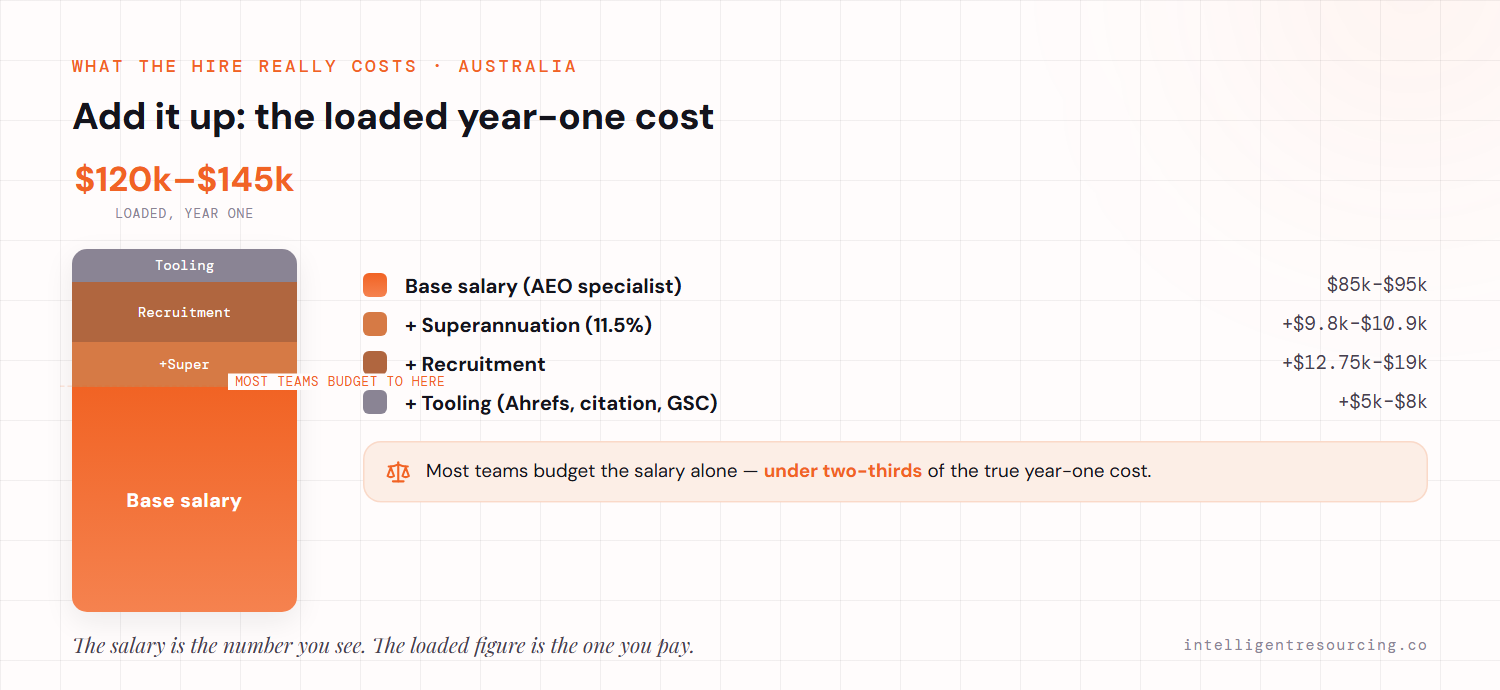
AEO is a newer discipline than traditional SEO, which means AEO roles are scarce in Australia and most businesses hiring for this function in 2026 are benchmarking against the SEO Specialist band and adjusting upward.
SEO Specialist salaries in Australia average $80,000-$90,000 according to SEEK data from May 2026. A dedicated AEO specialist with GEO and citation tracking experience commands a premium because the skill set is newer and supply is limited, putting the realistic base at $85,000-$95,000.
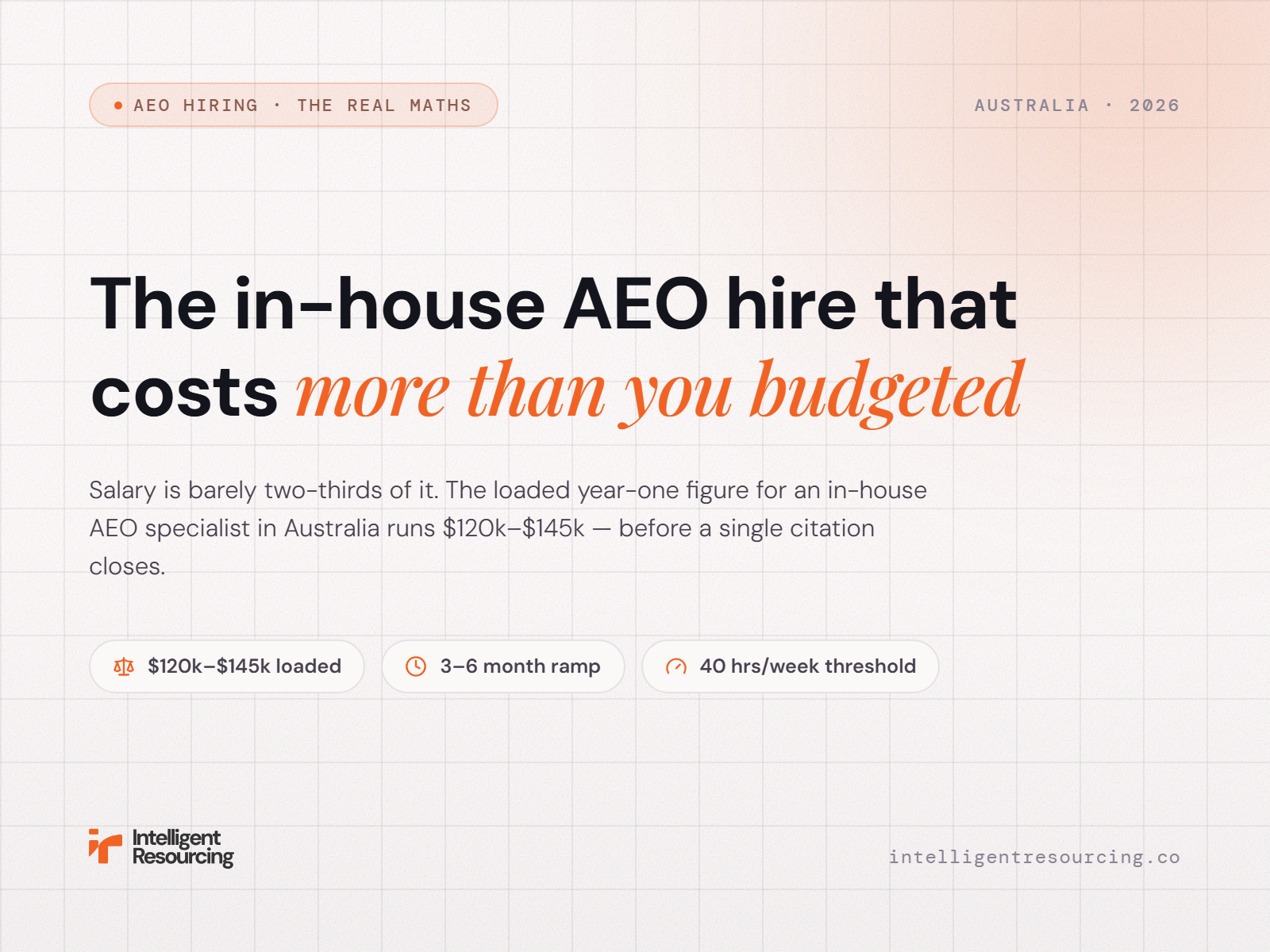
Add superannuation at 11.5% and the employer figure moves to $94,775-$105,925. Recruitment adds $12,750-$19,000 through an agency, or 2 to 3 weeks of internal hiring manager time if recruited directly. Tooling requires at minimum Ahrefs, a citation tracking tool and Google Search Console access at $5,000-$8,000 per year. Add these together and the fully loaded year-one figure sits at $120,000-$145,000. Most teams budget the salary alone, which covers less than 67% of what the specialist costs in year one.
Citation Gaps Widen During the Ramp Period
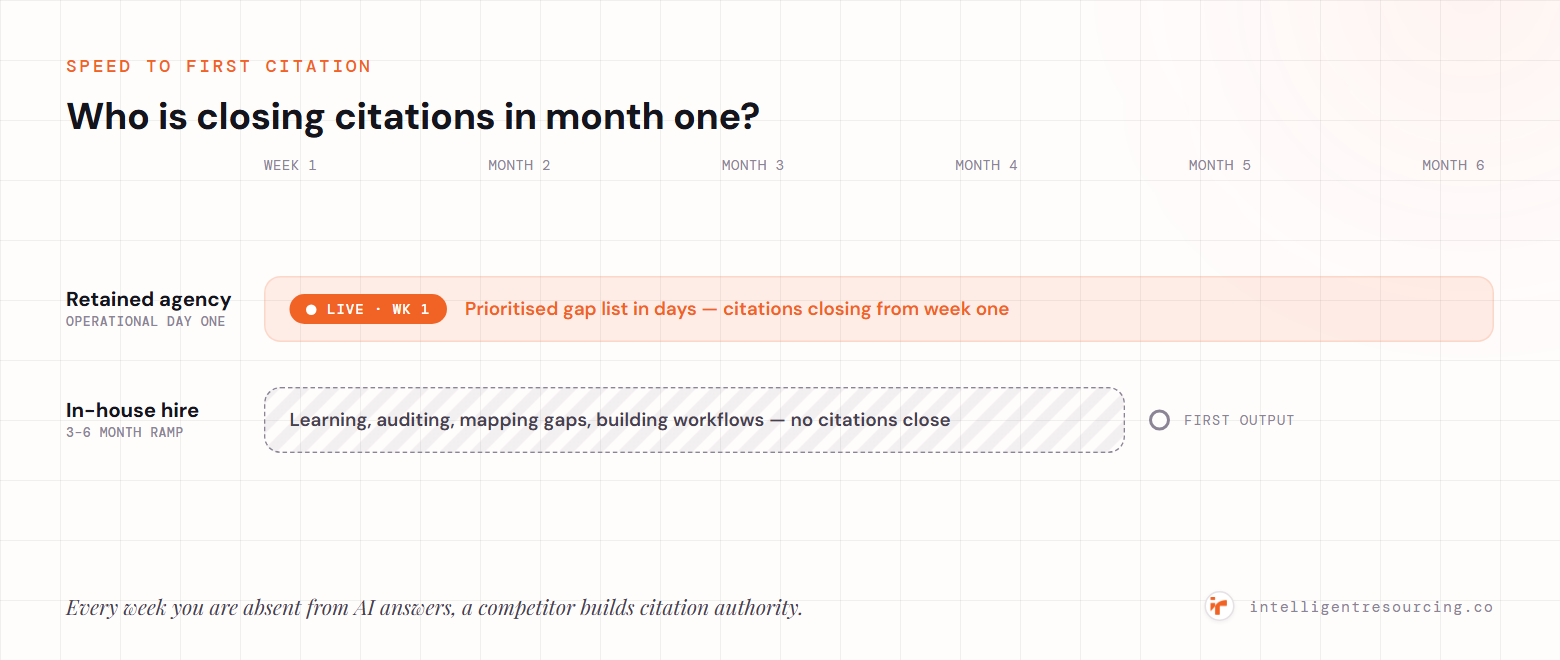
When a new specialist joins, they spend 3-6 months getting up to speed. That time goes into learning the business, auditing existing content, mapping citation gaps and building the workflows needed to run an ongoing programme. No citations close during this period.
For AEO specifically, that is a direct commercial problem. AI search is not a future channel. AI Overviews and assistant-style answers keep absorbing a larger share of buyer research every quarter. Every week your brand is absent from AI search answers is a week a competitor builds citation authority that takes longer to displace.
A retained agency arrives with the tracking tools, the gap classification process and the action map framework already operational. It produces a prioritised list of gaps within days of starting, not months.
What the Retained Agency Model Delivers
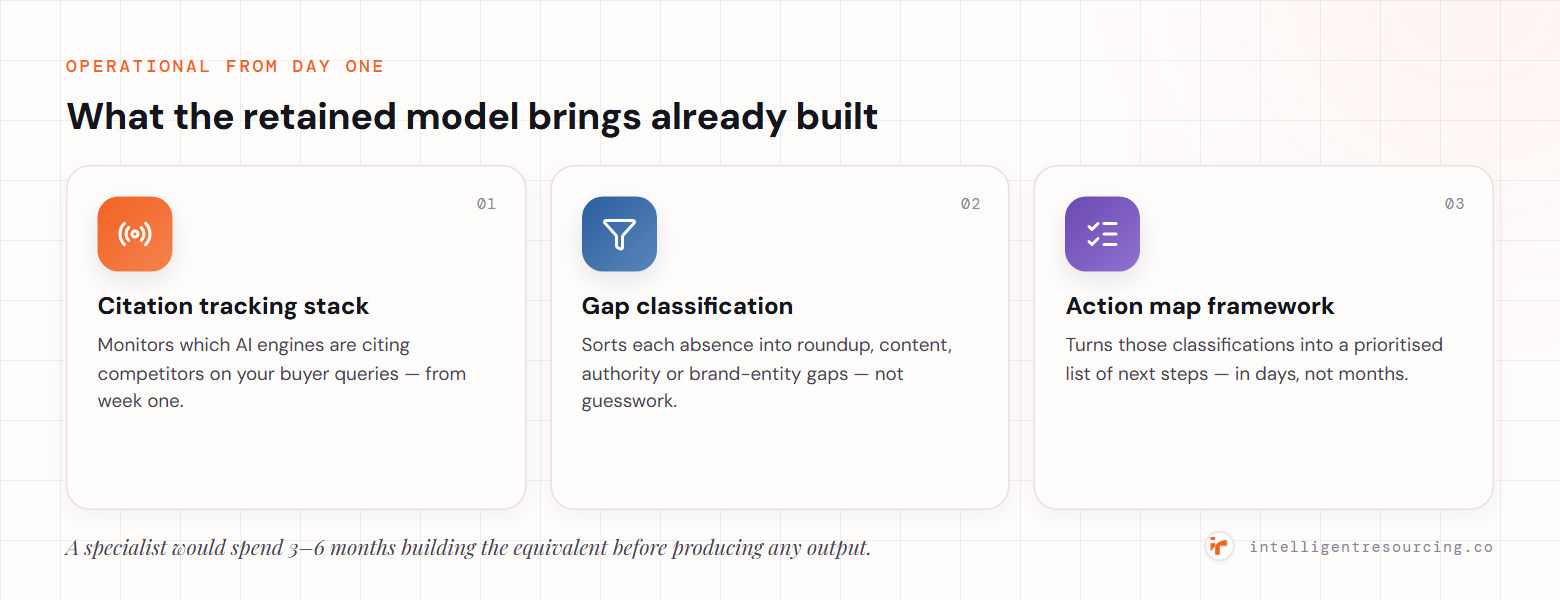
Intelligent Resourcing's Answer Engine Optimisation programme arrives with 3 things already operational: a citation tracking stack that monitors which AI engines are citing competitors on your buyer queries, a gap classification process that identifies whether each absence is caused by a roundup gap, content gap, authority gap or brand-entity gap, and an action map framework that turns those classifications into a prioritised list of next steps.
These arrive with the engagement rather than being built during it, and they are applied to your brand from the first week. A specialist would spend the first 3-6 months building the equivalent infrastructure before producing any of the same output.
The citation tracking setup, content architecture, gap maps and Answer Engineering framework are built during the engagement and keep running as an ongoing capability that Intelligent Resourcing operates alongside your team.
The Case for Hiring In-House
Three conditions make the specialist the right decision.
If your business runs AEO across 3 or more brands or product lines simultaneously, the volume of work eventually exceeds what a retained agency handles in a single engagement.
If AEO is a permanent, ongoing function rather than a build phase, the specialist accumulates institutional knowledge of your citation landscape, category patterns and competitor gaps over time. That knowledge does not transfer when you switch providers.
If your team already produces content and needs AEO direction only, the specialist role can be scoped more narrowly. The loaded figure changes when the role is scoped to direction only, not full execution.
When AEO requires more than 40 hours per week of dedicated work on an ongoing basis, the specialist starts making financial sense. Below that threshold, the retained model is more efficient.
Fit Check
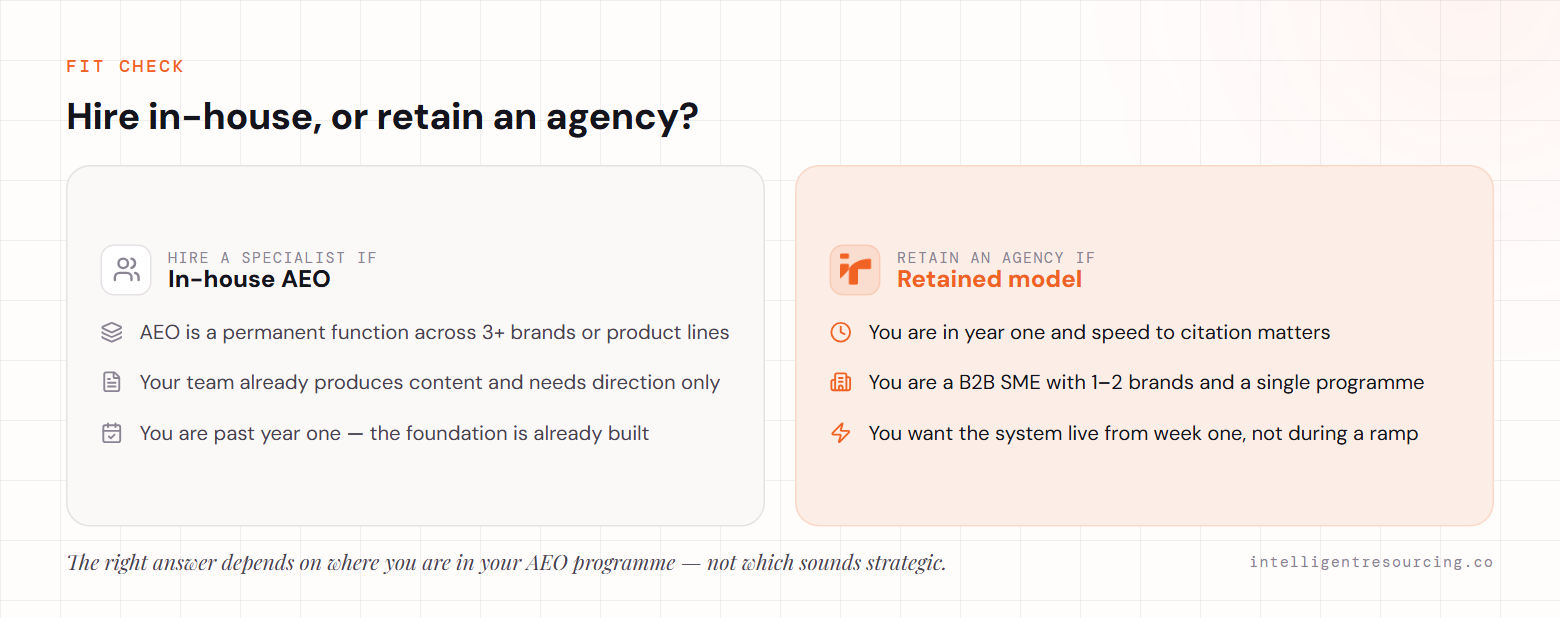
Hire a specialist if:
- AEO is a permanent, ongoing function across 3 or more brands or product lines
- Your team already produces content and needs AEO direction only
- You are past year one and the retained model has already built the foundation
Retain an agency if:
- You are in year one of AEO investment and speed to citation matters
- You are a B2B SME with 1 or 2 brands and a single AEO programme
- You want the system built and producing from week one rather than built slowly during a ramp period
The trade-off: the agency model produces output faster and keeps the system running as an ongoing capability. The specialist builds institutional knowledge over time but takes longer to reach full output and carries a heavier year-one figure. The right answer depends on where you are in your AEO programme, not which option sounds more strategic.
Most teams bring in a specialist before the function is ready to support a full-time role. Your competitor's citation authority is building during your ramp period.
Comparisons
A retained AEO programme arrives with the tracking stack, gap classification and action map already operational.
FAQs
What does an AEO specialist earn in Australia?
The closest comparable SEEK salary band is SEO Specialist at $80,000-$90,000 (May 2026). A dedicated AEO specialist typically commands $85,000-$95,000 base. Add superannuation, recruitment and tooling and the loaded year-one figure sits at $120,000-$145,000.
How long does it take an in-house AEO specialist to reach full output?
Typically 3-6 months. The specialist needs time to audit the existing citation landscape, map gaps and build the processes needed to run an ongoing programme. Citation gaps widen during that ramp period.
Is there a point where hiring a specialist makes more sense than retaining an agency?
Yes. When AEO becomes a permanent, high-volume function across multiple brands or product lines, and when the volume exceeds what a retained agency can efficiently handle, the specialist makes sense. For an Australian B2B SME in year one, that threshold has not been reached.
What does a retained AEO agency deliver that a specialist cannot?
A retained agency arrives with tracking tools, a gap classification process and an action map framework already built and running. A specialist builds those things during the ramp period. The agency closes gaps from week one and keeps the system running as an ongoing capability.