
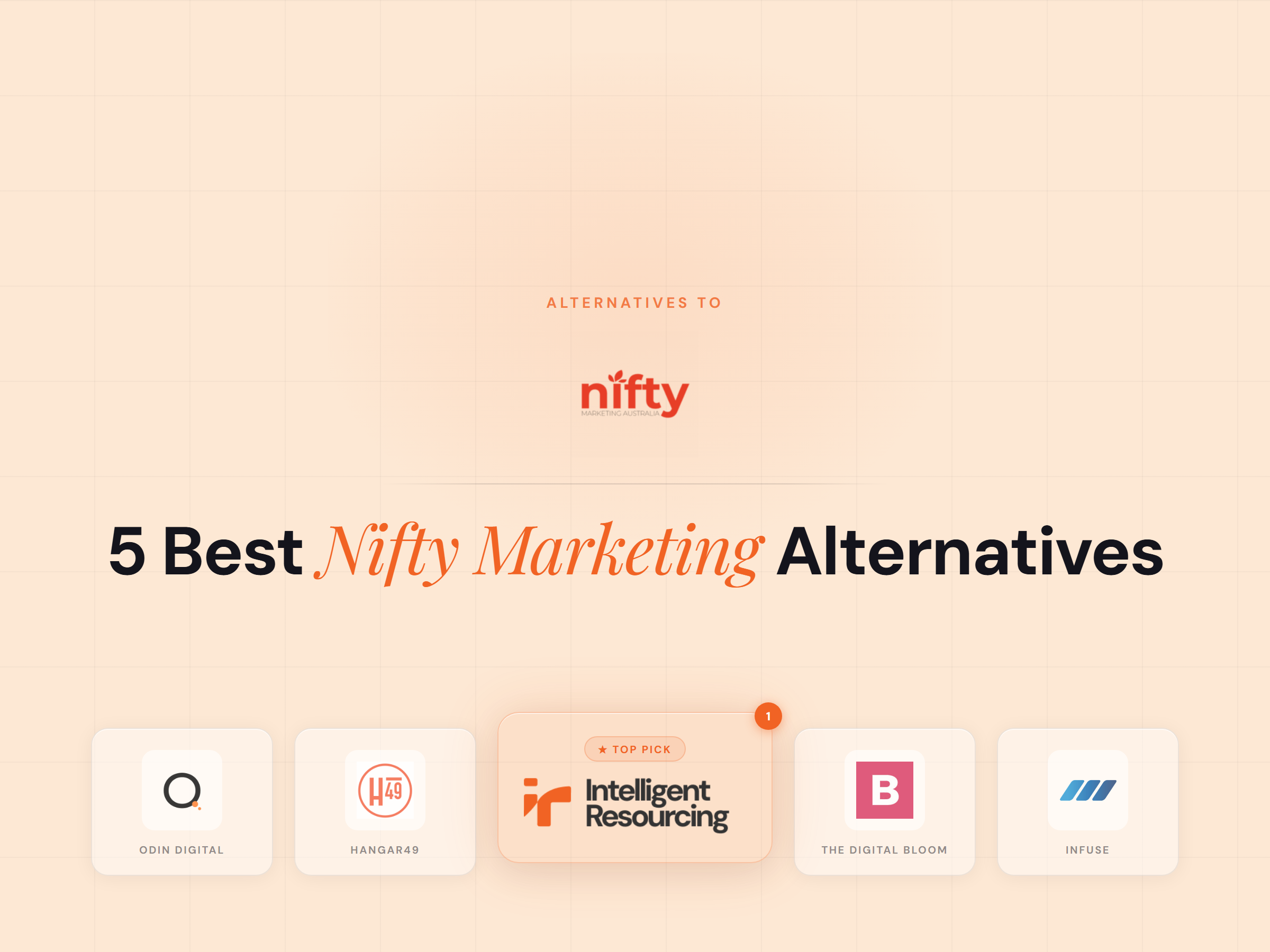
The best Nifty Marketing alternatives for RevOps teams tracking the gap between content volume and pipeline attribution are Intelligent Resourcing, Odin Digital, HANGAR49, The Digital Bloom and INFUSE. Each solves a different version of the same problem: blog posts reach searchers. Nifty Marketing delivers what its model is built for: domain authority, AEO structure and content visibility at an accessible price point.
Domain Rating measures backlink profile strength on a logarithmic scale. Signal-Led Growth monitors account behaviour: job changes, funding events, technology stack shifts and active evaluation signals. These are different metrics measuring different things at different points in the buying journey.
AEO content places a brand in AI answer environments. A Verified Buying Window triggers outreach when a monitored account is actively comparing vendors. The first builds the authority layer. The second builds the timing layer. Both are required for the pipeline equation to close.
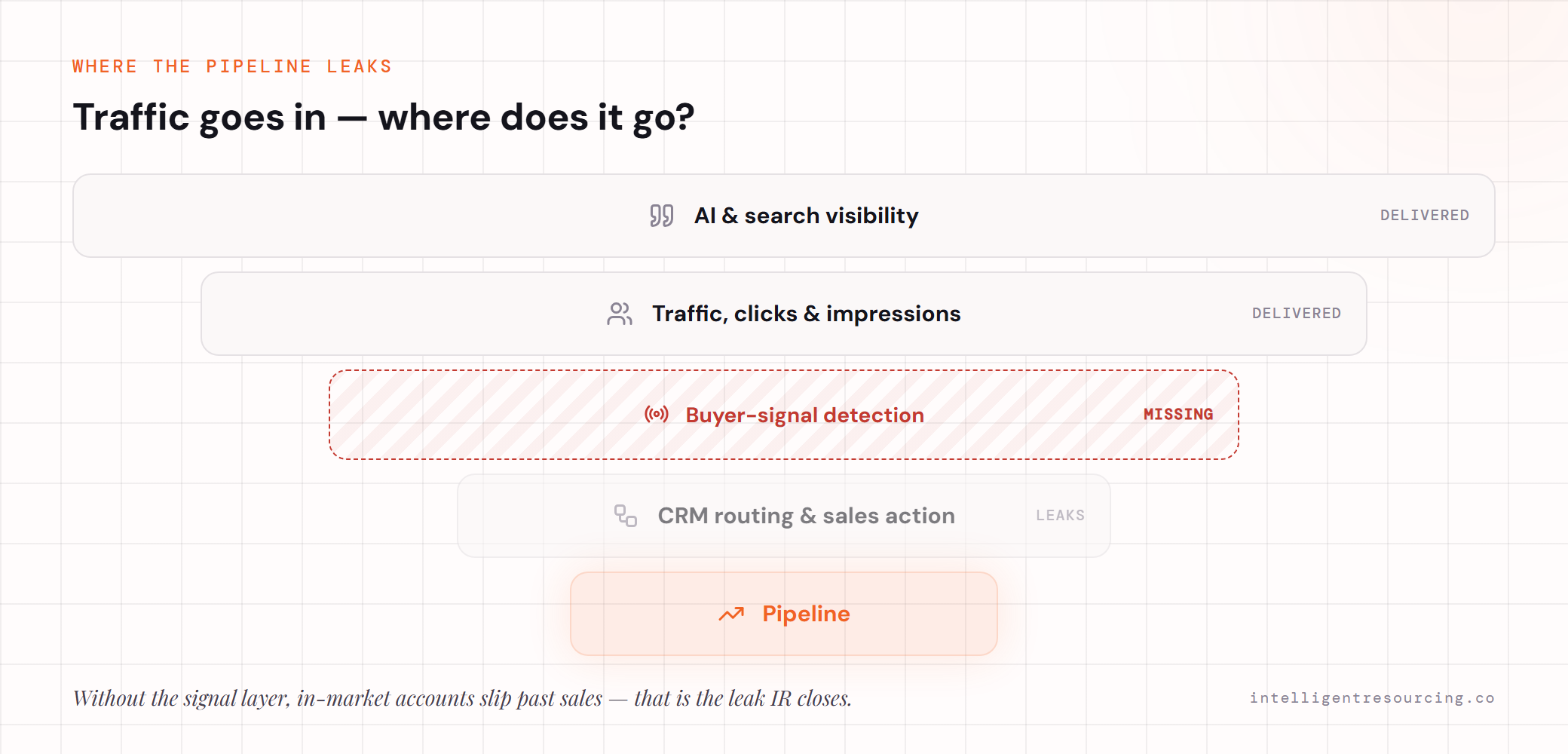
Every alternative in this article solves a different version of the same gap: content that reaches searchers but does not yet identify which named accounts on your list are actively buying.
Why Are RevOps Teams Auditing Blog Traffic?
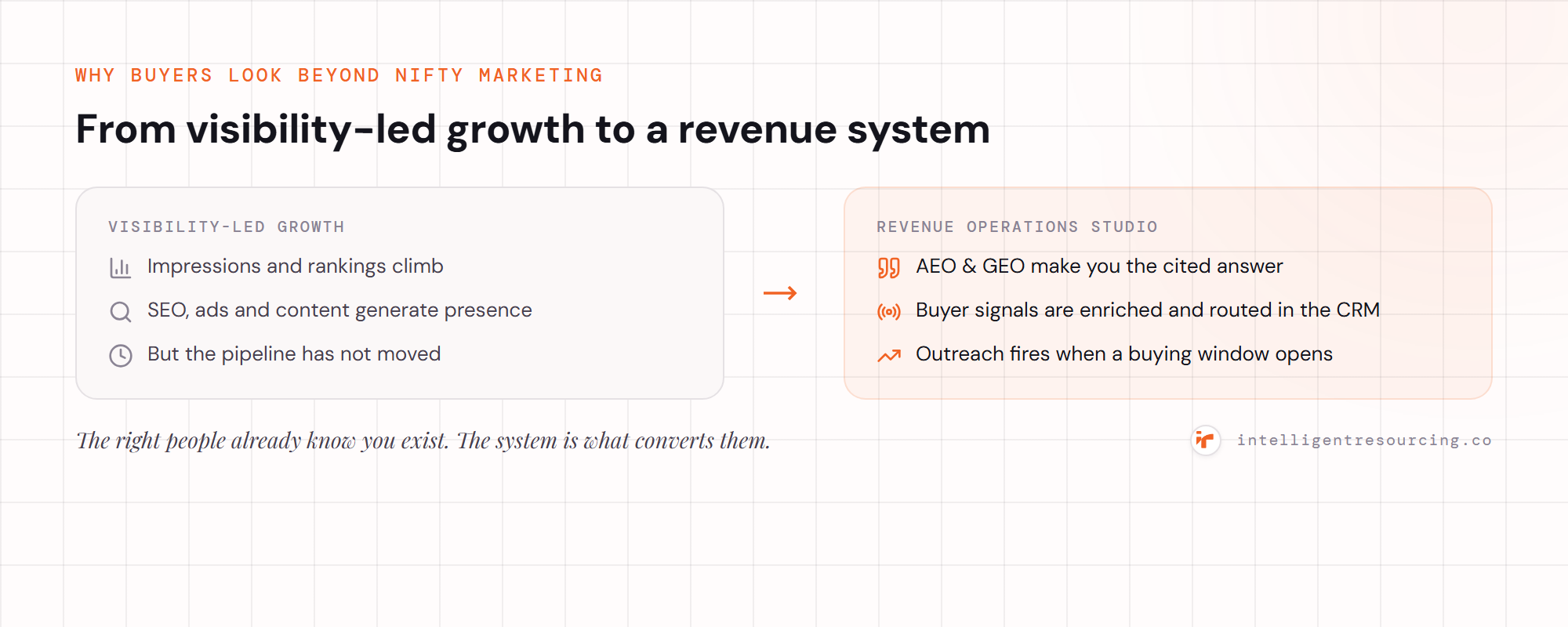
RevOps teams are auditing blog traffic because traffic growth does not prove pipeline movement. Nifty Marketing can produce content that ranks, lifts DR and grows sessions, but those metrics do not show which named target accounts opened a buying window last quarter which shows that the issue is attribution and not content quality.
Nifty Marketing Australia positions itself around SEO, AEO, Google Ads, Meta campaigns, websites, analytics, AI automation frameworks and conversion-focused digital strategy. That is a legitimate digital marketing model for companies still building visibility, but it does not automatically create account-level signal-to-action workflows inside the CRM.
The reason this gap matters in 2026 is that B2B buying has become more invisible before sales contact. Most of the evaluation now happens before a buyer ever fills in a form, which means content can influence the decision long before the CRM sees the account.
AI has made the gap sharper. If content is not structured for AI answer extraction, it misses discovery inside AI search. If it is structured for AI search but has no signal layer, it still does not tell RevOps which account is active.
What Should RevOps Check Before Switching?
The evaluation question is not "which alternative produces more content?" It is "which alternative connects content to pipeline attribution in a way the RevOps team can report?" 5 criteria answer that question before any agency is contracted.
Pipeline metric, not content metric
Does the alternative measure success by meetings booked, pipeline influenced, or revenue from signal-triggered outreach? If the primary metric is sessions, rankings, or content volume, the attribution gap does not close.
Signal layer
Does the alternative monitor named target accounts for buying intent signals: job changes, funding events, tech stack shifts, competitor switches and active research? Content alone reaches whoever searches. A signal layer identifies which accounts are actively evaluating and triggers outreach at that moment.
CRM integration
Does the alternative connect its activity to HubSpot or Salesforce at the account level, not just form fills or UTM parameters? A RevOps team needs to see which accounts the content touched, which signals they triggered and which meetings resulted, all within the same pipeline view.
Scope honesty
Is the alternative explicit about what it does and does not do? A RevOps professional values precision over breadth. An alternative that claims to solve the whole pipeline problem while measuring success in blog posts has not understood the question.
At any given time, only a small share of target customers are actively in-market. A RevOps team needs to know which accounts are active right now, not only how many people read the blog.
Comparison Table
| Intelligent Resourcing | Nifty Marketing | Odin Digital | HANGAR49 | The Digital Bloom | INFUSE | |
|---|---|---|---|---|---|---|
| Model | Signal-Led Growth system | SEO/AEO content retainer | B2B SEO with revenue reporting | Managed outreach, content and data enrichment | B2B marketing, content, demand generation and ABM | Full-funnel demand generation and buying group activation |
| Signal Layer | Yes: Verified Buying Window | No dedicated buying signal layer publicly listed | No dedicated buying window layer | Partial: data-led outreach and audience development | Partial: ABM and demand generation execution | Yes: intent signals and buying group intelligence |
| Pipeline Metric | Meetings with in-window accounts | Traffic, rankings and blog output | Pipeline and closed deals from SEO | Opportunities generated and conversations | Pipeline, MQLs and C-suite meetings | Pipeline velocity, buying group activation and demand performance |
| CRM Integration | Clay, HubSpot and n8n workflows run by IR inside your CRM | No direct CRM integration publicly listed | CRM-connected revenue attribution | Managed motion connected to your CRM | Not positioned as CRM-native RevOps infrastructure | Platform-led demand intelligence and real-time tracking |
| Outreach Timing | Fires when a Verified Buying Window opens | Publishing calendar, not account timing | SEO performance cycles | Campaign cadence set by the engagement | Campaign and content cadence | Intent-informed campaign triggers |
| Best Fit | Series A to C, defined target account list | Foundation stage: DR, content and AEO | Post-foundation SEO with pipeline attribution | Post-foundation outreach and content unification | Content measurement rebuilt around pipeline outcomes | ABM and buying group demand activation at scale |
5 Best Nifty Marketing Alternatives
These 5 alternatives solve different versions of the same RevOps problem. The question is not whether Nifty Marketing produces content but whether your next model turns content visibility into active prospect intelligence, CRM attribution and pipeline action.
1. Intelligent Resourcing
Intelligent Resourcing replaces content-volume reporting with a signal-led system it builds and runs inside the client’s stack as an ongoing capability.
Intelligent Resourcing is a Revenue Operations Studio that installs Signal-Led Growth systems for B2B teams with defined ICPs and target account lists. The stack uses Clay, HubSpot and n8n to monitor account movement, enrich records, score buying signals and trigger outreach when a Verified Buying Window opens. AEO content becomes a signal-layer input, not a separate content programme. When a monitored account shows evidence of evaluation, the system routes that account into the right workflow so sales acts on timing, not session volume.
This is the direct answer for RevOps teams that already have SEO and AEO foundations but cannot connect blog posts to meetings booked with named accounts.
Best for
RevOps teams with a defined target account list that need pipeline attribution from account-level signals, not session volume from content.
Limitation
Intelligent Resourcing requires digital foundations and CRM to already be in place. It is not the starting point if the SEO and AEO content layer has not yet been built. It also requires a defined ICP and target account list at the outset.
2. Odin Digital
Odin Digital upgrades the SEO model from traffic reporting to pipeline attribution. It is CRM-connected, full-funnel and still inside the content-led growth model.
Odin Digital is an Australian B2B SEO agency that positions around revenue rather than rankings. It presents itself as a HubSpot Solutions Partner and frames SEO reporting against revenue and conversion data. That makes Odin a strong option for a RevOps team that is not ready to leave SEO, but needs the content programme reported against pipeline and closed deals rather than keyword positions alone.
The difference from Nifty Marketing is not that Odin abandons content. It keeps SEO at the centre, then ties organic performance to the CRM. For a RevOps leader, that changes the review conversation from "which posts ranked?" to "which organic journeys influenced MQL, SQL, opportunity and closed-won movement?"
RevOps teams who want to stay within the SEO and content model but need CRM pipeline attribution replacing traffic reports.
Odin Digital improves attribution, but it does not publicly position around a buying signal layer that monitors named target accounts for Verified Buying Windows. It shows what converted and which SEO work influenced revenue. It does not show every account that is about to convert.
3. HANGAR49
HANGAR49 unifies outreach, content and data enrichment into 1 managed pipeline motion, replacing 2 disconnected agency relationships with 1 accountable team.
HANGAR49 positions itself as a B2B demand generation agency. Its site describes the M-HEAL methodology for data analysis, controlled experimentation and fast-tracked learning across audience development, outreach and content.
Its site adds more pipeline framing: HANGAR49 says it helps marketers develop audiences, create conversations and build pipelines, and reports $261M+ in revenue opportunities pumped into pipelines. It also names Virgin Money, Compleye and SEACOM among customer stories.
RevOps teams whose pipeline gap is the disconnection between content production and outreach execution: 2 vendors, 2 reporting frameworks and no shared pipeline motion.
HANGAR49 is a managed service. The activity depends on the engagement. It is data-led and outreach-focused, but it is not the same as a signal-led system that Intelligent Resourcing builds and runs inside the client’s stack as an ongoing capability.
4. The Digital Bloom
The Digital Bloom rebuilds content measurement around the pipeline, not just traffic. It is the RevOps-aligned content and demand generation option for teams that still need content, but need it reported in revenue terms.
The Digital Bloom publishes B2B marketing case studies with metrics across SEO, content marketing, demand generation and ABM. Its case study page states $1.3M+ pipeline generated, 436% average traffic growth, 40+ MQLs per month and 5 C-suite meetings in week 1. It also says it works with B2B software, SaaS and professional services companies.
That makes it a useful alternative for RevOps teams whose content measurement is broken but whose content layer still matters. The Digital Bloom is not simply "more blogs." Its proof page frames content and demand generation around named outcomes such as marketing-attributed pipeline, MQLs and C-suite meetings. For a RevOps team, that is closer to the pipeline report than a classic content-volume dashboard.
RevOps teams that need content, SEO and demand generation rebuilt around pipeline outcomes, especially in B2B software, SaaS and professional services.
The Digital Bloom is not positioned as a signal-infrastructure builder. It can connect content to pipeline outcomes, but the public proof does not show a Clay, HubSpot and n8n-style buying signal system built and run inside the client’s stack.
5. INFUSE
INFUSE is the ABM and buying group activation option for RevOps teams that need intent signals and account-based demand at scale, but prefer a managed programme over a dedicated signal system built and run in their own stack.
INFUSE describes itself as a global B2B demand and revenue marketing performance company. Its homepage says its demand engine combines first-party buying groups, multi-level intent signals and full-funnel demand orchestration to deliver outcomes for B2B GTM teams. It also states that INFUSE identifies and engages complete buying groups using AI-driven technology, first-party data, market intelligence and intent signals.
Its intent activation guide explains the signal logic clearly: demand marketers use buyer signals and intent data to identify in-market accounts earlier, personalise ABM programmes with role-level and account-level insights, and align activation with clean data and workflows.
RevOps teams with target account lists that need account-based demand generation, buying group activation and intent-informed campaigns at scale.
INFUSE is a managed demand engine, not an Intelligent Resourcing-style Signal-Led Growth system. It suits teams that want buyer group demand activation managed for them. It is less suitable when the RevOps team wants a signal-led system built and run inside its own stack.
Which alternative closes the specific pipeline gap
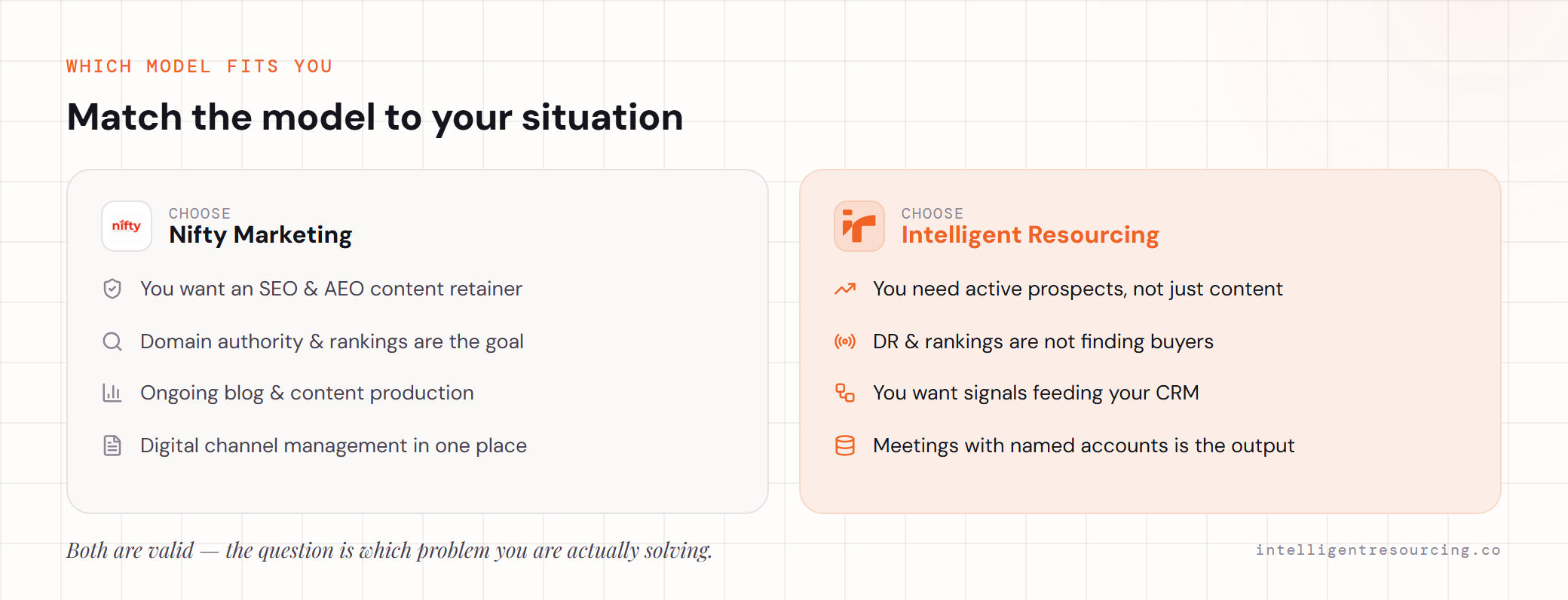
The right Nifty Marketing alternative depends on the pipeline gap the RevOps team sees in the CRM. Content traffic growing while the pipeline stays flat is not 1 problem. It can mean attribution is broken, outreach is disconnected, content is not linked to signals, or account intent is unmanaged.
Content is producing traffic but pipeline attribution is impossible in CRM
Choose Odin Digital, it stays inside the SEO and content model but connects organic performance to your CRM. That gives RevOps a cleaner path from SEO activity to pipeline reporting without changing the whole GTM architecture.
Inbound and outbound are running as 2 disconnected motions with 2 vendors
Choose HANGAR49, its model combines audience development, outreach, content and data-led experimentation into a managed pipeline motion. That fits teams whose core issue is operational disconnection rather than content quality alone.
Content exists and is well-built but no signal layer monitors which target accounts are evaluating
Choose Intelligent Resourcing, its Signal-Led Growth installs the Verified Buying Window layer on top of existing content foundations, so outreach fires while the account is still comparing vendors rather than after the shortlist has already closed.
Content measurement is broken and needs to move from traffic metrics to pipeline metrics
Choose The Digital Bloom, its public case studies report pipeline generated, MQLs and C-suite meetings, which makes it a better fit than a content agency reporting only sessions and content output.
Target account list exists but outreach is not connected to account-level buying signals
Choose INFUSE, it is the managed ABM and buying group activation option for teams that want intent signals, first-party buying groups and omnichannel demand orchestration without building the infrastructure themselves.
Already decided on Intelligent Resourcing: next step
Intelligent Resourcing's AEO content layer is built as part of the signal architecture, not a separate content programme.
What Should RevOps Keep From Nifty?
More than the content volume, the SEO foundations, domain authority and indexed content produced during the Nifty Marketing retainer are inputs into the next architecture. The decision is not what to throw away but it is what to redirect.
AEO content built during a Nifty Marketing engagement can become the foundation for Intelligent Resourcing's signal layer. Keyword and topic research can inform which evaluation questions need answer-first content. Domain authority built over time can support AI search inclusion without a total rebuild.
The specific moment to switch is when the quarterly pipeline attribution report cannot connect any blog post to a meeting booked with a named account and that is the signal the model needs to change.
If Nifty Marketing is mid-programme and content is producing measurable organic pipeline, there is no urgency to switch immediately. If the content is still building the foundation and the CRM shows pipeline movement, keep building. If blog traffic keeps growing while named-account meetings stay flat, redirect the model.
The strongest transition preserves content assets and adds a signal layer and it does not discard SEO rather turns it into a source of buying intent.
For the full head-to-head on model, stage fit and pipeline architecture
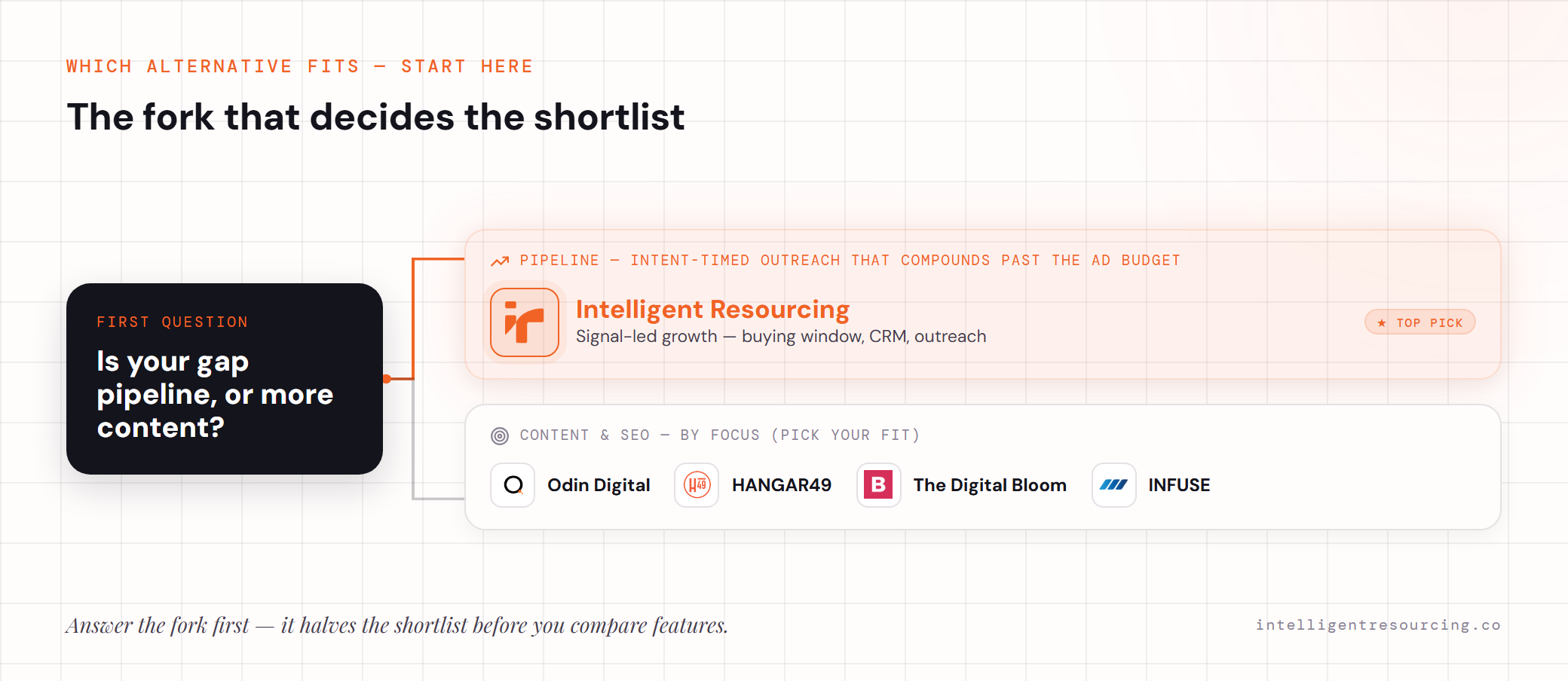
Here’s the full head-to-head on model, stage fit and pipeline architecture between Intelligent Resourcing and Nifty Marketing.
Comparisons
If your content is visible but your CRM cannot show which target accounts are in a buying window, Intelligent Resourcing can map the signal gap. 30 minutes, no commitment.