
Has your revenue team outgrown its agency? The work is getting done, the content is going live and the rankings are moving, but the pipeline still is not matching the targets your team is expected to hit.
That gap is a growth stage problem, not an execution problem, which means a better digital agency with stronger SEO or AEO capability does not solve it because the architecture itself is the constraint.
Arcadian Digital builds real digital marketing capability for B2B companies at growth stage. SEO, AEO, content strategy and digital presence are the foundations that enable organic pipeline. Its services cover SEO, performance marketing, AEO, digital strategy, AI and data, web development and marketing automation.
Intelligent Resourcing installs a Signal-Led Growth system for revenue teams whose ICP complexity and pipeline requirements have outgrown digital foundation work, so the team stops managing 2 disconnected motions and starts running a single signal-to-pipeline architecture.
What does "outgrowing your agency" look like at the quarterly review?
It looks like this: digital marketing activity produces traffic, rankings and content output, but the pipeline attribution column in the quarterly review stays thin. The ICP has sharpened, target account lists exist, the buying committee roles are mapped and signals are being tracked internally, but the agency's content strategy was built for a broader audience at an earlier stage.
The revenue team runs outbound separately from the agency's inbound work. Content strategy serves a wider audience than the target account list. The quarterly review shows digital activity, but no clear route from account behaviour to outreach timing.
Arcadian Digital represents the capable generalist digital agency that serves companies well at growth stage. The comparison exists because scaled buyers now ask a different question: can the agency architect signal-led GTM, not only SEO, content and AEO?
That question matters because B2B buyers now move across many interaction channels during a single buying journey. More channels create more signal, but only if the revenue team has a system for reading it.
Quick Verdict
For B2B revenue teams with defined ICPs and target account lists whose pipeline is not tracking with their revenue targets, Intelligent Resourcing installs a Signal-Led Growth system that monitors target accounts for buying signals: job changes, funding events, and technology stack shifts. The wrong-fit condition is equally specific: if your digital foundations are still being built, the signal layer arrives too early because it has nothing to connect to yet.
Arcadian Digital fits the stage when digital foundations still need building. Intelligent Resourcing is the next architecture when those foundations are built and the pipeline is not moving with them, because at that point the constraint is not what the content is doing but whether a signal layer exists to connect it to outreach timing.
Comparison table
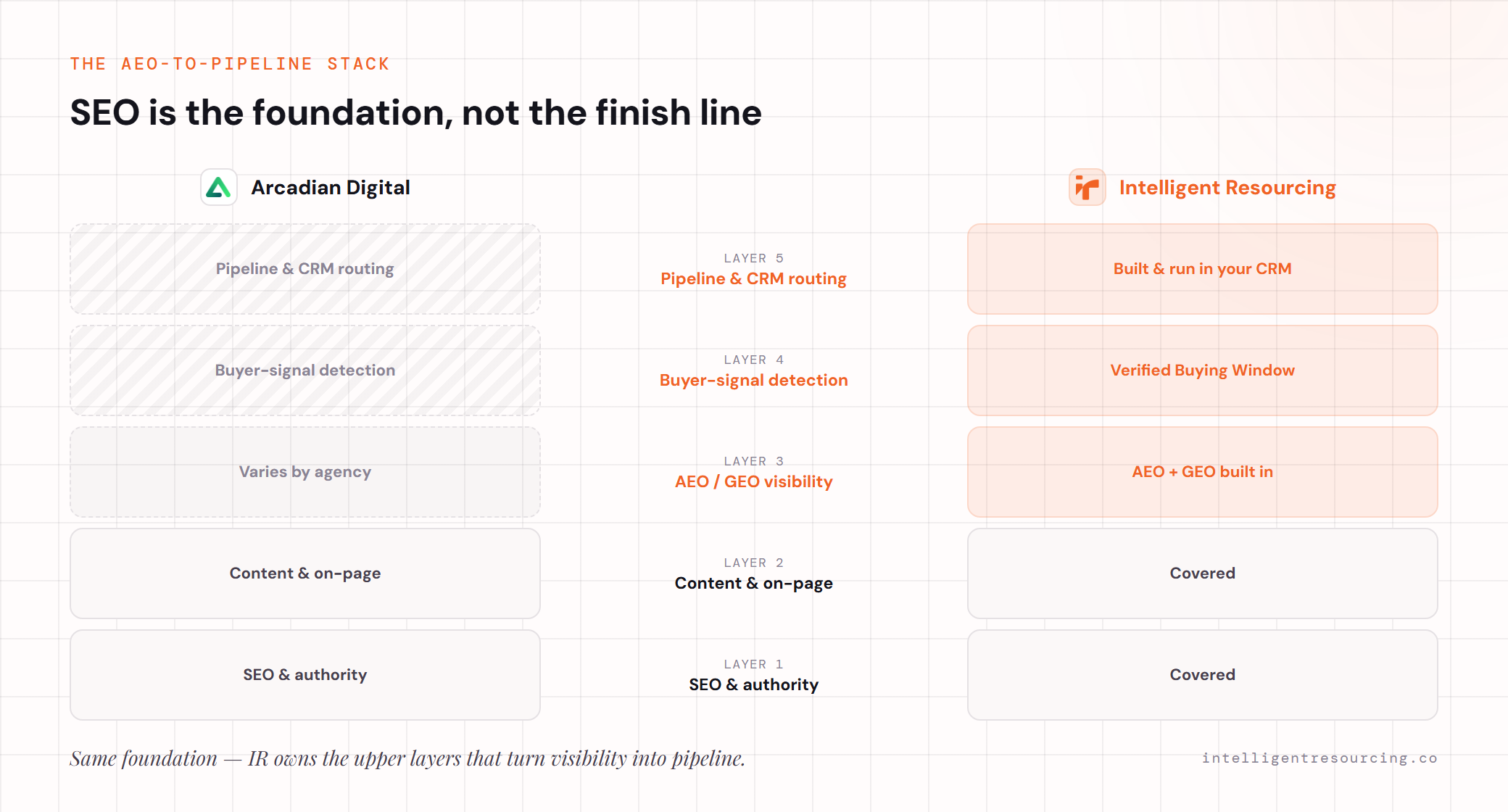
| Criteria | Intelligent Resourcing | Arcadian Digital |
|---|---|---|
| Core model | Signal-Led Growth system for scaled revenue teams. | SEO, AEO, digital marketing, AI and data, web development and strategy for growth-stage businesses. |
| Growth stage fit | Series A to C+ teams with defined ICP and target account lists. | Early to mid growth, foundation building and digital presence. |
| Digital foundation building | Not the starting point. | Strong core capability: SEO, AEO, content optimisation, technical SEO and digital strategy. |
| Buyer intent signals | Verified Buying Window: job changes, funding events, technology shifts and account behaviour. | Public pages discuss targeting, audience data, conversion tracking and reporting, but not a dedicated Verified Buying Window model. |
| Outreach trigger | Triggers outreach when the buying window opens. | Not publicly listed as a core offer. |
| AEO and AI answer coverage | Yes, integrated into signal architecture through AEO/GEO as a Service. | Yes, AEO is part of its public offer. |
| ICP targeting precision | Target account list with signal layer. | Broader content and search strategy. |
| Technical stack | Clay, HubSpot and n8n, built and run by IR's GTM engineers inside the client's stack. | Agency-managed delivery. |
| Data freshness and signal source | Live account signals: job changes, funding events, technology shifts and repeat account behaviour, refreshed continuously. | Search, traffic and campaign analytics reported on a periodic cadence. |
| Pipeline attribution | Meetings booked with accounts inside a Verified Buying Window. | Digital marketing metrics: rankings, traffic, conversions and ROI tracking. |
| Pricing | Discovery-first for Revenue Operations Studio work. | No public rate card on the reviewed service pages. Typical Australian B2B agency ranges run A$2,000 to A$5,000 per month for mid-sized businesses and A$5,000 to A$20,000+ for enterprise campaigns. Verified as of June 2026. |
When Does Arcadian Digital Fit and Hit Its Ceiling?
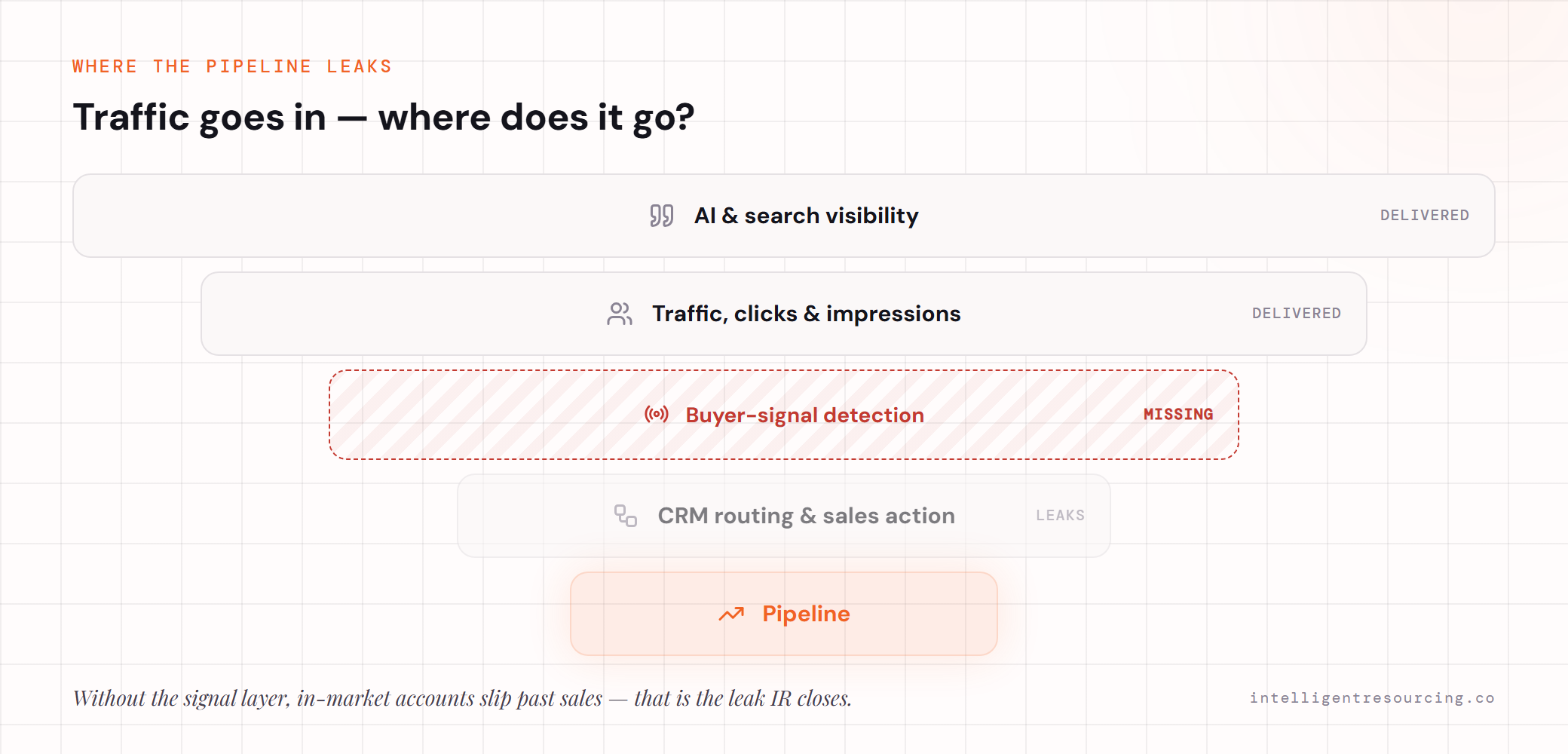
Arcadian Digital's model fits best when a B2B company is building its digital marketing foundations: SEO presence, AEO content, content strategy and organic pipeline infrastructure. The ceiling appears when the revenue team's ICP precision and outbound complexity exceed what a content-and-SEO model serves.
Arcadian Digital SEO is about attracting the right audience and converting users into paying customers. Its AEO positions a business for direct answers, snippets, voice results and AI-powered search answers.
A company with weak organic visibility, thin content, poor technical SEO or no AEO structure should not skip foundation work. Arcadian Digital is a logical starting point for that stage.
The ceiling appears when the revenue team matures, the ICP becomes sharper and account lists become smaller. Sales starts asking which target accounts are active now, not only which pages rank. At that point, a broader content model no longer owns the whole GTM motion.
Intent data identifies which companies are actively researching a solution in a given category. That shift changes the operating question from "how do we rank?" to "which account is showing readiness?"
For a revenue team at that stage, the limitation is architectural rather than executional: Arcadian Digital's public pages show AEO, SEO, digital strategy, performance marketing and conversion tracking, but none of those surfaces a dedicated system that connects AEO content to target-account outreach timing, identifies a Verified Buying Window, or runs signal infrastructure inside your stack.
What Does Intelligent Resourcing Install When Pipeline Outgrows Content and SEO?
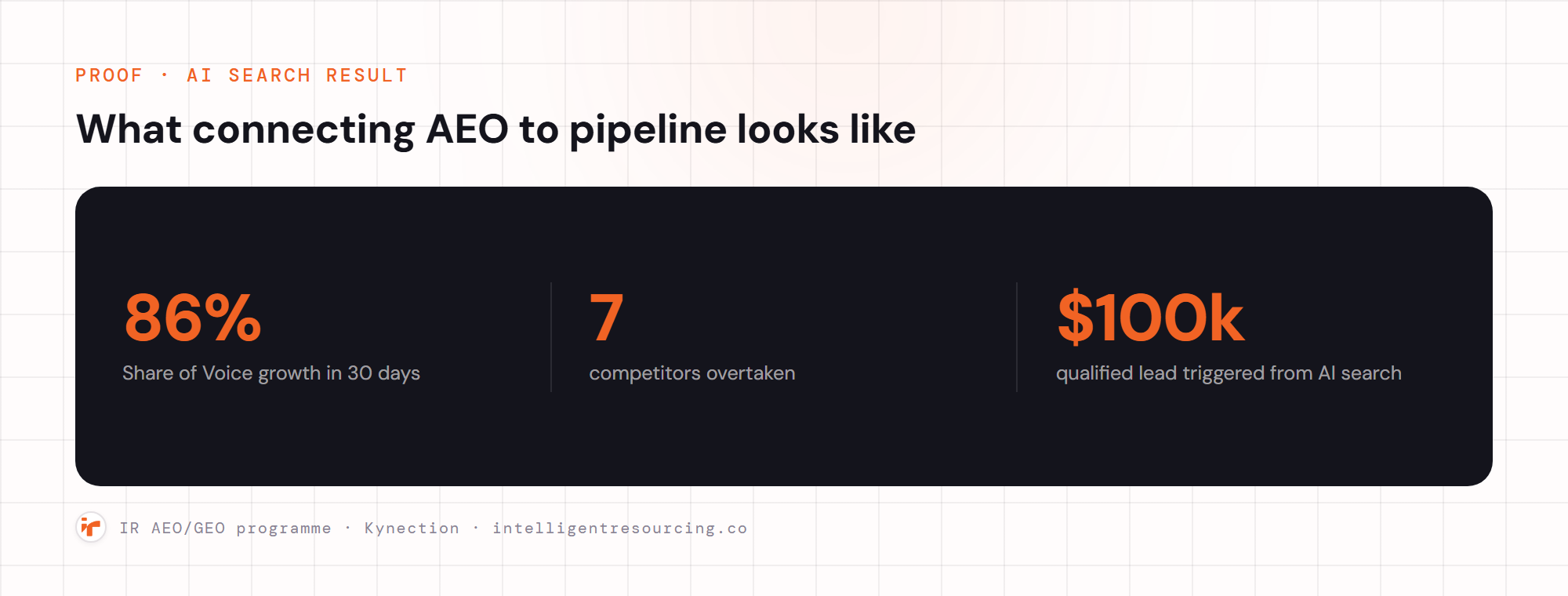
Intelligent Resourcing is a Revenue Operations Studio that installs a Signal-Led Growth system: account intelligence, AEO positioning, outreach triggers and workflow automation running on the client's stack. The starting assumption is that content and SEO foundations are already in place and Intelligent Resourcing connects that foundation to buying intent data and pipeline timing.
That signal-led lead gen system monitors defined target accounts for buying signals: job changes, funding events, technology stack shifts, repeat site visits and relevant account movement. When a Verified Buying Window opens, the system triggers AEO-informed outreach. Because the signal is account-specific, outreach lands when the buying context is live.
This works best when ICP precision is already strong: a vague ICP produces vague signals. A defined account list, mapped buying committee and clear sales motion produce cleaner routing. The more precise the ICP, the more useful the signal layer becomes.
The operating stack uses Clay workflow automation, HubSpot and n8n. Intelligent Resourcing designs workflows that identify, enrich, score and route high-quality leads into a CRM and sequencer. Intelligent Resourcing builds and runs these workflows inside the client's stack, including Clay, HubSpot and n8n, as an ongoing capability, so the infrastructure compounds without depending on internal RevOps capacity.
The "outgrown" connection is important since Intelligent Resourcing is not the starting point. It is the next architecture after the starting point has been built. A company with no SEO presence, no AEO content and no organic foundation should build that first. If those foundations are present and the pipeline still lags, Intelligent Resourcing adds the signal layer.
Where does Intelligent Resourcing fall short?
Intelligent Resourcing is not the right fit for every B2B revenue team because the system they build requires established digital foundations, a defined ICP, and target account lists to function. Without those inputs, the signal layer has nothing to connect to and no buying window to detect.
It does not run Google Ads, paid social or content production as standalone services. Revenue teams that still need channel execution alongside signal architecture will need to retain that capability separately or work with a digital agency alongside the Intelligent Resourcing system.
When does a digital agency become the wrong architecture?
A capable digital agency becomes the wrong architecture when the revenue team's GTM motion becomes more precise than the agency's content model. The agency optimises for discoverability while the revenue team needs outreach timing based on which specific accounts are actively evaluating. That is a growth stage mismatch, not an execution problem.
Arcadian Digital produces AEO content that positions the client in AI search answers. That part of the model overlaps with Intelligent Resourcing. The divergence is what happens when a target account searches for that AI answer.
Both models can produce AEO content that surfaces in AI search results. A revenue team comparing the 2 on service deliverables sees overlap: SEO, AEO, content structure, search visibility and AI answer presence.
One approach positions the client broadly; the other sits that same content inside a signal architecture. When a monitored target account researches a topic the client is positioned on, that research event informs outreach timing for that account.
Picture a revenue operations director at a target account asking an AI assistant about GTM engineering agencies. Arcadian Digital has positioned the client in that answer. Intelligent Resourcing has identified the same company on its monitored account list, detected a hiring signal 3 days earlier and already triggered personalised outreach.
Both models produced the AI search result, but only one had already detected a hiring signal three days earlier, triggered personalised outreach, and put the client in front of that RevOps director before the shortlist was formed.
That distinction matters because most buyers build their shortlist before they ever contact a vendor. Wynter's 2024 B2B buyer journey research found that 91% of buyers arrive at a sales meeting already familiar with the vendor, and buyers typically earmark just 3 to 5 vendors to invite to pitch. Visibility helps you enter the shortlist; signal architecture helps you act before the shortlist is even drawn.
What does the wrong model cost a scaling revenue team?
The cost is the pipeline gap between what your digital foundation is producing and what your revenue targets require, and that gap widens as your ICP sharpens and your target account list grows, because the more precisely you have defined who you are selling to, the more visible it becomes that the content and SEO motion was built for a broader audience than the one your sales team is actually chasing.
Every quarter your revenue team runs a digital marketing motion that was built for an earlier growth stage, the gap between activity and pipeline attribution widens, because your content is being produced, your AEO is working, and your target accounts are evaluating solutions right now, but the outreach is not reaching them when the window is open because nothing in the current architecture tells your team when to act and which specific account to contact. Signal exists across more surfaces than your traffic report captures, and that gap is recoverable, but it gets harder to close the longer the wrong architecture runs, because every quarter it continues, your target accounts are evaluating and closing with whoever reached them at the right moment while your quarterly review shows the same distance between activity and attribution that the previous one did.
Which Model Should You Choose?
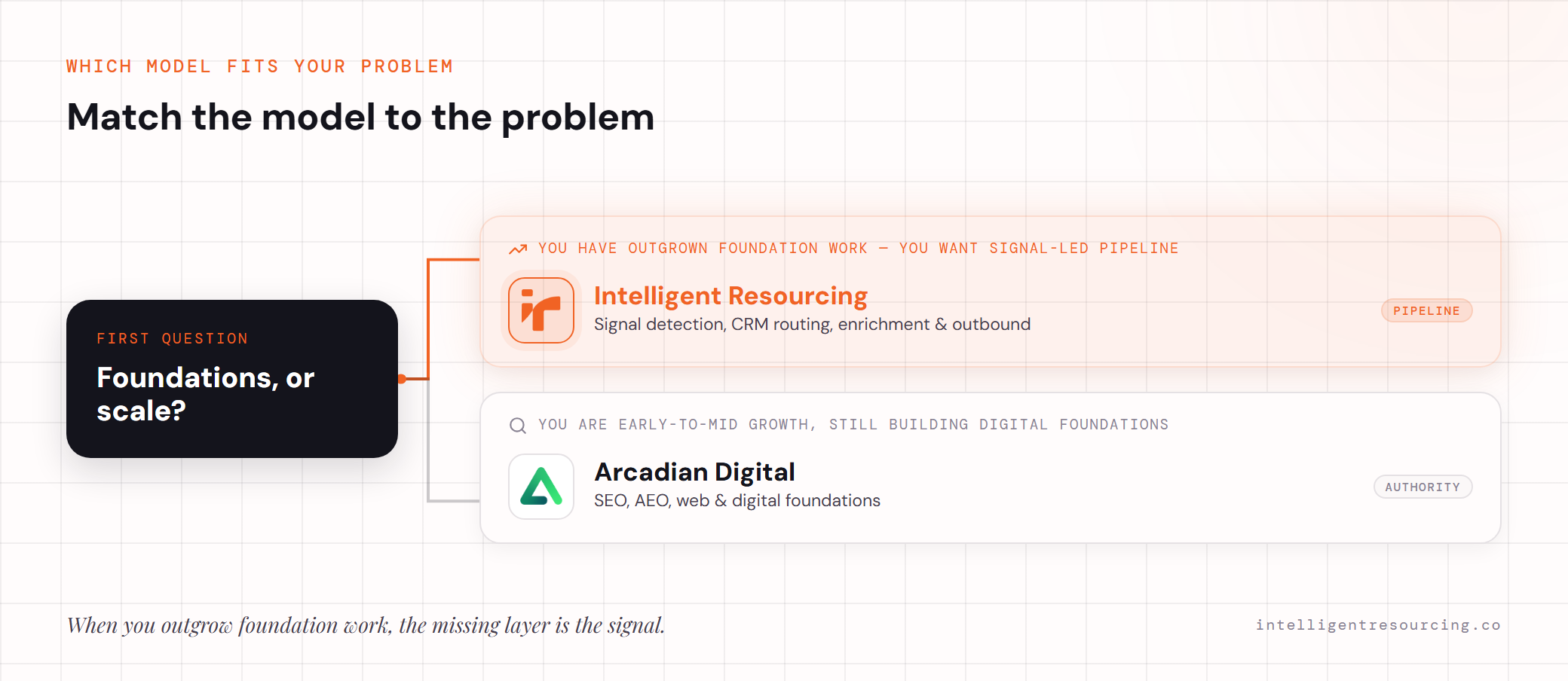
When digital foundations are still being built, the right move is a better digital agency rather than a different architecture because the signal layer has nothing to connect to yet. When those foundations are in place and your pipeline is still not moving with your revenue targets, switching agencies does not close the gap because the constraint is no longer the agency's execution but the absence of a signal layer above what they built.
Most B2B buyers now want to self-serve part or all of the buying journey, which only increases the need for the right human interaction at the right moment, delivered to the right account when its window is open.
If Your Digital Foundations Are Still Being Built
Arcadian Digital is the right model for this stage. Signal-Led Growth architecture requires foundations to connect to. If your site lacks authority, technical SEO, useful content and AI-search structure, the signal layer arrives too early.
Your Foundations Are Built, But Pipeline Is Not Keeping Up
Intelligent Resourcing installs the signal layer that connects that foundation to outreach timing and pipeline. It connects account intelligence, AEO positioning and outreach triggers into a single pipeline architecture. The outcome is not more marketing output but a system that works from signal to account action.
If You Are Already Here, This Is the Next Step
Intelligent Resourcing maps your target accounts against open buying windows before the session starts, so you arrive seeing which accounts are actively evaluating now rather than sitting through a pitch about why they might be. Some of those accounts are being reached by a competitor right now while your current architecture has no visibility into the window being open. Book a Discovery Call now.
Comparisons
Intelligent Resourcing maps your target accounts against open buying windows before the session starts, so you arrive seeing which accounts are actively evaluating now rather than sitting through a pitch about why they might be.