
What are the three AEO pricing models?
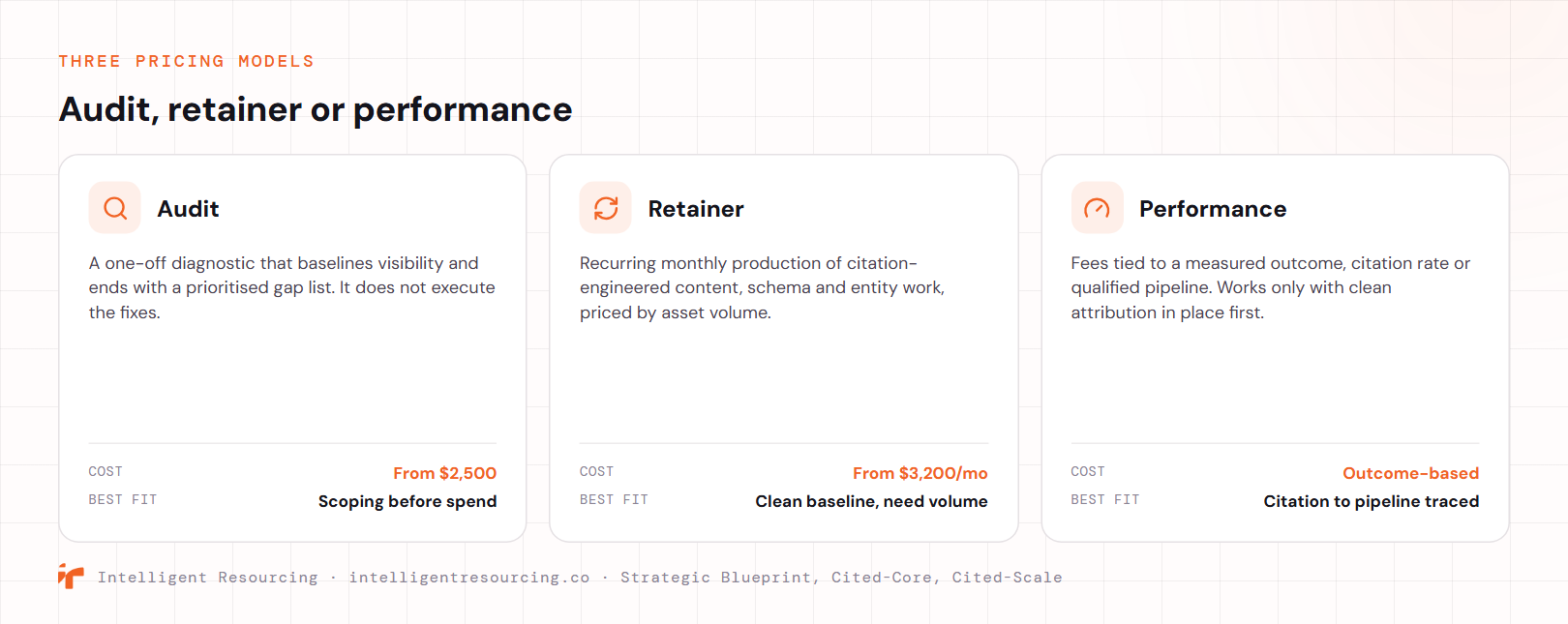
AEO pricing structures cost and risk differently depending on the model. An audit is a one-off diagnostic. A retainer funds ongoing monthly production. Performance pricing ties fees to a measured outcome, such as citation rate or qualified pipeline. The job of a buyer is to match the model to what stage the business is at, not the smallest number on the invoice.
Intelligent Resourcing's generative engine optimisation service makes content citable inside AI answers, across ChatGPT, Perplexity, Gemini and Google AI Overviews. Pricing for this work has not settled into one standard shape, because the label covers genuinely different scopes depending on who sells it. A traditional SEO agency bolting AEO onto an existing retainer prices it as an add-on line. A boutique AEO specialist prices citation-engineered content as the entire deliverable. An enterprise technical-SEO firm prices schema and entity work as its own separate track.
Three different scopes sit under one shared label, which is exactly why the AEO pricing landscape varies as widely as it does. Comparing models on their structure, not their sticker price, is the useful exercise.
What is an AEO audit?

An AEO audit is a one-off diagnostic that baselines visibility across engines and ends with a prioritised list of fixes, without executing any of them itself. Intelligent Resourcing runs this as a Strategic Blueprint, priced from $2,500, and it sorts every citation absence into one of four distinct gaps, each pointing to a different fix:
- Roundup gap: the category's "best [X]" comparison content does not exist yet, or does not name the brand.
- Content gap: the answer is not structured for an engine to lift cleanly.
- Authority gap: third-party corroboration, reviews, directories, earned mentions, is missing.
- Brand-entity gap: the engine cannot consistently resolve who the brand is across its own pages.
Intelligent Resourcing's own tracker shows this in a live example, an 85% absence rate paired with a specific recommended fix (source: Intelligent Resourcing AEO Tracker, 15 July 2026).

What is an AEO retainer?

An AEO retainer is recurring monthly production, citation-engineered content, schema work and entity consistency, priced against a fixed volume of assets each cycle. Most standard content retainers ship two to four pieces a month. Orbit Media's 2025 survey of 808 content marketers found only 39% publish at least weekly, rarely enough to compound into sustained citation coverage. Intelligent Resourcing's tiers:
- Cited-Core: from $3,200/mo, ~16 assets, ~$200 per asset
- Cited-Scale: from $3,700/mo, ~24 assets, ~$154 per asset
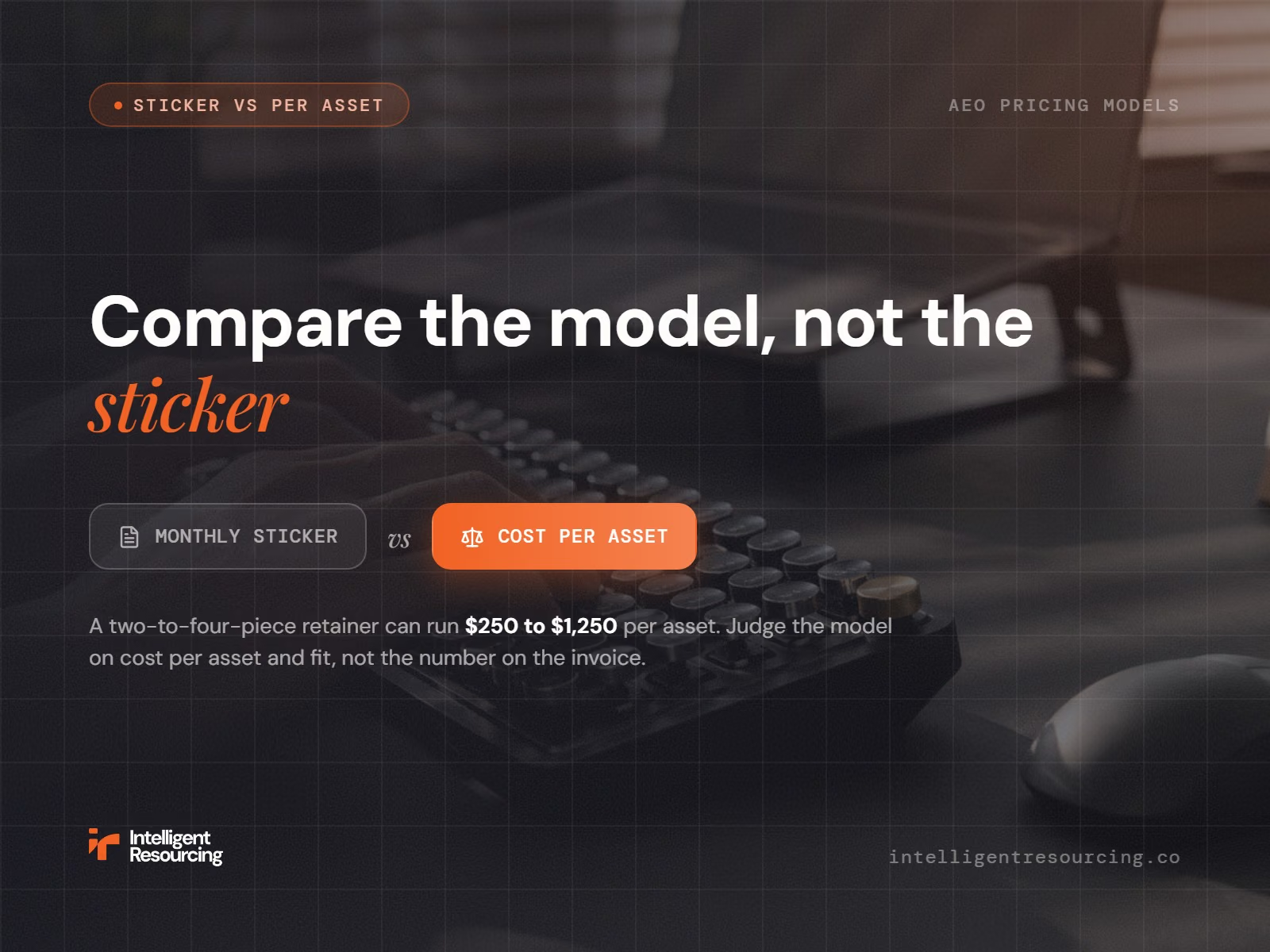
At $250 to $1,250 per asset, a standard two-to-four-piece retainer costs more per output than either Intelligent Resourcing tier, even though its monthly sticker price often reads lower. Cost per asset, not the invoice total, is what a buyer is paying for.
Clean attribution is the price of admission
Performance-based pricing ties fees to a measured outcome, citation rate, qualified leads or attributable pipeline, rather than a fixed monthly cost. This model only works when the buyer already has clean attribution in place. Without a verified baseline and a defined measurement method agreed in writing before work begins, a performance contract has nothing enforceable to pay against.
Clean attribution means three things exist before a contract gets signed, not just at renewal. A locked prompt set both sides agree on, since either party quietly changing it later means the fee is negotiated on numbers that never stayed fixed. A defined method for tracing a citation to the exact page that earned it, not the whole domain, since domain-level credit inflates results that never actually moved. A dated baseline taken before the engagement starts, so the fee is measured against where things genuinely stood on day one.
This is the model with the least standardisation across the market today. It is also the one where a buyer should ask the most specific questions before signing anything, since the fee structure only holds if both sides agree exactly how an outcome gets counted.
Audit vs retainer side by side
The number on the invoice is not the real dividing line. Whether a buyer is still confirming the shape of the problem, or already knows it and needs sustained volume against it, decides which model fits. An audit priced lower than a retainer is not automatically the cheaper choice if it gets skipped and the wrong retainer tier gets bought instead.
| Dimension | Audit (one-off) | Retainer (ongoing) |
|---|---|---|
| Cost structure | Fixed project fee | Fixed monthly fee, scaled by asset volume |
| What it buys | A baseline and a prioritised gap list | Ongoing citation-engineered content production |
| Commitment | None, one-off | Six-month minimum is common across Australian GEO retainers |
| Best-fit buyer | Scoping before any spend commitment | An ongoing programme built on a clean, already-confirmed baseline |
Why cost per qualified meeting is the real value frame

Comparing AEO pricing against a monthly retainer number alone misses the cost that matters to a sales team, the Cost-Per-Qualified-Meeting Gap, an SDR-sourced meeting set against an inbound enquiry generated from content, measured over a year.
A fully-loaded SDR costs roughly AUD $90,000 to $110,000 a year once salary and statutory on-costs are counted, with the compulsory superannuation guarantee alone adding 12% on top of salary from 1 July 2025, according to the ATO. SEEK's own July 2026 data puts SDR salaries at $75,000 to $90,000 before super and on-costs are added, consistent with that fully-loaded range.
Set a retainer's monthly fee against that baseline, not against a cheaper competitor's invoice. Citation-engineered content producing even a modest, steady flow of inbound enquiries can land at a lower cost per qualified meeting than the outbound headcount alternative. That is the comparison worth running before deciding a retainer costs too much.
Five hidden costs that inflate an AEO quote
The invoice is rarely the whole cost. Five things quietly inflate what a buyer pays beyond the quoted fee.
- Setup or onboarding fees: charged on top of the first month, with no clear description of what they buy.
- Tool licence markup: an agency resells third-party software at a premium instead of the buyer licensing it directly.
- Scope creep: the monthly fee holds steady while the actual deliverables quietly shrink.
- Aggressive lock-in: exit terms make a six-month minimum function closer to a year.
- Metric-gaming: in performance deals, an agency chases easy citations that never convert into a qualified enquiry.
The defence against all five is the same. Ask any agency to itemise tools, methodology, execution and expected outcomes as separate line items before signing, then check each line against what a fair retainer should cost to deliver.
Fit check
Match the model to the diagnosis already in hand, not to budget alone. Confirming which gap is driving a citation absence points to an audit. A clean baseline with an ongoing need for volume points to a retainer. Only a team that can trace a citation through to a qualified pipeline outcome is a real fit for performance pricing.
The Cost-Per-Qualified-Meeting Gap is the practical test. Divide a retainer's monthly fee by the qualified meetings it realistically generates, then compare that against an equivalent SDR-sourced meeting cost. A lower number settles the choice. An attribution gap too wide to run that comparison is the answer on its own: fix measurement first.
Best for:
- Buyers who have not yet confirmed which specific gap, content, technical or authority, is driving a citation absence
- Teams ready to commit to sustained monthly volume once that diagnosis is in hand
- B2B teams that want the audit and the retainer connected as one structure, not two separate purchases from different places
Not for:
- Buyers expecting an audit alone to move a citation rate. That is the retainer's job, not the diagnostic's.
- Teams wanting performance pricing without an already-clean attribution baseline in place first.
The trade-off: a lower monthly number can still be the more expensive route once cost per asset and the actual gap being funded are on the table. Diagnose first. Scale the retainer to the volume the category genuinely needs.
Comparisons
Send us any AEO quote and we will break it into audit, retainer and performance components, run the cost per asset and the Cost-Per-Qualified-Meeting Gap, and flag the hidden costs before you sign.
FAQs
How much does an AEO audit cost?
A well-scoped AEO audit runs as a one-off fee, structured as a fixed diagnostic rather than an ongoing charge. Intelligent Resourcing's own Strategic Blueprint starts from $2,500.
Is a retainer or performance-based AEO pricing better for B2B?
It depends on attribution maturity. Retainers suit sustained programmes without a fully clean measurement chain yet. Performance pricing only suits buyers who can already trace a citation through to a qualified pipeline outcome.
What should I ask an agency to itemise before signing an AEO contract?
Ask for tools, methodology, execution and expected outcomes as separate line items, not one bundled fee. Any line an agency resists breaking out is worth questioning before you sign.
Does a six-month minimum apply to most AEO retainers?
A six-month floor is common across Australian GEO retainers. The number worth comparing across quotes is the total contract commitment, not the length of the term alone.
Is a lower monthly retainer always the cheaper option?
Not necessarily. A lower-priced retainer producing fewer assets a month can cost more per asset than a higher-volume programme priced above it. Cost per asset, not the monthly figure alone, is what determines which fee costs more.