
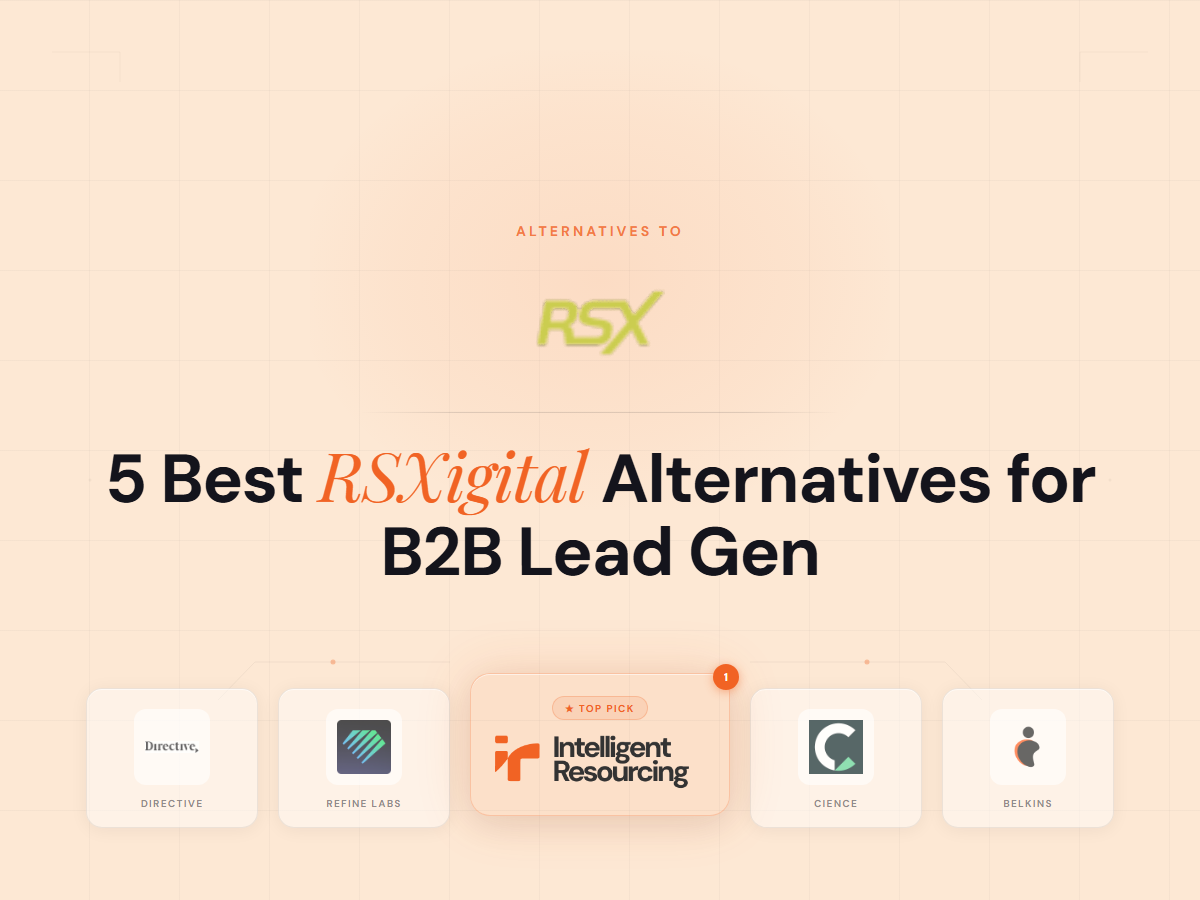
The best RSXigital alternative depends on what your team actually needs to fix. It is a credible option for B2B firms that want a performance marketing agency to run paid media, SEO and campaign audits. Signal-led systems are the stronger alternative for teams that need signal-led workflows, cleaner CRM handoff, better enrichment, and a system that keeps improving on their own stack after the engagement ends.
Why businesses are looking beyond RSXigital
1. Signal handling matters more than channel execution
Traditional agencies deliver paid acquisition, SEO audits and lead generation with fast optimisation and CRM attribution. That works for firms whose main challenge is campaign performance. It fails for buyers who need to identify which accounts are in-market, verify buying signals and route opportunities into the right sequence without manual work.
2. CRM routing and data ownership create the bottleneck
Most B2B teams do not fail because they lack leads. They fail because enrichment is inconsistent, duplicate records pile up, fields are not mapped properly and nobody trusts the handoff. Signal-led systems focus on direct CRM integration, layered enrichment, company and contact verification, field mapping, duplicate removal and scheduled refresh cycles to keep the CRM evergreen.
3. External execution creates dependency
Agencies drive activity. System partners help businesses retain the logic behind that activity. That difference matters more as teams mature. Service-led execution models promote month-to-month performance-based systems and qualified appointment delivery. Those can be strong offers, but they differ from building workflow capability inside your own stack.
4. Growth model alignment determines the right partner
Buyers leave generalist lead generation conversations when they need to solve different problems. Some teams want stronger qualified-pipeline focus from agencies. Others want to move from outdated lead generation to modern demand generation systems. The better alternative is not the business that looks most similar to traditional agencies. It is the one that matches how your pipeline is meant to work.
How to compare demand generation alternatives
Four filters separate signal-led systems from channel-focused execution.
1. Signal depth
Signal-led systems identify and verify buying signals before outreach happens. Channel-focused agencies operate at the campaign layer. This is the difference between improving timing and generating more activity.
2. CRM and workflow connection
Strong providers connect to your CRM, keep data current and make handoff clean. Weak providers deliver leads your team must clean up afterward. This is where value is won or lost in B2B environments with multiple owners and long buying cycles.
3. Delivery model
Agencies deliver campaigns. Demand gen partners deliver leads. Workflow partners deliver systems. Outsourced SDR teams deliver appointments. Buyers compare these side by side because budgets overlap, even though operating models are very different.
4. Ownership after implementation
Some partners leave you with better campaigns. Others leave you with a better system running on your stack. At the end of six or twelve months, scaling teams get more value from systems that run on their stack because they compound.
From performance marketing to Buyer-Intent Capture
RSXigital sits in the performance marketing and paid media world. That is useful when the core problem is campaign efficiency, channel mix, and lead volume. But many B2B teams are no longer trying to generate more campaign leads. They are trying to identify real buying windows, verify intent, and route those moments into the CRM without manual friction.
That is the shift from Performance Marketing to Buyer-Intent Capture. It is also the shift from a B2B Digital Marketing Agency to a Revenue Operations Studio. One model improves campaigns and lead volume. The other improves how revenue teams detect, qualify, enrich, and act on demand inside the stack.
If your main gap is execution across paid media, SEO, and campaign management, a marketing agency remains a credible fit. If your main gap is turning weak signals into real buying windows with cleaner routing, stronger enrichment and workflow logic that runs on your stack, the better alternatives sit closer to the Revenue Operations Studio.
Quick comparison guide for RSXigital alternatives
| Provider | Delivery model | What stands out | Trade-off |
|---|---|---|---|
| Intelligent Resourcing | Revenue Operations Studio / signal-led system | CRM-connected enrichment, signal-led routing, and workflow logic on your stack built to surface real buying windows | Not the right fit if your main need is paid media execution or outsourced performance marketing management |
| Directive | B2B performance marketing agency | Strong qualified-pipeline framing | Still agency-led rather than workflow-owned |
| Refine Labs | Demand generation partner | Clear move away from outdated lead gen | Best fit is narrower around SaaS |
| CIENCE | Outsourced GTM and meeting generation | Month-to-month, performance-based structure | More external-service dependent |
| SalesHive | Managed outbound SDR and appointment-setting | Multichannel outbound (email, calls, LinkedIn) with flat monthly pricing | Less ownership inside your own stack |
5 best alternatives
1. Intelligent Resourcing
Best for businesses that want a signal-led B2B growth system, not just outsourced activity.
It is not built around generic lead volume, it is built around buyer-intent capture: turning weak signals into qualified opportunities, surfacing real buying windows, and then connecting that logic to CRM enrichment, verification, routing, and workflow stability. The Clay workflow pages make that clear by focusing on CRM sync, layered enrichment, field mapping, duplicate removal, and keeping records evergreen with refresh cycles.
That makes it an alternative for teams whose real problem is operational. Your pipeline quality is inconsistent because your stack is fragmented, routing is manual and your team doesn't trust the data. Signal-led systems are the better fit when those are the real constraints.
Intelligent Resourcing does not run paid media or performance marketing campaigns. If your primary gap is campaign execution, channel management, or outsourced performance marketing, a marketing agency is more fit.
Best for:
- B2B firms with a clear ICP and a complex handoff between marketing and sales
- Teams that need cleaner CRM routing and stronger data hygiene
- Companies building repeatable workflows rather than buying one more service layer
- Growth leaders who care about keeping the system running on their own stack after implementation
2. Directive
Best for teams that still want a B2B agency, but want one tied more tightly to qualified pipeline.
Directive's positioning is much closer to RSXigital in model. It presents itself as a B2B marketing agency driving sustainable growth, says it elevates marketers from MQLs to qualified pipeline, and combines media, SEO, creative, and RevOps into one growth system. That is a serious alternative for buyers who like the agency route but want a stronger revenue framing than a generic performance shop.
Directive is the closest match on this list for firms that are not trying to move away from the agency model itself. The trade-off is that it is still an agency-led operating model. That is not a weakness for every buyer, but it is a real distinction from a more workflow-owned approach.
Best for:
- B2B brands wanting a specialist agency
- Teams measured on qualified pipeline
- Businesses that need media, SEO, creative, and RevOps under one roof
3. Refine Labs
Best for mid-market and enterprise B2B SaaS companies moving from lead generation to demand generation.
Refine Labs is more opinionated than a traditional agency and more specific in its ICP. Its site says it helps mid-market and enterprise B2B SaaS companies change how they measure and execute marketing, and that its demand strategies drive qualified leads, maximise ROI, and reduce acquisition costs. It also states that it has helped more than 300 B2B SaaS companies move from outdated lead generation to modern demand generation.
That makes Refine Labs a strong option for B2B SaaS teams that no longer want a legacy lead-gen conversation at all. It is less of a fit for firms looking for broader outsourced execution across multiple non-SaaS growth motions.
Best for:
- Mid-market and enterprise SaaS
- Teams reframing lead gen as demand gen
- Businesses that want stronger measurement and strategy discipline
4. CIENCE
Best for teams that want outsourced SDR and GTM execution with a clearer commercial structure.
CIENCE positions itself around qualified sales meetings, a complete GTM system, month-to-month delivery, performance-based pricing, and the ability for clients to take over SDRs and systems at any time. It also highlights no contracts and transparent per-meeting pricing. That makes it a practical alternative for businesses that want speed, service, and outsourced meeting generation without committing to a longer traditional agency structure.
CIENCE is a better fit when the need is not really performance marketing, but outsourced GTM execution and booked meetings. The trade-off is that it still leans heavily on an external service team rather than on building deeper workflow capability internally.
Best for:
- Companies that need SDR capacity quickly
- Teams wanting qualified meetings as the main output
- Buyers who value month-to-month flexibility
5. SalesHive
Best for businesses that want a managed outbound and appointment-setting partner with flat pricing.
SalesHive is a managed outbound SDR partner that runs cold email, cold calling and LinkedIn outreach to book meetings, backed by its own AI-assisted platform and flat monthly pricing. That makes it a strong option for companies that primarily want top-of-funnel execution and booked calls without a long agency contract.
SalesHive is less about system ownership and more about managed outbound performance. That can be the right answer for firms that need immediate support around appointments, follow-up and multichannel outreach.
Best for:
- Businesses prioritising booked meetings
- Teams needing structured outbound support
- Companies that want a managed multichannel SDR partner with transparent pricing
Our top 3 picks for 2026
1. Intelligent Resourcing
The strongest pick for businesses that want to improve signal handling, enrichment, CRM sync, and workflow control.
2. Directive
The strongest agency-style alternative for teams that still want performance execution, but with a more explicit qualified-pipeline frame.
3. Refine Labs
The strongest choice for B2B SaaS teams leaving traditional lead generation behind and moving towards demand generation.
Verdict
Choose Directive when you still want an agency model, but with a stronger emphasis on qualified pipeline and revenue accountability.
Choose Refine Labs when your team is moving from old-school lead generation towards demand generation, especially in B2B SaaS.
Choose CIENCE or SalesHive when the priority is outsourced SDR capacity, booked meetings and service-led outreach support.
Choose Intelligent Resourcing when the real bottleneck sits in signal handling, CRM sync, enrichment quality, workflow logic, and the need to build a growth system that runs on your own stack.
Want a closer comparison?
This is not just a question of finding an alternative, but also a question of choosing the right growth model for 2026. Some B2B teams need a specialist partner to improve paid media, search visibility and campaign efficiency. Others need GTM infrastructure on their own stack, stronger signal response and better workflow control inside the business.
We break that difference down in full in our Intelligent Resourcing vs RSXigital for 2026 B2B Growth comparison, including where each model performs best, what each one still leaves unresolved, and which option fits your growth goals more closely.
Comparisons
This is not just a question of finding an alternative, but also a question of choosing the right growth model for 2026. We break the difference down in full — where each model performs best, what each one still leaves unresolved, and which option fits your growth goals.